Aligning Hong Kong's blueprint with 15th Five-Year Plan to drive high-quality growth

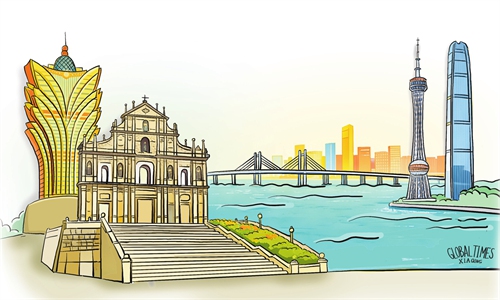
Illustration: Xia Qing/GT
Editor's Note:As China enters the annual time of two sessions, the country is turning its focus toward the strategic blueprint of the 15th Five-Year Plan (2026-30). Within this vision, the Guangdong-Hong Kong-Macao Greater Bay Area (GBA) is expected to play a greater role as a strategic pivot point of China's new development pattern, a demonstration zone for high-quality development and a leading area for Chinese modernization.
Against this backdrop, the Global Times launches a commentary series, "GBA: New Voyage." The series includes insights from National People's Congress (NPC) deputies and Chinese People's Political Consultative Conference (CPPCC) National Committee members from the special administrative regions as well as international professionals in Hong Kong and Macao.
In the fourth installment of the series, Global Times (GT) reporter Zhang Ao interviewed David Whitwam (Whitwam), chairman of the New Zealand Chamber of Commerce in Hong Kong, to discuss the historic opportunities brought by the 15th Five-Year Plan for Hong Kong.

Courtesy of Whitwam
GT: 2026 marks the inaugural year of China's 15th Five-Year Plan period and the rollout of Hong Kong's first-ever five-year development blueprint. How will the two align?
Whitwam: This year presents an opportunity to recalibrate and strengthen the economic linkages that make Hong Kong a key gateway for international business. The two sessions see a strong sense of anticipation and optimism and will project a powerful message of stability, continuity and deepened commitment to reform and opening-up.
The 15th Five-Year Plan and Hong Kong's blueprint signal a deliberate effort to create a cohesive growth model, with the two sessions providing strategic alignment to leverage Hong Kong's strengths for national priorities. This alignment is crucial for businesses that operate at the intersection of international markets and the Chinese mainland's economic drive.
GT: The two sessions will review the draft outline of the 15th Five-Year Plan for national economic and social development. How do you view the historic opportunities brought about by the 15th Five-Year Plan for Hong Kong?
Whitwam: Hong Kong will not merely benefit passively from national development. It will also serve as a strategic driver. Backed by "Finance+," it will strengthen offshore RMB systems, expand connectivity schemes and develop regulated new asset classes to build more sophisticated financial markets serving the real economy. Driven by "AI+," it will develop the Northern Metropolis into an innovation technology hub, launch an innovation fund and advance cutting-edge sectors including aerospace and embodied intelligence, opening new collaboration frontiers.
Hong Kong's "GoGlobal" framework helps mainland enterprises expand globally, offering international firms strong potential partners in supply chain management, global marketing and cross-border compliance.
Deepening integration into the GBA, underpinned by Hong Kong's unique advantage under "one country, two systems" and upgraded Closer Economic Partnership Arrangement arrangements, lowers the threshold for overseas businesses to use Hong Kong as a base for engaging with the mainland market.
Practical engagement includes joining Northern Metropolis projects, accessing innovation funding schemes and partnering with Hong Kong small- and medium-enterprises supported by the Fund on Branding, Upgrading and Domestic Sales.
Hong Kong's alignment with national plans provides policy certainty, while its professional services and rule of law offer a stable, high-standard environment. "Go Global, Choose Hong Kong" is more than a slogan, it's a reflection of this enduring institutional strength.
GT: In your view, what strategic role does the GBA play during the 15th Five-Year Plan period? How should Hong Kong leverage its strengths to foster new, higher-quality growth drivers?
Whitwam: The GBA will assume an even more pivotal strategic role during the 15th Five-Year Plan period. It is designed to become China's primary laboratory for institutional innovation and a core engine driving high-quality development. It is where the dual circulation strategy is being operationalized.
Hong Kong will leverage its advantages and lead the creation of higher-quality drivers, which requires a strategic pivot from being a "super connector" to becoming a "super value-adder." It needs to move beyond simply facilitating transactions and focus on creating value, upgrading from capital conduit to risk management and standards hub, from trade facilitation to integrated supply chain orchestration, from technology consumer to innovation commercialization partner, from policy taker to institutional innovator.
By strengthening its role as the GBA's premier offshore RMB hub and international fundraising center, Hong Kong can develop a more mature offshore RMB ecosystem to support GBA enterprises and international investors. Its common law system, international dispute resolution mechanisms, professional services and global standards serve as reliable support for cross-border cooperation. Hong Kong will attract global R&D talent, cooperate with manufacturing hubs in the GBA and promote cross-border data flow pilots in fintech, remote healthcare and smart logistics. Leveraging its "one country, two systems" strengths enables Hong Kong to drive high-quality growth in the GBA.
GT: You have lived and worked in Hong Kong for over three decades. How do you see the evolution of Hong Kong's role as a key gateway to the mainland market? And what new areas can it unlock for practical cooperation between China and New Zealand?
Whitwam: Hong Kong has evolved from a geographic and infrastructure hub into a financial and professional services center, and now a "super value-adder" connecting global capital, standards and mainland innovation, where complex, high-value solutions are crafted for the GBA and beyond. As the 15th Five-Year Plan begins in 2026, this new role enables China-New Zealand cooperation to go beyond traditional trade into innovation, sustainability and high-value services.
My message to New Zealand companies considering establishing a presence is one of confident encouragement: Hong Kong is not just open for business; it is uniquely positioned to amplify your success in Asia. It offers not just a market, but a partnership - a platform to build something enduring in the most dynamic region in the world.
Whitwam: This year presents an opportunity to recalibrate and strengthen the economic linkages that make Hong Kong a key gateway for international business. The two sessions see a strong sense of anticipation and optimism and will project a powerful message of stability, continuity and deepened commitment to reform and opening-up.
The 15th Five-Year Plan and Hong Kong's blueprint signal a deliberate effort to create a cohesive growth model, with the two sessions providing strategic alignment to leverage Hong Kong's strengths for national priorities. This alignment is crucial for businesses that operate at the intersection of international markets and the Chinese mainland's economic drive.
GT: The two sessions will review the draft outline of the 15th Five-Year Plan for national economic and social development. How do you view the historic opportunities brought about by the 15th Five-Year Plan for Hong Kong?
Whitwam: Hong Kong will not merely benefit passively from national development. It will also serve as a strategic driver. Backed by "Finance+," it will strengthen offshore RMB systems, expand connectivity schemes and develop regulated new asset classes to build more sophisticated financial markets serving the real economy. Driven by "AI+," it will develop the Northern Metropolis into an innovation technology hub, launch an innovation fund and advance cutting-edge sectors including aerospace and embodied intelligence, opening new collaboration frontiers.
Hong Kong's "GoGlobal" framework helps mainland enterprises expand globally, offering international firms strong potential partners in supply chain management, global marketing and cross-border compliance.
Deepening integration into the GBA, underpinned by Hong Kong's unique advantage under "one country, two systems" and upgraded Closer Economic Partnership Arrangement arrangements, lowers the threshold for overseas businesses to use Hong Kong as a base for engaging with the mainland market.
Practical engagement includes joining Northern Metropolis projects, accessing innovation funding schemes and partnering with Hong Kong small- and medium-enterprises supported by the Fund on Branding, Upgrading and Domestic Sales.
Hong Kong's alignment with national plans provides policy certainty, while its professional services and rule of law offer a stable, high-standard environment. "Go Global, Choose Hong Kong" is more than a slogan, it's a reflection of this enduring institutional strength.
GT: In your view, what strategic role does the GBA play during the 15th Five-Year Plan period? How should Hong Kong leverage its strengths to foster new, higher-quality growth drivers?
Whitwam: The GBA will assume an even more pivotal strategic role during the 15th Five-Year Plan period. It is designed to become China's primary laboratory for institutional innovation and a core engine driving high-quality development. It is where the dual circulation strategy is being operationalized.
Hong Kong will leverage its advantages and lead the creation of higher-quality drivers, which requires a strategic pivot from being a "super connector" to becoming a "super value-adder." It needs to move beyond simply facilitating transactions and focus on creating value, upgrading from capital conduit to risk management and standards hub, from trade facilitation to integrated supply chain orchestration, from technology consumer to innovation commercialization partner, from policy taker to institutional innovator.
By strengthening its role as the GBA's premier offshore RMB hub and international fundraising center, Hong Kong can develop a more mature offshore RMB ecosystem to support GBA enterprises and international investors. Its common law system, international dispute resolution mechanisms, professional services and global standards serve as reliable support for cross-border cooperation. Hong Kong will attract global R&D talent, cooperate with manufacturing hubs in the GBA and promote cross-border data flow pilots in fintech, remote healthcare and smart logistics. Leveraging its "one country, two systems" strengths enables Hong Kong to drive high-quality growth in the GBA.
GT: You have lived and worked in Hong Kong for over three decades. How do you see the evolution of Hong Kong's role as a key gateway to the mainland market? And what new areas can it unlock for practical cooperation between China and New Zealand?
Whitwam: Hong Kong has evolved from a geographic and infrastructure hub into a financial and professional services center, and now a "super value-adder" connecting global capital, standards and mainland innovation, where complex, high-value solutions are crafted for the GBA and beyond. As the 15th Five-Year Plan begins in 2026, this new role enables China-New Zealand cooperation to go beyond traditional trade into innovation, sustainability and high-value services.
My message to New Zealand companies considering establishing a presence is one of confident encouragement: Hong Kong is not just open for business; it is uniquely positioned to amplify your success in Asia. It offers not just a market, but a partnership - a platform to build something enduring in the most dynamic region in the world.
RELATED ARTICLES