Illustration: VCG
Although the World Economic Forum Annual Meeting 2026 concluded, concerns voiced during the meeting about the world sliding toward a "ruleless" era continue to reverberate across the international community.Some countries embrace a logic of "might makes right" and believe in their unilateral supremacy, displaying their bullying behavior over neighbors or even allies openly and without restraint. History and reality both show that once a world loses the constraints of international rules, the foundations of peace and development are inevitably shaken and conflicts and tensions will increasingly surface. The international community must therefore reaffirm unity, uphold international order and the rule of law, and jointly resist the risks and challenges brought by hegemonism and power politics.
US-EU relations are mired in discord
"A rupture in the world order." Some Western media outlets have pointed out that the rifts in transatlantic relations between the US and Europe are now impossible to conceal, with mutual trust between them plunging to a historic low.
In its latest National Security Strategy, the US has elevated US-EU frictions to the level of a "civilizational erasure." Washington has steadily advanced its ambition to seize Denmark's Greenland, intensified tariff threats over Europe and repeatedly belittled the role of NATO allies. This series of actions has led Europe to increasingly realize that, under the logic of US power politics, the alliance does not provide shelter from the storm.
The new shifts in US policy toward Europe lay bare the operating logic of hegemony: nothing is off the table. Europe's sense of "powerlessness" in the face of repeated shocks is, to some extent, the price it is paying for long-standing strategic dependence on the US. A remark by European Commission President Ursula von der Leyen reflects Europe's ongoing psychological adjustment: "Nostalgia is part of our human story. But nostalgia will not bring back the old order. And playing for time - and hoping for things to revert soon - will not fix the structural dependencies we have."
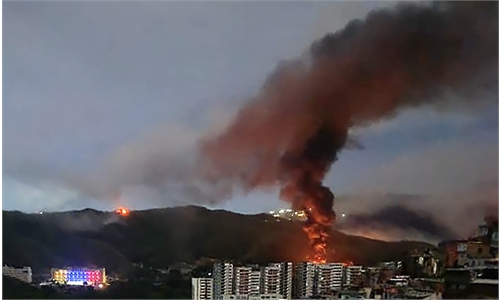
At present, US-EU relations are mired in discord, revealing from one angle the deeper crisis facing the world. From forceful action against Venezuela to the blatant attempt to seize Greenland, this year has seen the hegemonic power indiscriminately and recklessly trampling on international law and order, accelerating the world's slide toward a "ruleless" state. French President Emmanuel Macron has warned: "It's as well a shift towards a world without rules. Where international law is trampled underfoot and where the only law that seems to matter is that of the strongest. And imperial ambitions are resurfacing." German Chancellor Friedrich Merz has likewise urged Europeans to enhance their own defense capabilities and economic competitiveness in order to survive under the new circumstances.
Risks of 'rulelessness' are becoming interconnected across multiple domains
An article on the Foreign Affairs website notes that the US is leading the world into an anarchy marked by a "new level of chaos."
Although the postwar international order was not perfect, it played an important role in preserving overall global peace, keeping global trade relatively open and promoting international cooperation. It has also continued to serve as the foundation for the orderly functioning of today's world. However, in recent years, one country that was once deeply involved in building this order has taken a sharp policy turn, increasingly acting as a disruptor and wrecker of international law and the international order.
Today, the risks of "rulelessness" are emerging and becoming interconnected across multiple domains, profoundly shaping the environment in which all members of the international community exist.
From the perspective of political and security affairs, the principle of sovereign equality is being trampled by the logic of power. When major countries can arbitrarily define legitimacy based on their own judgments and take coercive actions accordingly, the rule-based foundations on which the international system operates are eroded, posing a fundamental threat to the stability of the global governance system.
From the perspective of economic and trade cooperation, tools meant for win-win outcomes are being distorted into weapons of confrontation. Trade, investment and other economic ties that once underpinned global prosperity are being systematically "weaponized" by a handful of countries, directly disrupting global industrial and supply chains and dealing a severe blow to multilateral trade rules. Under a "ruleless" economic and trade order, any economic linkage can become a target under geopolitical pressures, leaving no room for certainty or stability and pushing the global economy toward bloc formation and fragmentation.
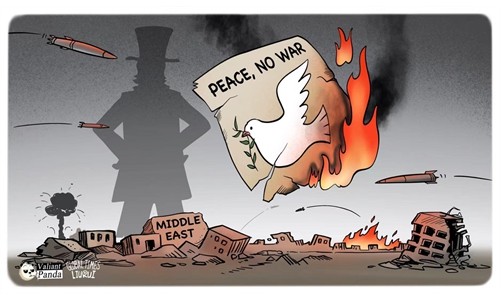
From the perspective of multilateral cooperation, cooperation platforms are sliding into dysfunction. Hegemonic powers have engaged in sweeping "withdrawals," leaving core institutions of global governance such as the UN and the WTO facing an unprecedented crisis. The erosion of multilateralism will undermine the integrity and effectiveness of the global governance system and exacerbate the challenges confronting world peace and development.
In an environment that disregards rules and worships power, no country will find it easy to effectively safeguard its own interests. When constraints disappear, unpredictability itself becomes a potent destructive force, pushing the world toward a more disorderly and uncontrollable state.
The world must stand united to rise to the challenge
Looking back on the history since the end of World War II, the threat of hegemony has loomed all along. Some in the West are fond of talking about the "golden past" simply because, for a long time, hegemonic powers directed their moves elsewhere, and the pain never hit their own doorstep. Today, the US' bullying of the weak and wanton destruction of the international order have caused widespread pain in the international community. The world must face up to the grave risks and stand united to rise to the challenge.
To prevent the world from sliding into an abyss of "rulelessness," we must defend the rule of international law. The rule of international law is the result of civilizational progress. It is the most powerful safeguard for the sovereignty, security and development interests of all countries. It is a "civilized public good" that prevents the strong from devouring the weak and ensures common security.
In today's era, international law and fundamental norms of international relations, centered on the purposes and principles of the United Nations Charter, are the bedrock of global peace and stability, as well as the cornerstone for resolving international disputes. Only by comprehensively and faithfully adhering to international law and fundamental norms of international relations, ensuring uniform application of rules without double standards, can we prevent the "law of the jungle" from becoming the dominant logic of the world.
To prevent the world from sliding into an abyss of "rulelessness," we must rekindle the spirit of solidarity. Nations share a common destiny; self-preservation in the face of power politics is not the way forward. Countries should act from a shared interest, build on a common understanding of global risks, strengthen the foundation of solidarity and cooperation, and jointly resist the challenges of hegemony and power politics.
The international order established after World War II has sheltered the world for over eight decades. We should consolidate its foundations and reform it for improvement, not dismantle its pillars or undermine its very basis. Some argue that where the old order fractures, emerging forces committed to independence and pragmatic cooperation will gain increasing space to define the rules. From this perspective, chaos is also the prelude to change. Much like the increasing disorder described by the second law of thermodynamics for open systems, disorder is rising but also incubating the possibility of a new order. The international community must discern the direction amid history's twists and turns, insisting on equality rather than bullying the weak, pursuing win-win cooperation instead of winner-takes-all and propelling the international order toward greater fairness and justice.
The world stands at a critical crossroads. The international community cannot stand idly by as the world is pushed toward an abyss of "rulelessness." Only by jointly upholding the international system with the United Nations at its core and the international order based on international law, and by fostering certainty through dialogue and cooperation, can humanity be guided toward a brighter future.
Huan Yuping is an international commentary column of the People's Daily. opinion@globaltimes.com.cn
RELATED ARTICLES