US bombing of Iran a moral, strategic disaster
By Published: Jun 23, 2025 07:45 PM

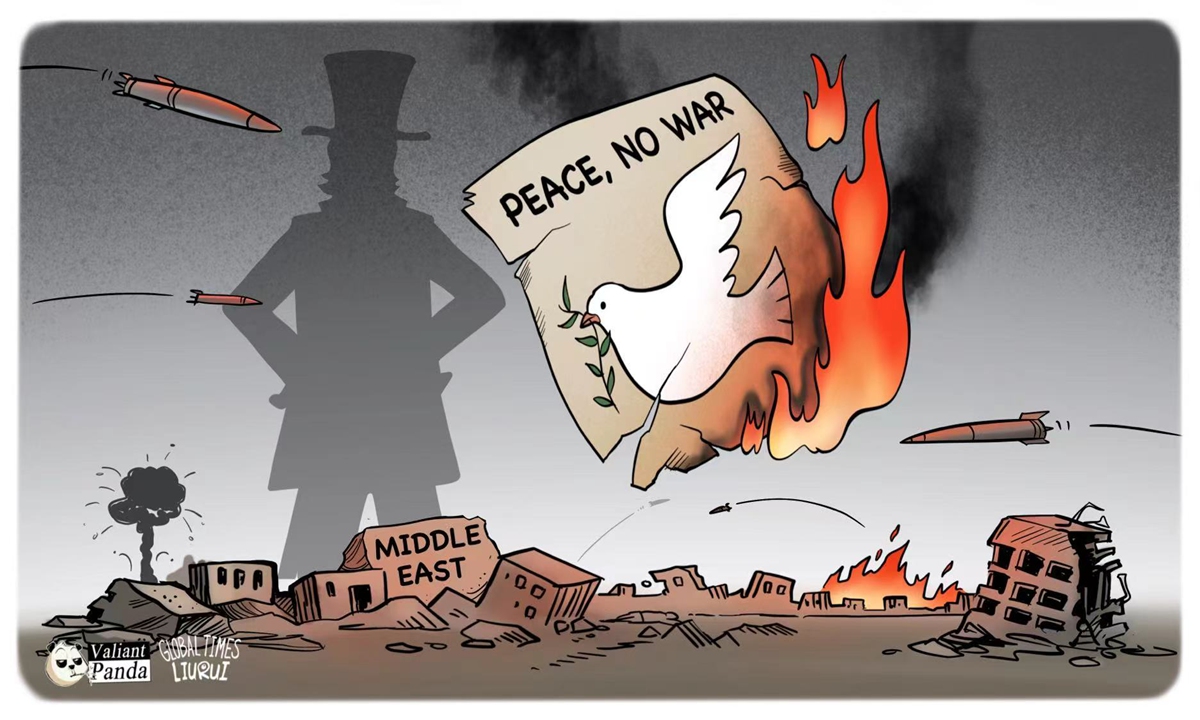
Destroying peace. Illustration: Liu Rui/GT
The recent US bombing of Iranian nuclear sites, carried out without public debate or legal justification under international norms, marks a grave escalation in an already volatile region. It is a sobering reminder that peace is fragile - and power without restraint is the greatest threat to civilization.For decades, the US has relied on a doctrine of exceptionalism to justify unilateral military actions. But the strike on Iran's sovereign infrastructure, conducted outside any declared war or legitimate multilateral mandate, crosses a new threshold. It reveals a nation not merely retreating from global leadership, but actively undermining the foundations of international law itself.
There is no ambiguity about what this was: a targeted strike on critical infrastructure in a sovereign country, conducted outside the framework of the UN Security Council. The decision to carry out this attack on Iranian nuclear facilities unilaterally and without accountability signals decay - a superpower increasingly disconnected from the global norms it once helped establish.
In fact, we have seen this all before. The erosion of multilateral diplomacy, the use of vague "national security" pretexts to justify aggression, and the assumption that the world will simply watch and forget - these are symptoms of a geopolitical sickness. The fact that this strike was launched without public scrutiny or congressional oversight should alarm every global citizen. It is not just the Iranian people whose future is endangered. It is the very architecture of peacekeeping that is being set ablaze, at a time when the world is seeing the greatest amount of armed conflicts since 1946.
As an American citizen, I find this deeply shameful. It is not simply a strategic mistake - it is a moral disgrace. That my country would commit such an act in the dark, behind the backs of its people and in defiance of the very legal principles it claims to uphold is a stain on whatever remains of our international credibility. It is a betrayal of law and diplomacy.
Make no mistake: Actions like these do not occur in a vacuum. They ripple across borders, weaken the legitimacy of international institutions, and could embolden other states to follow suit. When the most powerful country on Earth behaves with impunity, it teaches others that law is optional, that treaties are conditional and that violence remains the default language of power.
The world is watching. And the world is beginning to speak - not in outrage alone, but in quiet, decisive divergence. Trade alliances are shifting. Security arrangements are being reconsidered. The long-assumed alignment of global interests with American interests is fracturing. This is not just geopolitical realignment; it is a moral and strategic reckoning with a former guarantor of order that now operates outside the bounds of restraint.
The bombing of Iran's nuclear facilities is not a deterrent. It is a provocation. Yet provocation is no substitute for strategy. It may buy temporary silence, or domestic applause, or a brief swing in media narrative. But it will not create peace. It will not restore order. And it will not stop history from passing its judgment. What is needed now is not more firepower. The international community must insist on the primacy of law over violence, dialogue over escalation and common humanity over great-power rivalry. Regional actors must resist being drawn into proxy dynamics. Independent nations must assert their sovereign right to choose peace. Global institutions must reclaim their relevance by condemning actions that threaten the very stability they were created to preserve.
We must remember that diplomacy is not weakness. It is civilization. Abandoning it is a regression to a world ruled by fear, not reason. If one state - however powerful - can unilaterally decide who lives, who dies and which rules apply, then we are not living in an international order. We are living in its absence.
As an American living abroad, I have learned that the world no longer sees the US as a guarantor of order - but increasingly, as a catalyst of chaos. The question now is whether the international community will rise to meet this moment before it spirals out of control.
The author is a Prague-based American journalist, columnist and political commentator. opinion@globaltimes.com.cn
RELATED ARTICLES