Venezuela will by no means be the last country affected by US 'return to the Western Hemisphere' strategy: Zheng Yongnian
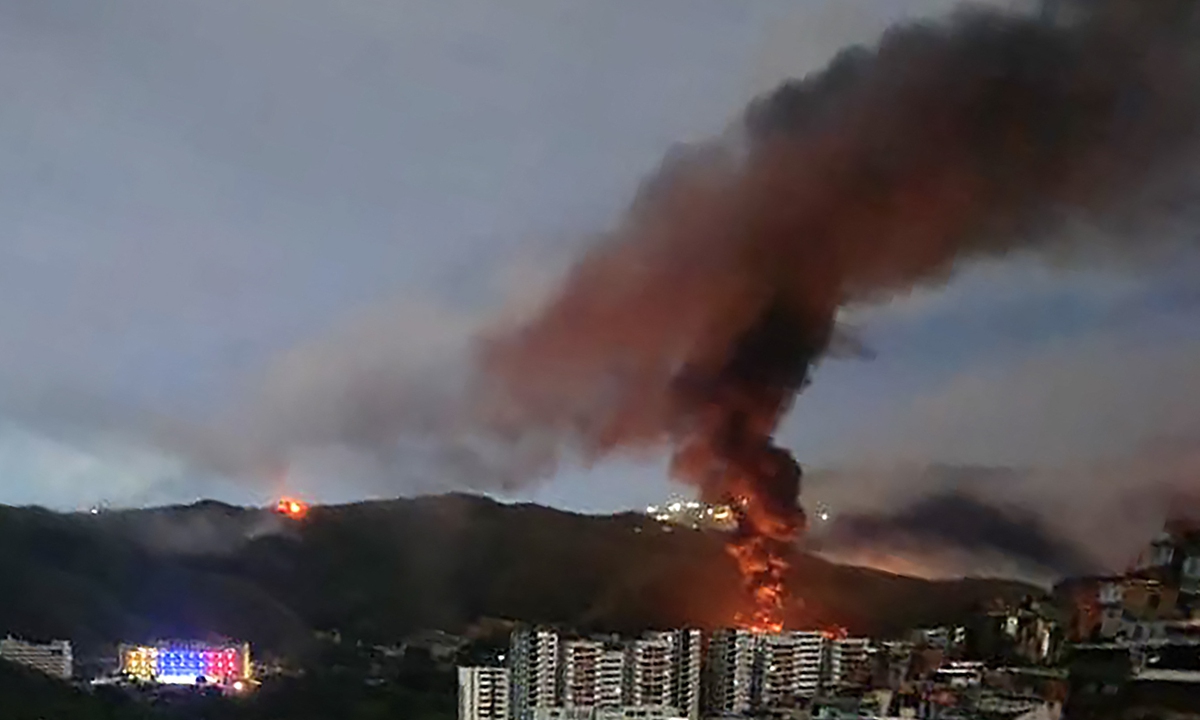
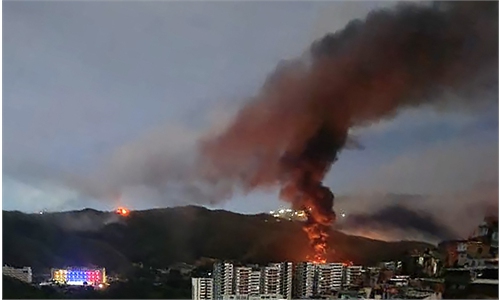
Fire at Fuerte Tiuna, Venezuela's largest military complex, is seen from a distance after a series of explosions in Caracas on January 3, 2026. The US military was behind a series of strikes against the Venezuelan capital Caracas on Saturday, which reportedly led to the capture of Venezuelan President Nicolas Maduro and his wife, US media reported. Photo: AFP
Editor's note:At the very beginning of 2026, the US launched a surprise attack on Venezuela and forcibly took control of President Nicolás Maduro and his wife, delivering a heavy blow to an already turbulent world order. How should we interpret this move after Washington's proclaimed "return to the Western Hemisphere"? What geopolitical calculations and strategic maneuvering lie behind it? Gongziwuji, a member of Xia Ke Dao, an online offshoot of People's Daily Overseas Edition, spoke with Professor Zheng Yongnian (Zheng), director of the Institute of International Affairs, Qianhai at the Chinese University of Hong Kong, Shenzhen. Global Times has obtained authorization from Zheng to publish the English version of this interview.
Xia Ke Dao: The military bombardment of Venezuela and the forcible seizure and abduction of a sitting head of state by special forces came as a strong shock, even though US troops had been massed offshore and pressure had been mounting for months. Many people are asking: Is such an action reasonable or lawful? Chilean President Gabriel Boric said, "Today, it's Venezuela. Tomorrow, it can be anyone." How do you view such actions?
Zheng: If we set aside "morality" and look purely at the international order, the US move once again demonstrates its belief that the order of great powers stands above international law. People may ask whether international law even exists, but for powerful states, international law has never truly existed. Modern international law originated in Europe and functioned as the rule of law only when power was relatively balanced. Since the end of World War II, however, major powers have in practice become the "legislators" of the international system.
Some say that "law is the weapon of the weak," and the same applies internationally: international law is the weapon of weaker states, while major powers often place themselves above the law. From Britain and the US to the Soviet Union, did international law ever truly bind them? Take the South China Sea issue as an example: the US neither joins the UN Convention on the Law of the Sea nor abides by it, yet still seeks to use those rules to constrain China. For major powers, law is merely a tool to govern others - used when it suits them and discarded when it does not.
Using military force to seize another country's leader is a naked display of power. Although today's information environment may make such actions feel especially shocking, from a historical and international-relations perspective, this has long been the case.
Xia Ke Dao: Just days into 2026, the US staged such a dramatic operation. US President Donald Trump even said that watching the live broadcast at Mar-a-Lago felt like "watching a television show" and was "amazing." What kind of "precedent" does this set for the world? Is it a warning to smaller countries' leaders who are deemed "disobedient"?
Zheng: This is not really a precedent - Washington has done this many times before. The capture of Saddam Hussein during the Iraq War, the overthrew of Muammar Gaddafi in Libya, the US invasion of Panama in the late 1980s to directly arrest its president, and targeted killings such as that of Qasem Soleimani - all of these show that such actions have never ceased.
As we have discussed before, after World War II, US interests became deeply embedded across different regions. Now Washington is adjusting its strategy and policies, gradually withdrawing from places such as Europe and the Middle East. When it withdraws, local order is disrupted and instability follows. The reverse is also true. The new US strategic adjustment emphasizes a "return to the Western Hemisphere," reallocating power according to a sequence of domestic priorities, surrounding regions, and key areas. It is re-embedding its interests in regions it deems important. Latin America, long seen as its "backyard," will inevitably experience new shocks and new disorder as a result of this renewed re-embedding.
Therefore, for Latin America, Venezuela will certainly not be the last country affected. Once the US seeks deep re-embedding, it will fundamentally reshape the local order.
The Monroe Doctrine once proclaimed that "America for the Americans," yet the US has done little good in the hemisphere and much harm. From history to the present, Latin America has suffered greatly. Economically, the region is highly dependent on the US and Western capital, yet the West does not truly regard Latin America as part of the West. Western countries developed well by extracting resources from Latin America, but the benefits of that development were not passed on to the region.
As a result, from the 1940s and 1950s to today, Latin America has followed a path of dependent development, relying heavily on the US and the West, while ordinary people have gained little sense of progress. Many Latin American countries have long been trapped in the middle-income trap or even experienced regression, accompanied by polarization, inflation and a host of social problems.
We have often emphasized that both "independence" and "development" are crucial for a country. Latin America has lacked sufficient independence; dependent development has stripped it of its own autonomy. Within many Latin American countries, political forces tend to swing between two extremes - either strongly pro-Western or fiercely anti-American.
As long as this dependent structure remains unchanged, Latin America will be unable to achieve genuine development. Without development, backwardness made it vulnerable to attack; but even with development, if it is not independent and lacks real autonomy, the region will still be subject to attack.
Xia Ke Dao: The new US National Security Strategy (NSS) clearly states the goal of "restoring American preeminence in the Western Hemisphere," reflecting the belief that the Western Hemisphere is the paramount zone of strategic interest for the US. In fact, this is a redefinition of the "sphere of influence" for great powers, not allowing others to enter America's "backyard" in Latin America. Following military actions, the US president announced that the US would "run" Venezuela until a "safe" transition and that US oil companies will take over the Venezuelan energy production companies. What new issues does this model of "profit-seeking + regime change" illustrate?
Zheng: As shown in the new US NSS, the Western Hemisphere is a sphere of influence that the US must control. Unlike the extraction of minerals and signing minerals deal with Ukraine, the White House now seeks to directly control Venezuela's economy. In the past, the US engaged in color revolutions and supported opposition groups, but now it is taking direct action. In my opinion, this goes far beyond the realm of past imperialism and resembles early colonialism, or what can be called "neo-colonialism" strategies.
From a colonialist perspective, the US may not necessarily want Venezuela to be controlled by pro-American leaders; it might directly participate in administrative management and control the economic lifeline. At least during the so-called "transitional period," the possibility of neo-colonialism is significant.
The US president is very persistent in his claims. For instance, the US administration claimed it wants to have Canada and Greenland; while many previously thought this was a joke, it now seems it might genuinely be considering this. The risks of neo-colonialism must be taken seriously: They do not go to places where there is no profit, but where there is profit, they want direct control.
Venezuela, along with Latin America, is rich in energy and key minerals, which are essential for US development. The US is likely to take further actions that will affect its relations with Latin America and other major powers. In its view, if countries in its "backyard" get too close to its competitors, it must intervene.
This is why we say that Venezuela is not the last. The US has already issued warnings to countries like Cuba, Colombia, and Iran, which will lead to profound structural changes.
Xia Ke Dao: Currently, multiple countries have issued statements condemning the US military intervention and forcible control measures. The European Union has also released a statement stressing that international law needs to be respected. Domestically in the US, the Democratic Party has reacted relatively strongly, arguing that these military actions lack congressional approval and are therefore illegal. Protest demonstrations have taken place in over 100 cities across the country. How much pressure will these voices from both the international community and within the US place on the White House?
Zheng: It is difficult to form substantial pressure. The strategic consensus in the US is that it has previously overexpanded and needs to consolidate its "backyard" in Latin America. In fact, the international condemnation is not strong enough. The statement from the European Union carries no weight; it is mild. Although leftist governments in Latin America oppose this, they still feel a sense of fear toward the US, after all, they are "too far from heaven and too close to the US." In contrast, right-wing governments, such as Argentina, have openly come out in support of the US. US imperialism will do what it wants, regardless of what the outside world says. These opposing voices will not change the US' actions, nor can they stop them.
In the view of the US administration, the "backyard" cannot be controlled by anti-American forces. US imperialism can provoke patriotism, nationalism, and even populism among its own people, and the "trial" of Maduro can also stir up emotions.
The excuse the US is using this time is to combat drugs, handling international issues through domestic law enforcement. The White House claims this is a law enforcement action, allowing it to circumvent domestic resistance. Of course, this is not the first time. Previously, the US used its soft power to tell compelling stories that many believed, but based on experience and history, the reality of America is entirely different from the narrative portrayed by the US.
Some say that the US has transformed from the "world's police" into an unruly "world villain." The US was somewhat "civilized" before, but now it no longer cares about decency; the law of the jungle has returned. The world order established after World War II has effectively disintegrated. Without order, there is anarchy. Mere protests are ineffective; other countries need to consider how to protect their own interests.
Xia Ke Dao: This operation, involving intelligence penetration, forward military deployment, electronic interference and special forces strikes, indeed demonstrated the US' formidable military and intelligence capabilities. For left-wing political forces in Latin America, it also represents a major blow. Given that Latin America has previously seen relatively few geopolitical conflicts, could the region now become a new geopolitical "powder keg"?
Zheng: Since World War II, the US has been involved in warfare almost every year, and all of it has been real combat. This operation certainly shows that the US remains the world's most powerful military force. But to what extent has Venezuela been penetrated internally? Extreme anti-US sentiment on one end and extreme pro-US sentiment on the other have already caused deep divisions within Latin American societies. The US's next target country may well be one that already harbors many pro-US "internal collaborators."
The ebb and flow of left- and right-wing forces in Latin America also depends on domestic dynamics within the US. Washington's policy toward the region is shaped by the balance of forces at home. If the Democratic Party suffers another defeat in the midterm elections, the US will likely shift further to the right, and its policy toward Latin America will become even tougher. Given Latin America's economic and social structures, the left will not disappear - where there is pressure, there is resistance. But the US will do its utmost to cultivate right-wing, pro-US forces. If the US truly withdraws from other regions and redirects substantial attention toward Latin America, focusing on its energy resources, critical minerals and strategic footholds, the region's political landscape will be further reshaped.
Latin America will not become a "powder keg," because no country in the region is capable of confronting the US militarily. Even in the past, resistance took the form of guerrilla warfare or targeted violence - non-asymmetric methods. The region will not become the source of a world war, but further violence is inevitable. While the Latin American left seeks independence and autonomy, such developments may instead push the region into even deeper dependence on the US.
RELATED ARTICLES