US actions against Venezuela indicate it ‘is effectively replacing multilateral rules with the will of the powerful’: Chinese scholar
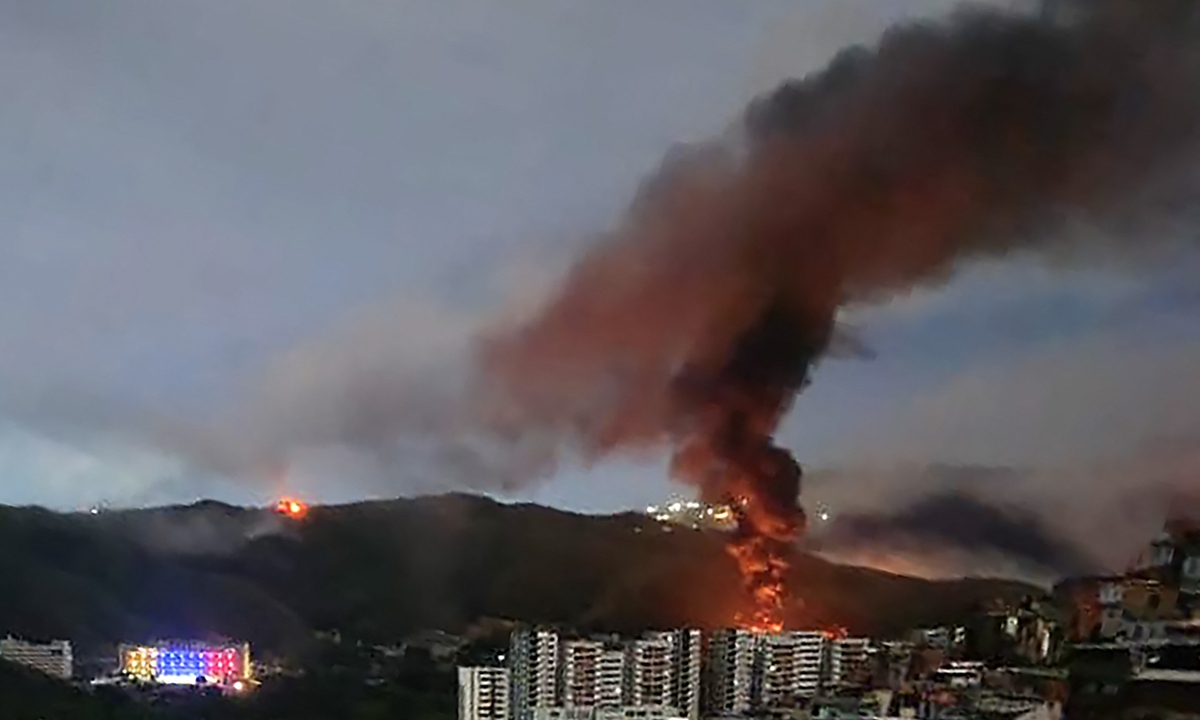
Fire at Fuerte Tiuna, Venezuela's largest military complex, is seen from a distance after a series of explosions in Caracas on January 3, 2026. The US military was behind a series of strikes against the Venezuelan capital Caracas on Saturday, which reportedly led to the capture of Venezuelan President Nicolas Maduro and his wife, US media reported. Photo: AFP
US President Donald Trump announced on Saturday via social media that the US had launched a massive strike against Venezuela and that President Nicolás Maduro and his wife had been captured and flown out of the country. This shocking news instantly swept across the globe. The Venezuelan government issued a communique strongly condemning what it termed "extremely grave military aggression." Numerous countries joined in condemning the US invasion.
For generations, the US has treated Latin America as its "backyard." Employing measures such as military strikes, regime change, targeted assassinations and transnational arrests, Washington has punished "disobedient" nations - an approach that is, at its core, an attempt to reshape the regional order through raw power to serve US geopolitical and resource interests. From controlling strategic chokepoints like the Panama Canal to plundering Venezuela's oil, every US intervention is driven by naked self-interest.
The policy of the current US government has pushed this hegemonic ambition to the extreme. The National Security Strategy report released by the US administration last month bluntly vows to "restore American preeminence in the Western Hemisphere." This is a calculated attempt to coerce regional countries into total political, economic and diplomatic dependence on the US, to suppress regional leftist and what the US deems as "hostile" forces, to interfere in election cycles and to forcibly reshape the regional political landscape.
What the US leader labeled as the "Donroe Doctrine" represents an intensified interventionist policy that the US administration is pushing across the Americas. It perpetuates the hegemonic logic of the original Monroe Doctrine, now guided by an "America First" orientation, with the ultimate goal of restoring US dominance in the Western Hemisphere. Its toolkit includes military threats, economic coercion and political interference. This is a modern manifestation of US hegemonism, reflecting a desire to retain absolute control over affairs in the Americas.
The use of domestic law to carry out the arrest of a sitting president of another country is a quintessential example of unilateral hegemony that delivers a systemic shock to the international order. It openly violates the principles of sovereign equality and non-interference enshrined in the UN Charter and undermines the longstanding principle of jurisdictional immunity afforded to sitting heads of state, marking another dangerous instance where the US places its domestic laws above international law. By bypassing the UN Security Council and resorting to unilateral judicial and military means, the US is effectively replacing multilateral rules with the "will of the powerful," severely undermining the authority of core UN mechanisms.
Furthermore, this military operation against Venezuela - executed via executive order while bypassing Congressional authorization - substitutes administrative decrees for national law. This maneuver not only tramples on the fundamental principles of the "rule of law" that the US purports to uphold, but also strips away the mask of its supposed legal integrity.
This US behavior accelerates the fragmentation of the international legal system and exacerbates the trust deficit in the international rule of law among nations. In Latin America, an intervention in the style of the "Donroe Doctrine" intensifies regional antagonism and increases the risk of geopolitical conflict. Simultaneously, it undermines mutual trust between states, compromises the safety of diplomatic personnel performing their duties and significantly weakens the effectiveness of global governance.
These actions by the US are a blatant violation of the international rule of law driven by hegemonic logic. If this becomes the norm, the Western Hemisphere - and perhaps the entire international order - will revert to the "law of the jungle," leaving the sovereignty and development rights of small - and medium-sized countries unprotected and rendering global governance mechanisms ineffective.
Official statements from some European and Latin American countries, as well as a warning from UN secretary-general, reflect an international consensus that the international community should jointly uphold the purposes and principles of the UN Charter and resist unilateral sanctions and illegal interference. External interference in a country's internal affairs should be opposed, and sovereign states have the right to determine their own future.
Continued US interference is strengthening Latin American countries' sense of sovereignty and their consensus on autonomy, pushing them to seek diverse and independent development paths. The fate of Latin American countries should be decided by their own people; this is a historical trend no hegemonic act can reverse.
The author is a director of the Latin American and Caribbean Region Law Center at the China University of Political Science and Law. opinion@globaltimes.com.cn
RELATED ARTICLES