Utilities disruptions, long supermarkets lines and psychological pressure, Chinese in Venezuela share with GT local situation following US large-scale attack
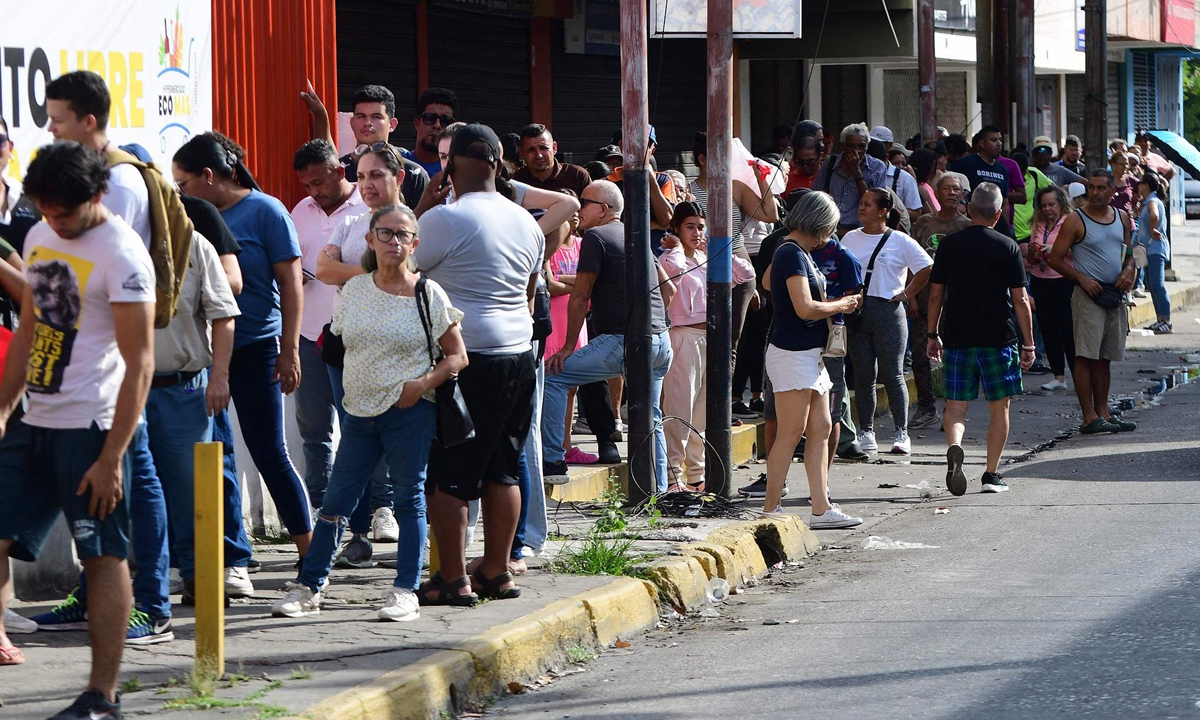
People make a line to buy groceries in Caracas on January 3, 2026. Photo: VCG
Following the US' large-scale military operation on Venezuela and capture of President Nicolás Maduro, certain areas of Venezuela's capital Caracas have experienced intermittent water and power outages, with long queues forming at local supermarkets, according to information obtained by the Global Times from multiple Chinese residents in the South American country.
"Caracas remains relatively calm at the moment. Most supermarkets have reopened and are selling food, with people queuing in an orderly manner to make purchases. However, many restaurants are still closed," Cen Minghui, vice chairman of the Venezuelan Federation of Chinese Overseas Associations, who is based in Caracas, told the Global Times on Sunday.
"We are also maintaining close contact with the Chinese Embassy in Venezuela, and so far, we have not heard any reports of Chinese nationals being injured or facing immediate danger," Cen said.
Another Chinese resident from the capital, Lobo (pseudonym), provided more details. He said that the streets in downtown Caracas and the eastern areas are largely empty, with very few people around. Supermarkets and pharmacies have long queues due to entry restrictions only allowing 10 people in at a time. "Every gas station I've seen is closed..."
In La Guaira State, which is several kilometers from the capital, some people rushed to supermarkets and pharmacies to stock up on supplies on Saturday morning, but by the afternoon, things had calmed down considerably, and the situation has remained stable, Wu Sixiong, president of the Chinese Community Association in La Guaira State, told the Global Times on Sunday.
"Overall, the situation remains relatively stable, and everyone is in a wait-and-see mood regarding how the situation will unfold," Wu said.
Apart from some psychological pressure caused by the US strikes, the daily work and lives of the Chinese community in Venezuela remain largely unaffected, Feng Yongxian, president of the Federation of Chinese Business Associations in Venezuela, told the Global Times.
Feng resides in Valencia, a city in central Venezuela, about 180 kilometers from the capital. He said that in the area where he lives, businesses are operating as usual, with food supermarkets are doing good particularly. General situation is generally stable, but there is few traffic and pedestrian flow on the streets.
According to Feng, approximately 200,000 Chinese nationals are residing in Venezuela. At present, they are using online group chats and phone calls to stay connected and provide mutual assistance.
The Xinhua News Agency reporters learned from several Chinese companies in Venezuela on Saturday that there have been no casualties among Chinese employees following the US strike on the country, the agency reported on Saturday night.
Earlier on Saturday, on-site visits by reporters with Chinese media in Caracas found that most shops were closed, long queues had formed outside some pharmacies and supermarkets, and some metro lines were not operating normally.
Several countries have issued strong condemnations of the US for its attack on Venezuela. Venezuela denounced the US' "military aggression" after large explosions were heard and aircraft were seen over its capital, Caracas, earlier in the day.
China expresses serious concern over the US' forcible control of President Nicolas Maduro and his wife and their transfer out of the country. The US' move is in clear violation of international law and the basic norms in international relations and the purposes and principles of the UN Charter, the Chinese Foreign Ministry spokesperson said on Sunday in response to reports that on January 3, the US sent forces to seize Venezuelan President Nicolas Maduro and his wife and took them out of the country and the governments of multiple countries have voiced opposition.
China calls on the US to ensure the personal safety of President Nicolas Maduro and his wife, release them at once, stop toppling the government of Venezuela, and resolve issues through dialogue and negotiation, the spokesperson said.
RELATED ARTICLES