Trump claims US will ‘run’ Venezuela following capture of Maduro; Move shocks intl community, draws condemnation
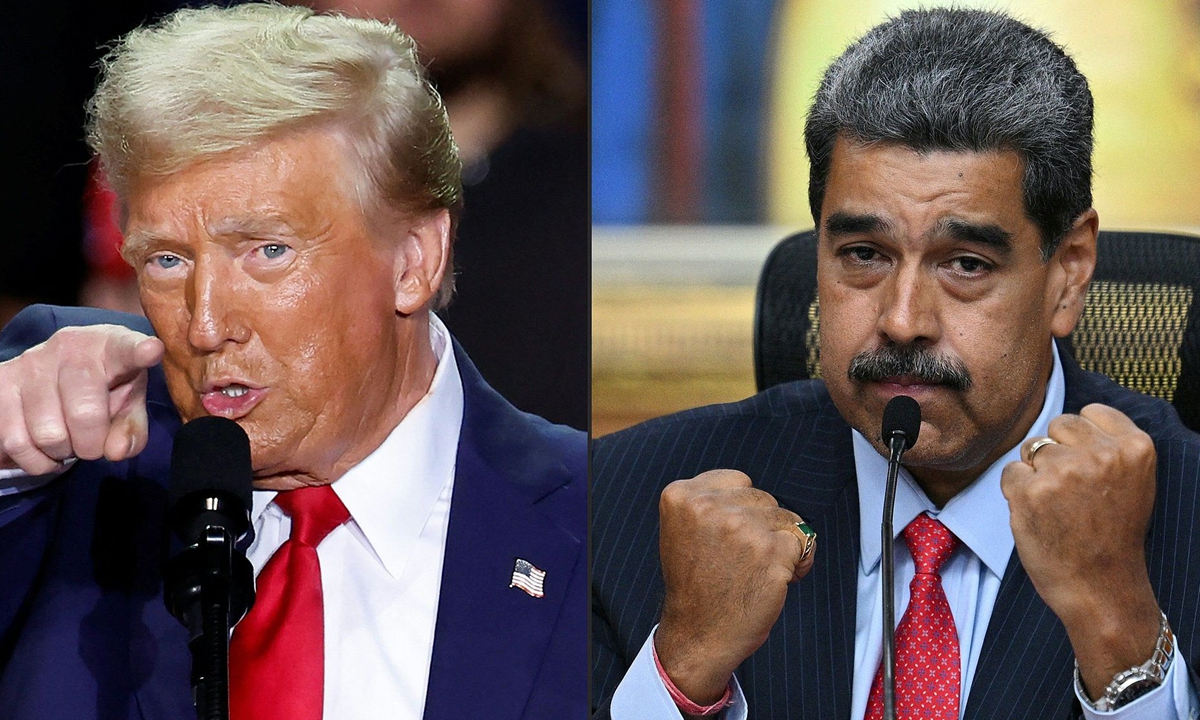
This combination of pictures created on August 07, 2025 shows US President Donald Trump (L) in Grand Rapids, Michigan on November 5, 2024, and Venezuelan President Nicolas Maduro (R) in Caracas on July 31, 2024. Photo: VCG
US President Donald Trump announced on Saturday that the US carried out a "large scale strike against Venezuela" and claimed that President Nicolas Maduro and his wife had been captured and removed from the country. Trump also posted on social media a photo of Maduro on board USS Iwo Jima after captured as the latest development of the US military operation.
The US military action against the South American nation has shocked the international community.
China on Saturday night said it is "deeply shocked" and strongly condemns the US' blatant use of force against a sovereign state and action against its president, warning that Washington's actions seriously violate international law and threaten regional peace and security.
"Such hegemonic acts of the US seriously violate international law and Venezuela's sovereignty, and threaten peace and security in Latin America and the Caribbean region. China firmly opposes it," a spokesperson for the Chinese Foreign Ministry made the remarks on the US military strikes on Venezuela on Saturday night.
"We call on the US to abide by international law and the purposes and principles of the UN Charter, and stop violating other countries' sovereignty and security," said the spokesperson.
Trump claimed during a press conference Saturday that "Late last night and early today, at my direction, the United States Armed Forces conducted an extraordinary military operation in the capital of Venezuela, overwhelming American military power," according to the Reuters. "Air, land and sea was used to launch a spectacular assault. And it was an assault like people have not seen since World War Two."
Trump claimed that the US will "run" Venezuela after the US military raided the country and captured its President Nicolás Maduro, Xinhua reported.
"We're going to run the country until such time as we can do a safe, proper and judicious transition," Trump said at the press conference at his Mar-a-Lago private club in Florida, according to report.
And then he turned to oil, claiming that American companies would fix the infrastructure, "and start making money for the country."
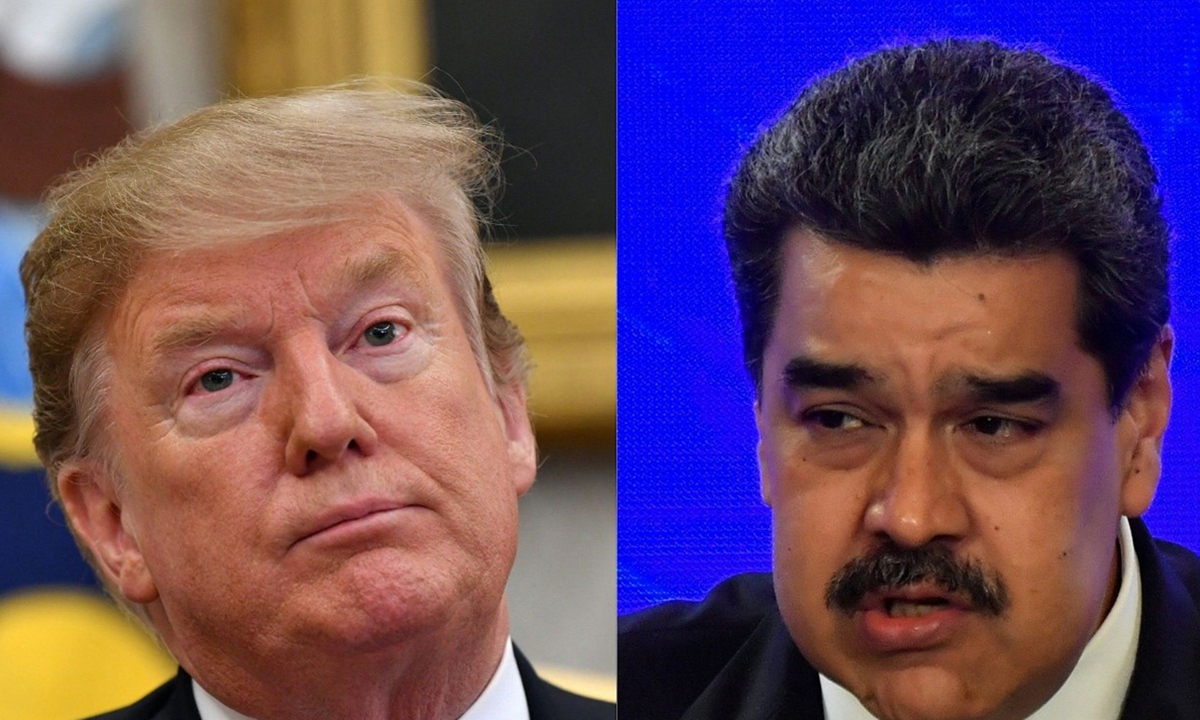
US President Donald Trump and Venezuelan President Nicolas Maduro Photo: VCG
What happened?
Multiple explosions rocked Venezuela's capital Caracas early on Saturday and columns of black smoke and aircraft could be seen, according to Reuters witnesses and images circulating on social media.
US President Donald Trump ordered strikes on sites inside Venezuela, including military facilities, US officials told CBS News.
The surprise operation sent shockwaves through the international community, with President Trump announcing on social media hours later that the Venezuelan President Nicolas Maduro and his wife had been "captured and flown out of the Country."
According to CBS News, the Venezuelan President was captured early Saturday morning by members of the US Army's elite Delta Force, citing US officials. The report said Delta Force, the US military's top special mission unit, was responsible for the operation.
Trump said that he watched the operation from Mar-a-Lago, when spoke with Fox News on Saturday morning just hours after the US hit Venezuela and captured its leader. He further stated that Maduro and his wife were taken by helicopter to the U.S.S. Iwo Jima.
According to Xinhua, US Attorney General Pam Bondi said Saturday morning that Venezuelan President Nicolas Maduro will "soon face the full wrath of American justice on American soil in American courts" after he was captured and flown out of the oil-rich South American nation.
The operation marked the latest escalation in Washington's long-running pressure campaign against the Maduro government, which has included an extensive US military buildup in the region.
Speaking on state television, Vice President Delcy Rodríguez said the whereabouts of Maduro and his wife are unknown, asking for proof they are alive, according to media reports.
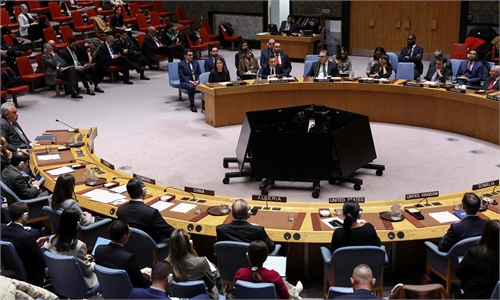
Following the initial shock, Caracas lodged a strong protest and requested an emergency meeting of the UN Security Council. Venezuela's Permanent Mission to the United Nations sent a letter on Saturday to the rotating president of the Security Council, Abukar Dahir Osman, Somalia's envoy to the UN, strongly condemning what it described as a "brutal, unjustified and unilateral armed aggression" launched by the US against Venezuela, the Xinhua News Agency reported.
Why it happened?
South Korea's Chosun Daily reported that this was the first instance since the US invasion of Panama in 1989, known as Operation Just Cause, where a sitting (or de facto) head of state was apprehended by US special forces on their own territory and forcibly transferred to a third country.
Diplomatic circles are viewing this incident as a decisive example of the U.S. ability to alter the status quo through force, which remains operational even in the 21st century, the Chosun Daily reported on Saturday.
The abruptness and unprecedented nature of the arrest of another country's leader in the post-Cold War era caught global media, experts and political figures by surprise. Global Times reporters contacted several Chinese experts closely following developments in Venezuela in the early hours after the strike. While they initially urged further observation, news of Maduro's capture emerged almost immediately, leaving many struggling to believe it at first.
"Overthrowing the Maduro government has long been an objective pursued by the US, but capturing a sitting head of state in this manner is highly unusual and can be described as reckless," Lü Xiang, a research fellow at the Chinese Academy of Social Sciences, told the Global Times on Saturday. "It not only violates international law, but also lacks any legal basis under US domestic law."
"This is a declaration of the revival of a new Monroe Doctrine and an assertion of US hegemony in the Western Hemisphere," Lü added.
In December, the US released its 2025 National Security Strategy, pledging to deprioritize Europe and focus more on the Western Hemisphere. His administration is calling it the "Trump Corollary" to the Monroe Doctrine.
Jiang Shixue, an expert on Latin American studies at Fudan University, told the Global Times on Saturday that the US military action is essentially the culmination of long-standing standoff between the US and Venezuela.
Jiang elaborated that on the political level, since former Venezuelan president Hugo Chávez took power in 1999, Venezuela has steadfastly raised the banner of anti-US hegemony and provided petroleum energy support to leftist countries such as Cuba. The US has long resented this, imposing multidimensional sanctions on Venezuela for years and consistently seeking to remove this "thorn in its side."
Jiang also believed that at the same time, the US also has economic demands, namely the contention over petroleum resources. Venezuela possesses the world's largest proven oil reserves. After Chávez came to power, he implemented nationalization of the petroleum industry, leaving only Chevron as the sole US oil company still conducting extraction and refining operations in Venezuela - a situation the US views as detrimental to its own interests.
The US, under the pretext of the so-called "war on drugs," has resorted to military force this time in an attempt to push for regime change in Venezuela, with the underlying intent of regaining control over Venezuela's vital petroleum resources, Jiang said.
Global reactions
In the wake of the shocking strike and Maduro's capture, the United Nations and countries around the world moved quickly to respond.
A spokesperson for the UN Secretary-General said the Secretary-General is "deeply alarmed by the recent escalation in Venezuela, culminating with today's United States military action in the country," warning that it carries "potential worrying implications for the region."
"Independently of the situation in Venezuela, these developments constitute a dangerous precedent," the spokesperson said, stressing the importance of full respect by all parties for international law, including the UN Charter, and expressing deep concern that the rules of international law may not have been respected.
Spain and the European Union also called for respect for international law following the latest events.
The European Union's High Representative for Foreign Affairs Kaja Kallas said that the bloc calls for restraint after the latest events in Venezuela.
"The EU has repeatedly stated that Mr Maduro lacks legitimacy and has defended a peaceful transition," Kallas said in a post on X. "Under all circumstances, the principles of international law and the UN Charter must be respected."
Countries including Germany and Italy said they are closely monitoring the situation.
Following the incident, President Javier Milei of Argentina commented the capture of Nicolás Maduro as "Liberty advances," Milei wrote on social media, The New York Times reported.
At the same time, a growing number of countries condemned the sudden US attack, including Brazilian President Luiz Inacio Lula da Silva, Chilean President Gabriel Boric, Cuban President Miguel Díaz-Canel, and Iranian Supreme Leader Ayatollah Ali Khamenei voiced oppositions toward the US action.
Russia urged the US to release Maduro and his wife, in a statement issued by the Russian foreign ministry on Saturday.
"In light of confirmed reports that Venezuelan President Nicolas Maduro and his wife are in the United States, we strongly urge the American leadership to reconsider its position and release the legally elected president of a sovereign country and his wife," the ministry said in the statement.
The US action has dealt a huge shock to the international order. On one hand, it wants to mediate the Russia-Ukraine conflict; on the other, it is creating new conflicts itself,Lü said.
In the future, Latin American countries may continue to face various forms of pressure and interference from the US, potentially triggering instability across South America, he added.
RELATED ARTICLES