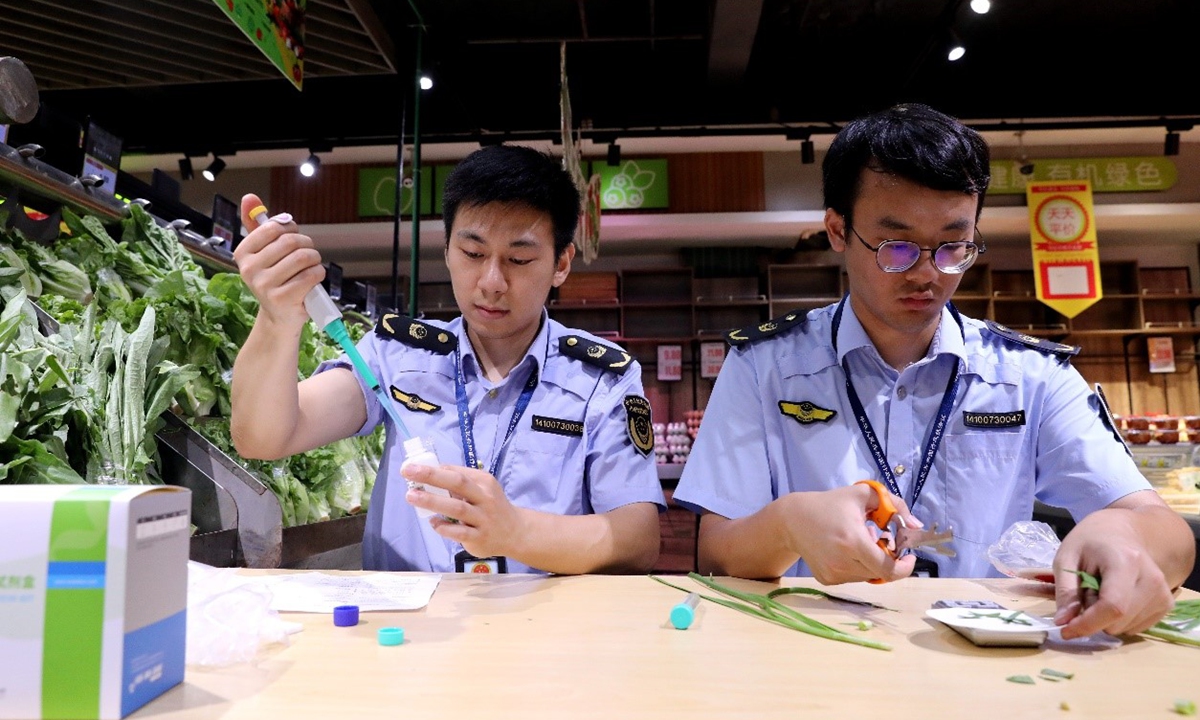
Staff members from the Xiajiang County Administration for Market Regulation conduct tests on vegetables sold at a supermarket in Xiajiang county, East China's Jiangxi Province, on September 22, 2026. Photo: VCG
China's top political and legal affairs authority has issued a guideline calling for stronger efforts to investigate and punish food safety violations and crimes, with particular attention to meat products, food served in schools, health food products, vegetables and fruit. The guideline also calls for strict adherence to the "four strictest" requirements to ensure food safety, the Xinhua News Agency reported on Monday.
The guideline also calls for stricter handling of cases throughout criminal proceedings, including tighter restrictions on the use of suspended sentences and exemptions from criminal punishment. Offenders involved in serious cases with severe social impact should face heavier penalties in accordance with the law.
The document was issued as food safety offenses increasingly involve networks, specialized operations and organized activity spanning longer supply chains, while gaps remain in coordination between administrative law enforcement and criminal justice, an official with the Commission for Political and Legal Affairs of the CPC Central Committee said in an explanation of the guideline on Monday.
The official also pointed to a series of recent criminal incidents, including "formaldehyde-treated cabbage," the use of the pesticide dichlorvos for disinfection, and bayberries soaked in chemical solutions, saying such cases had seriously compromised food safety and drawn widespread public concern.
The official noted that China's food safety work should continue to follow the "four strictest" requirements, namely the strictest standards, the strictest supervision, the strictest punishment and the strictest accountability, to safeguard public health and ensure food safety.
Under the guideline, enforcement will focus not only on particular types of food but also on key parts of the supply chain, including production and processing, online sales, catering services and food imports. Authorities are also required to strengthen supervision and guidance over major, difficult and complex food safety cases.
The guideline says criminal penalties should be used to substantially raise the cost of violations and deter businesses from breaking the law.
Another focus is specific measures to close gaps between administrative enforcement and criminal proceedings. The guideline calls for clearer standards on when cases should be transferred for criminal investigation, as well as rules covering testing and appraisal and the conversion of evidence collected in administrative cases for use in criminal proceedings.
Authorities are also asked to address practices such as substituting administrative fines for criminal prosecution or failing to impose administrative penalties where warranted. An information-sharing platform is to be established to improve coordination, while mechanisms for transferring cases back from the criminal justice system for administrative handling will also be improved.
The guideline also calls for accelerating a comprehensive revision of China's Food Safety Law to address the rapid growth of new forms of online businesses.
Regulatory requirements are expected to be further clarified for fresh food e-commerce, food delivery services and livestreaming e-commerce, with responsibilities assigned more clearly to the parties involved. The guideline also calls for a legal liability system in which penalties are proportionate to the seriousness of violations and set at different levels.
Authorities will also work to standardize the application of law in food safety cases through measures including the publication of typical cases and the inclusion of relevant cases in the People's Courts Case Database.
For newly detected illegal additives, the guideline calls for relevant departments to update the list of prohibited substances in a timely manner so that new forms of food safety crime can be dealt with under clearer legal and policy standards.
To prevent food safety problems at their source, judicial, procuratorial and public security authorities are urged to issue judicial recommendations, procuratorial recommendations and police alerts when investigations expose broader risks or regulatory loopholes in the food supply chain.
The guideline also calls for greater use of big-data legal supervision models and public-interest litigation to help regulators identify leads, rectify problems in relevant industries and shift food safety governance toward earlier prevention.
The Commission for Political and Legal Affairs of the CPC Central Committee will coordinate implementation, while the Supreme People's Court, the Supreme People's Procuratorate, the Ministry of Public Security and the Ministry of Justice will work together and make specific arrangements within their respective systems to carry out the guideline, according to Xinhua.
Global Times
RELATED ARTICLES