SCI-TECH / OTHERS
Chinese scientists identify key gene linked to evolution of human intelligence, develop brain folds in mice
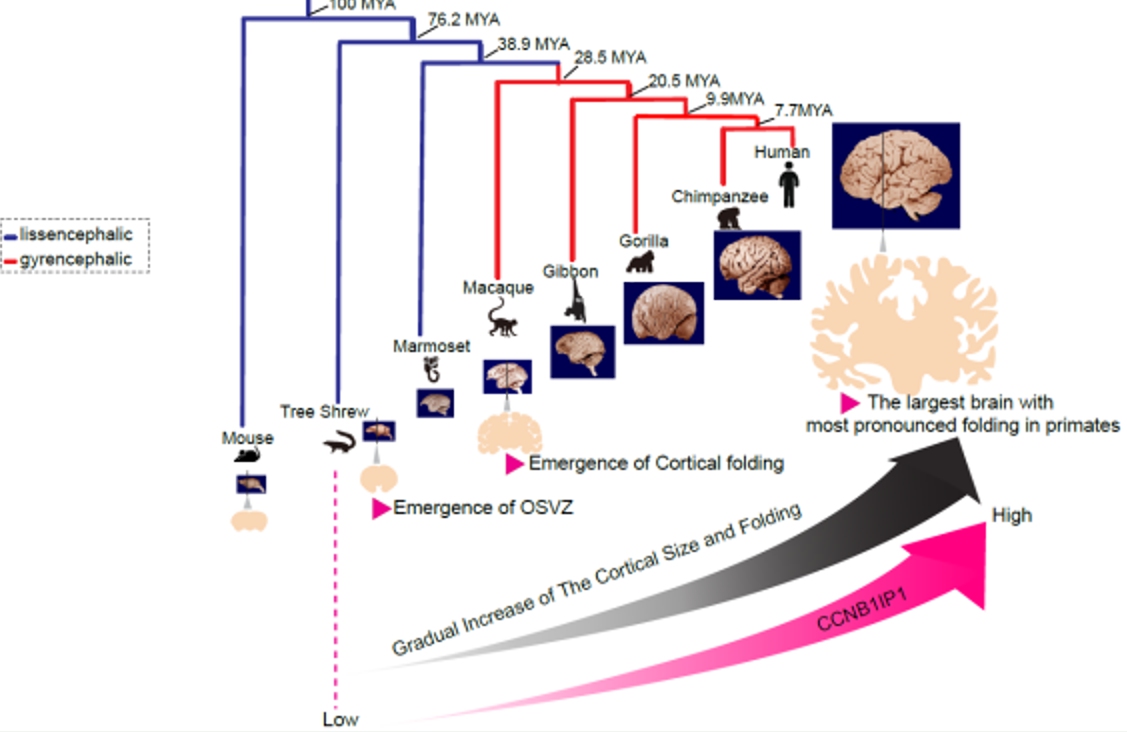
A schematic illustrating the relationship between cerebral cortical size, cortical folding, and CCNB1IP1 gene expression levels from mice to humans Photo: Courtesy of the Kunming Institute of Zoology under the Chinese Academy of Sciences
A research team from the Kunming Institute of Zoology under the Chinese Academy of Sciences has identified a key gene associated with the evolution of human intelligence and induced mice to develop brain folds resembling those found in the human brain by regulating the gene, state broadcaster CCTV News reported.Experts said that humans are more intelligent than other animals partly because of their larger brain capacity and the greater number of folds on the brain surface. These folds, known as cerebral gyri and sulci, are sometimes described as "walnut-like patterns," allowing the cerebral cortex to be folded and compressed inside the limited space of the skull, thereby expanding the cortex's total surface area, according to media reports.
When fully unfolded, the human cerebral cortex covers an area roughly equivalent to three sheets of A4 paper, while the smooth cerebral cortex of a mouse is only about the size of a postage stamp. A larger cerebral cortex can accommodate more neurons and neural connections, enhancing the brain's information storage and logical processing, thus supporting thinking and memory.
However, a greater number of brain folds does not necessarily mean higher intelligence. For example, cetaceans have more complex cortical folding than humans, yet their cognitive abilities are far below those of humans. Brain folds are only one of the structural foundations underlying intelligence.
To uncover the secrets behind the "walnut-like" structure of the human brain and the evolution of intelligence, the research team compared brain gene data from multiple species and identified a key gene involved in brain development, known as CCNB1IP1.
The ancient gene is not unique to humans and is carried by almost all mammals. Researchers found that differences in intelligence and brain structures among species are not determined by whether they possess the gene, but rather by the level at which the gene is expressed.
"We find that the expression of the CCNB1IP1 gene in primate brains shows a unique evolutionary pattern. Before the emergence of primates, the gene had already acquired the ability to be expressed in the brain of tree shrews. During subsequent evolution, its expression levels in both neural progenitor cells and neurons gradually increased. This increase showed a significant positive correlation over the evolutionary timeline with the expansion of the primate cerebral cortex and the deepening of its folding complexity," Shi Lei, leader of the research team, told the Global Times on Monday.
To verify their findings, scientists introduced human-level expression of the key gene into mice, whose brains are naturally smooth. The edited mice developed cerebral cortex folds resembling those of primates. The gene-modified mice also showed significant improvements in learning and memory abilities, suggesting that regulating this gene could influence brain development and cognitive functions.
"Further studies showed that the increased expression of CCNB1IP1 was driven by the evolution of cis-regulatory elements upstream of the gene," Shi said.
The study provides new insights into the genetic mechanisms behind human brain evolution and intelligence, while offering a new perspective on how brain structures are linked to cognitive abilities.
"The research also provides new clues for exploring the causes of neurodevelopmental disorders," Shi said.
RELATED ARTICLES