China, EU unveil fresh outcomes in auto trade talks; strong Chinese presence at Paris Motor Show 'underscores potential for deeper co-op'
Paris Motor Show highlights China-EU automotive cooperation potential
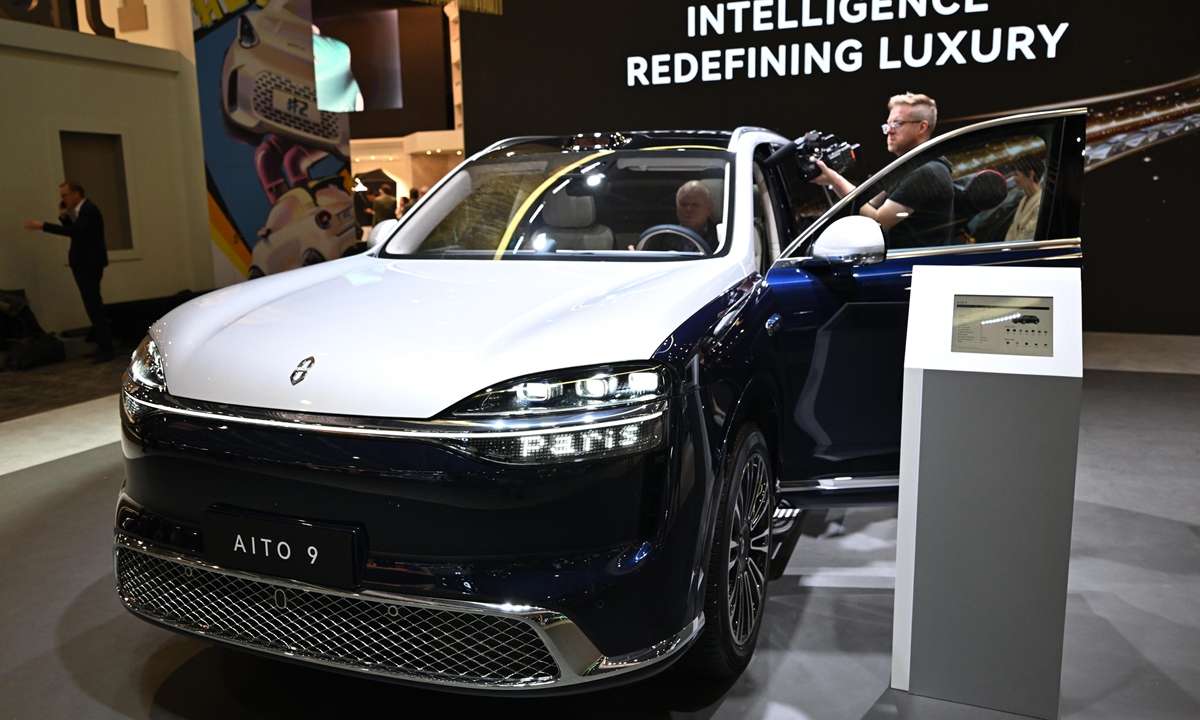
An Aito 9 SUV electric vehicle with programmable LED lighting reading "Paris" on the opening day of the Paris Motor Show in Paris, France, on Monday, Oct. 12, 2026. Photo: VCG
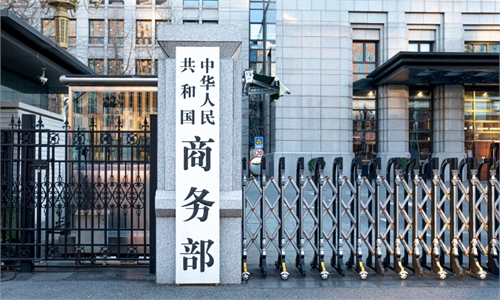
China and the EU have made fresh progress in automotive trade, following recent in-depth discussions on hybrid and electric vehicle (EV) trade under their trade and investment consultation mechanism. A spokesperson for China's Ministry of Commerce (MOFCOM) said on Monday that the two sides have maintained dialogue under the mechanism and reached a series of consensuses and outcomes, which will help maintain a stable and balanced trade partnership between the two major economies.
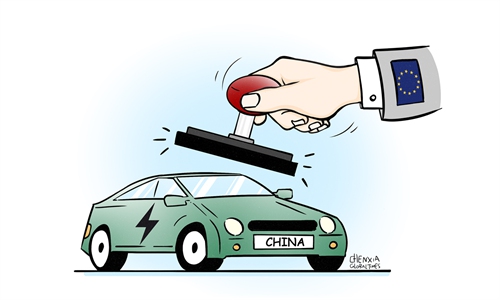
Against the backdrop of rising global trade protectionism and the accelerating transformation of the global automotive industry, it is of particular significance that China and the EU have achieved practical results through consultations on an equal footing, a Chinese expert said, noting that this joint effort demonstrates that both sides have the willingness and capability to properly resolve trade disputes through dialogue.
Meanwhile, with around 20 Chinese automotive brands participating in the Paris Motor Show, which opened on Monday, the potential for further China-EU cooperation in the automotive sector, including markets, technology and investment, has become increasingly evident.
Important consensus
China and the EU have held intensive consultations on hybrid and EV trade based on the principles of mutual respect and equal consultation, seeking to address trade and economic differences while accommodating each other's concerns, a MOFCOM spokesperson said on Monday.
The remarks were made in response to a media inquiry about the recent in-depth China-EU discussions on hybrid and EV trade under their trade and investment consultation mechanism, which helped prevent tensions from escalating, as well as speculation by some foreign media outlets over the volume and other details of the hybrid vehicle trade arrangements.
The MOFCOM spokesperson said that the two sides emphasized and confirmed three basic principles on hybrid vehicles.
According to Eurostat data, EU imports of hybrid vehicles from China stood at 107,000 units in 2024 and 302,000 units in 2025. Building upon the 2025 figures, the two sides reached an arrangement for upward adjustment to ensure export capacity and stable growth for Chinese enterprises, while addressing the realistic and legitimate concerns of industries on both sides.
The two sides also agreed that no measures will specifically target Chinese products, let alone subject Chinese enterprises to discriminatory treatment. The quotas allocated to China will be no less favorable than those granted to any other source of imports for the EU, according to the MOFCOM spokesperson, adding that both sides affirmed that trade arrangements should comply with WTO rules and that the Chinese side reserves all rights, including recourse to dispute settlement and demands for trade compensation, within the WTO framework.
On the subject of EVs, the spokesperson noted that the two sides secured a "soft landing" for the EU's countervailing duty case in January this year, when the EU issued general guidance on price undertakings, and that the EU will continue to advance procedures for company-specific price undertakings and other review processes under the EV case.
Based on equality and mutual benefit, the aforementioned consensus effectively safeguards the interests of Chinese enterprises and averts an escalation of trade friction between China and the EU; it also provides a stable, predictable, and sustainable environment for trade and investment, thereby fostering the stable, balanced, and healthy development of bilateral economic and trade relations, the spokesperson said.
The two sides approached the consultations with "limited time and limited objectives," while taking full account of each other's concerns. Reaching a series of concrete outcomes under such circumstances was no easy task, Jian Junbo, director of the Center for China-Europe Relations at Fudan University's Institute of International Studies, told the Global Times on Monday.
This once again demonstrates that China and the EU have both the willingness and capability to properly manage their differences and deepen cooperation through dialogue and consultation, Jian said.
Against the backdrop of a complex and volatile global trade environment, preventing trade tensions from escalating further will help safeguard business interests and stabilize market expectations, while also providing a useful example for addressing other trade and economic issues between the two sides, said the expert.
Window of opportunity
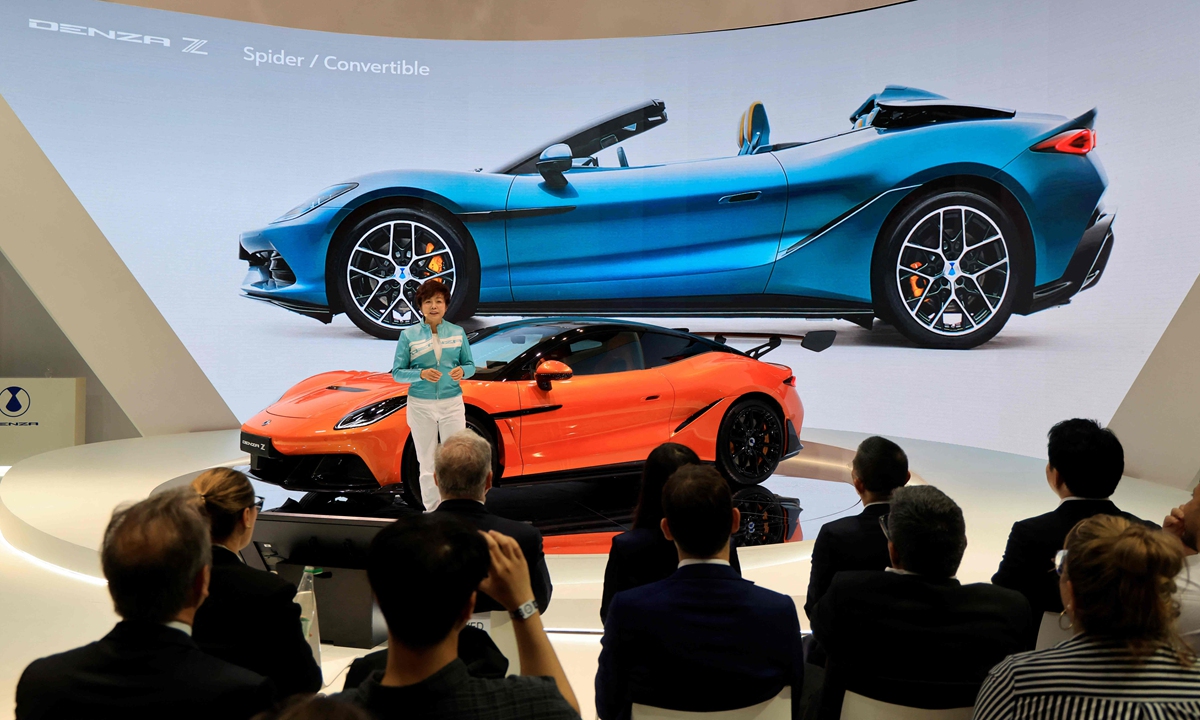
Stella Li, Executive Vice President of BYD and CEO of BYD Americas, speaks during the presentation of the Denza Z electric sport car, a sub-brand of BYD group, at the 91st edition of the international Paris Motor Show at the Porte de Versailles in Paris on October 12, 2026. Photo: VCG
The progress in China-EU automotive trade talks comes as Chinese automakers step up their presence in Europe, highlighting the importance of a stable and predictable trade environment for deeper industrial cooperation.More than 60 automakers are expected to participate in this year's Paris Motor Show, with Chinese brands particularly prominent, French automotive news website Automobile Actu reported. The number of participating Chinese automakers has doubled compared with the previous edition, with BYD, Leapmotor, XPeng, Geely, Chery, Changan and GAC among the exhibitors, accounting for roughly one-third of all participating automakers.
These Chinese automakers are showcasing their latest products and technologies, ranging from pure electric and hybrid vehicles to smart cockpits and fast-charging solutions.
On Monday, Chinese auto brand AITO showcased several of its flagship models and latest technological innovations at the 2026 Paris Motor Show, the Global Times learned from the company.
The Chinese auto company also unveiled its European market entry and development plans, announcing that it will enter the European market in autumn 2027, marking a significant step in its global expansion.
Clifford Kang, a member of the Board of Directors and Vice President of Seres Group, said at the auto show that from technological innovation to international expansion, AITO is moving toward a broader global market. Entering Europe marks an important step in AITO's commitment to sharing a new vision of luxury with its customers.
A representative from XPeng told the Global Times that the company will showcase a range of new-energy vehicles, along with its flying car and humanoid robots, at the Paris Motor Show. In terms of research and development, XPeng has established eight R&D centers worldwide, including its European R&D center in Munich, Germany. On the manufacturing front, the company has launched three localized production projects overseas, including one in Austria.
Chinese automakers have vast market opportunities in Europe. "There is no need for Europe to view the entry of Chinese automakers simply as a threat to its domestic industry... Instead, the two sides can achieve mutual benefits through technological cooperation, joint research and development, and collaboration across industrial and supply chains," Zhang Xiang, a visiting professor in the engineering department of Huanghe Science and Technology University, told the Global Times on Monday.
There are already numerous examples of cooperation between Chinese and European automakers. European automotive giant Stellantis and China's Leapmotor have established a joint venture to expand into international markets, while Germany's Volkswagen Group and China's XPeng have joined forces in EV development and technological research.
Zhang said that these partnerships demonstrate that beyond competition, the Chinese and European automotive industries are highly complementary, with considerable potential for mutually beneficial cooperation.
From the positive consensus reached in China-EU automotive trade consultations to the strong presence of Chinese automakers at the Paris Motor Show, these developments demonstrate that despite competition and differences in the automotive sector, considerable room remains for the two sides to deepen cooperation, Chinese experts said.
"For China and the EU, properly resolving trade disputes through dialogue and providing businesses with a fair, stable and predictable business environment will not only support the long-term development of their respective automotive industries, but also serve their shared interests in advancing the global automotive industry's green transition," said Jian.
RELATED ARTICLES