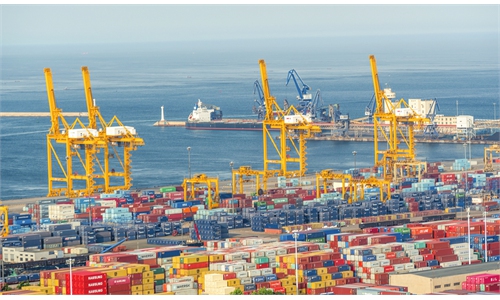
A view of the Lujiazui area in Shanghai Photo: VCG
Some Western media outlets have recently revived their pessimistic take on the Chinese economy, with some hyping the claim that a "growing debt burden limits space for economic stimulus."Such claims have been proven wrong before and lack any solid foundation this time around, as China's debt level remains lower than that of many major economies, the country has taken concrete steps to address the debt issue, and it retains ample policy room to ensure stable, high-quality growth.
China's government debt ratio is much lower than the average levels of both major developed economies and major emerging markets. As of the end of 2025, China's total government debt stood at 102.5 trillion yuan ($15.32 trillion), including 41.2 trillion yuan in central government debt, 54.8 trillion yuan in statutory local government debt and 6.5 trillion yuan in hidden local government debt, according to a State Council report published in August.
Is that debt level high? Under the broader measure used by the IMF, which includes more local government financing vehicle debt in the government sector, China's total government debt is expected to be around 107 percent of GDP around 2026. By comparison, the US is projected at about 126 percent during the same period, and Japan at more than 200 percent, according to some estimates. In other words, China's government debt is not the highest among major economies.
Now, would such a debt level limit China's space for economic stimulus as suggested? To answer that, one must first understand that China has not taken the old road of excessive reliance on aggressive policy stimulus. In recent years, its ongoing efforts to resolve local government debt, advance debt swaps, and optimize the structures of debt maturity have made marked progress. While these moves may impose short-term constraints on the scale of fiscal expansion, they are systematically defusing risks - thereby laying a far more solid foundation for steady, sustainable growth over the long run.
As for the inflation landscape, China's consumer price index rose 0.4 percent month-on-month in August, reversing a 0.1 percent decline in July, while year-on-year growth picked up to 0.8 percent. The producer price index rose 0.4 percent month-on-month, reversing a 0.7 percent drop the previous month, according to the National Bureau of Statistics. Both gauges indicated overall moderate price increases.
Meanwhile, the IMF in July raised its 2026 headline inflation forecast by 0.3 percentage points to 4.7 percent, compared with its April outlook. Despite global inflationary pressure, China's prices have remained stable. China neither faces the high-inflation constraints that once plagued Europe and the US, nor the policy dilemmas currently confronting many major economies.
Crucially, there is still ample room for China's monetary and fiscal policies. China's central bank has made clear that the average reserve requirement ratio (RRR) for financial institutions stands at 6.3 percent, leaving room for further cuts. Monetary policy can act flexibly based on actual economic conditions, releasing liquidity through RRR cuts, policy rate reductions, and targeted structural tools.
The ultimate litmus test of an economy's policy space is whether its growth targets can be met. In the first half of this year, China's GDP reached 69.6 trillion yuan, growing 4.7 percent year-on-year, a pace in line with the full-year growth target. Compared with the first half of last year, GDP increased by 3.6 trillion yuan - the largest increment for the period in the past five years, which speaks for itself as the most compelling proof of resilience.
In its July outlook, the IMF downgraded this year's global growth forecast to 3 percent while raising China's full-year growth forecast to 4.6 percent. This in itself shows that the international community's assessment of China's economic performance does not align with the pessimistic narrative in certain Western media. The consumer market continues to expand, new growth points such as services consumption and experiential consumption are being cultivated, household income is rising steadily, and the foundation of domestic demand is being consolidated.
Boosting domestic demand does not depend solely on large-scale fiscal spending. Structural reforms, including improving the business environment and revitalizing the private sector, all serve as drivers of demand. Fiscal spending is only one tool in the policy toolkit. Tying the recovery of domestic demand exclusively to massive stimulus reflects outdated thinking.
China maintains a well-stocked macro policy toolkit with ample room for counter-cyclical regulation. Together with the endogenous momentum unlocked through structural adjustment and reform, these elements form the overall resilience of the Chinese economy.
Global Times
RELATED ARTICLES