SCI-TECH / OTHERS
Xinjiang’s first embodied AI robot assembly line expected to be completed in April 2027
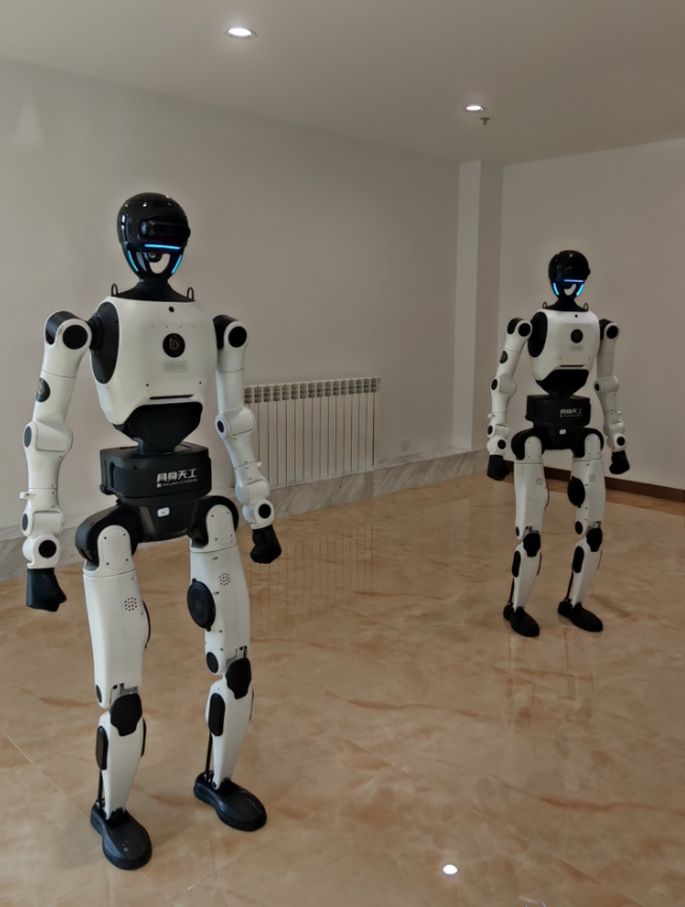
TienKung 3.0 humanoid robots are on display at an industrial park in the Urumqi Economic and Technological Development Zone on October 12, 2026. Photo: Courtesy of Xinjiang Dadao Industrial Investment Co Ltd
Urumqi-based Xinjiang Dadao Industrial Investment Co Ltd said it has launched the construction of a real-world training center and application validation base for embodied AI robots in Urumqi, capital city of Northwest China's Xinjiang Uygur Autonomous Region, making it the region's first production assembly line for embodied AI robots.The first phase of the base is expected to be completed by the end of October, providing a testing and verification site for its initial batch of embodied intelligence robots, according to information the company provided to the Global Times on Tuesday.
A production assembly line is slated for completion in April 2027, after which the company plans to tailor products to customers' application needs and deliver a range of models in small batches through multiple production runs, according to the company.
Industry observers say the project marks a key step in Xinjiang's embodied intelligence robot supply chain and could create new opportunities for local equipment manufacturing, smart manufacturing and industrial deployment.
Zhou Tao, deputy director of the company's training center, told the Global Times on Tuesday that the facility is developing its own "world model" to help robots adapt to their surroundings and perform tasks autonomously by learning from accumulated data.
According to Zhou, Xinjiang's strengths in developing embodied AI robots lie in its diverse application scenarios and distinctive testing conditions.
"Rich industrial settings can provide varied data, while the region's high-altitude terrain and extreme hot-and-cold weather offer real-world testing opportunities in harsh environments," Zhou said.
Analysts said real-world applications in Xinjiang's workshops, mines and other industrial settings could strengthen the local smart manufacturing supply chain and support workforce training.
The company plans to accelerate assembly line construction, adapt its robots to specific applications, improve compatibility with autonomous vehicles and enter the unmanned retail warehouse market. Once its industrial applications mature, it plans to expand into other supporting applications.
In recent years, advances in large AI models, sensors, motion control and computing platforms have accelerated the transition of embodied intelligence from research toward industrial application. For Xinjiang, a faster move into the sector could help foster new quality productive forces and establish a hub for intelligent equipment that could serve as a model for western China, Tian Feng, president of the Fast Think Institute and former dean of the Intelligence Industry Research Institute at SenseTime, told the Global Times on Tuesday.
The first robotics 9S center in Xinjiang - a new platform integrating robot exhibition, sales, leasing, customized development, maintenance, science education and industrial empowerment - officially began operation in Urumqi Economic and Technological Development Zone on September 16, according to local media reports.
The center has already established partnerships with 25 Chinese robotics companies and institutions, including humanoid robot developer Unitree Robotics, Shanghai-based AgiBot, Beijing-based Booster Robotics and China Mobile's embodied intelligence research center. These partnerships will help ensure robot supply, after-sales services, leasing capacity and technology development.
Tian said the projects reflect China's broader push to develop embodied intelligence, listed as a key future industry direction in the country's 15th Five-Year Plan (2026-30). As AI moves increasingly from the digital world into the physical one, provinces and regions across China are accelerating investment in training grounds, application validation platforms and pilot production bases.
By the end of June, more than 70 embodied intelligence training facilities had been built and put into operation across China, with over 40 others under construction or planned, Xinhua News Agency reported, citing the China Academy of Information and Communications Technology.
RELATED ARTICLES