Will the Pinglu Canal widen ASEAN’s trade deficit with China?: Global Times editorial
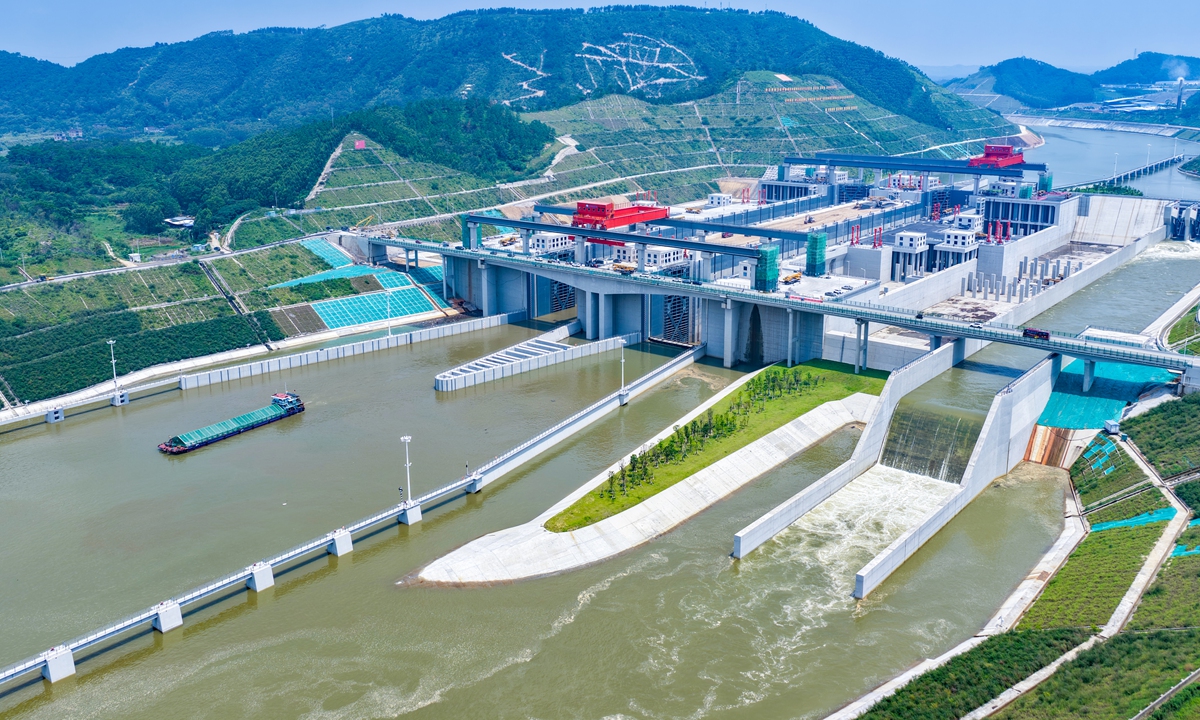
A vessel sails along the Pinglu Canal near the Madao hub. Photo: Courtesy of Pinglu Canal Group
Editor's Note:Currently, China's economy is steadily advancing along the path of high-quality development, even as domestic and international circumstances become increasingly complex. Some Western media, due to misunderstanding or bias, have repeatedly questioned or even distorted China's economic development. Accordingly, the Global Times launches the "Q&A on China's Economy" column to publish opinion pieces to present facts and clarify perceptions.
The Pinglu Canal has been operational since September 16. As the latest landmark project in China-ASEAN connectivity, the canal is a public good serving the wider region. However, since construction of the canal began, there have been noises in the West and certain ASEAN countries arguing that lower logistics costs could "flood" ASEAN markets with more Chinese goods, leading to trade "imbalance" between China and ASEAN and posing challenges for the development of local industries in Southeast Asia.
Such concerns are based to some extent on the realities of regional trade and economic relations, but the logic behind them is overly simplistic. As is well known, China and ASEAN have remained each other's largest trading partners since 2020. Their industrial chains are deeply interconnected, with intermediate goods accounting for more than 60 percent of bilateral trade. At the same time, many ASEAN economies maintain large trade surpluses with the US and Europe while running trade deficits with China. Will the opening of the Pinglu Canal therefore widen ASEAN countries' trade deficits with China? Such a view is clearly one-sided, for two reasons.
First, the current China-ASEAN trade pattern is determined by the regional division of labor in industrial and supply chains, not by the Pinglu Canal. The existing pattern of bilateral trade between China and ASEAN countries does not exist in isolation. It forms part of a triangular division of labor that has developed over time in the region and within global industrial chains. The opening of the canal will not change regional comparative advantages, nor will it create trade imbalances.
One important fact should not be overlooked. Many ASEAN countries run trade surpluses with European and US markets, and these surpluses often rely on intermediate goods, components, machinery and equipment imported from China. ASEAN countries process and assemble raw materials and components imported from China, and then export the finished products to end markets in Europe and the US. As a result, some ASEAN countries run trade deficits with China while maintaining surpluses with Europe and the US. This stems from the current regional industrial division of labour. The logistical convenience brought by the canal helps ASEAN countries leverage regional supply chains to expand exports to third-party markets, generating mutually beneficial outcomes at the level of regional industrial chains.
Second, as a public good for regional connectivity, the Pinglu Canal serves as a low-cost waterway that is open to market participants on both sides. It is not designed only to serve Chinese exporters. It can transport Chinese goods southward while also facilitating the movement of ASEAN agricultural products, minerals, forest products and components northward into China's vast inland consumer and production markets, and even onward to the broader Eurasian market.
Currently, China's month-on-month year-over-year import growth rate has outpaced export growth for six consecutive months. China's catalytic role in regional and even global trade and the economy has become more pronounced. Against this backdrop, the Pinglu Canal will help China import more ASEAN products in the years ahead.
The structure of industrial chains is not fixed. ASEAN countries are promoting industrial upgrading, and their capacity to export higher value-added products continues to grow. Amid elevated global energy prices, international freight rates and inflation, which have pushed up regional firms' costs and squeezed their profit margins, the low-cost transport route provided by the Pinglu Canal comes at an opportune moment, acting as a booster for ASEAN's manufacturing upgrade and facilitating easier access for locally manufactured products to China's inland markets.
The opening of the Pinglu Canal will, in the long term, strengthen China-ASEAN trade and the resilience of regional industrial and supply chains. As ASEAN goods enter China's inland markets at lower logistics costs, ASEAN economies will also become more deeply integrated into industrial chains in China. ASEAN products, from agricultural goods such as fruit, rice, rubber and palm oil to resources such as bauxite, will be able to move beyond China's coastal markets and reach more deeply into its western inland regions. At the same time, the canal will make central and western China more open to ASEAN and can also promote the development and transformation of Chinese industries.
The benefits of lower logistics costs brought by the Pinglu Canal can only be realized through joint efforts. Take the second ship lock on Xijin reservoir, regarded as a key gateway to the canal, as an example. It has handled a cumulative cargo volume of 70.8 million tons over the past three years. Realizing the canal's full potential requires China and ASEAN countries to jointly build and make good use of two-way logistics chains. As ASEAN goods gain lower-cost access to markets in Southwest China, enterprises, ports and logistics service providers along the route will all play important roles in shaping the emerging canal economy.
In short, the so-called "one-way corridor" narrative is essentially a new variant of the "China squeeze" narrative. The mutually beneficial and win-win cooperation framework between China and ASEAN remains unchanged, and will stay so. Only by expanding the pie of regional cooperation can China, ASEAN and more countries secure larger slices for themselves. In this process, the Pinglu Canal will serve not only as a multiplier for the expansion and optimization of trade, but also as a catalyst for structural improvement.
RELATED ARTICLES