ARTS / CULTURE & LEISURE
Creator explains fictional reason behind BABYQUEEN member Mity’s ‘pregnancy’ announcement
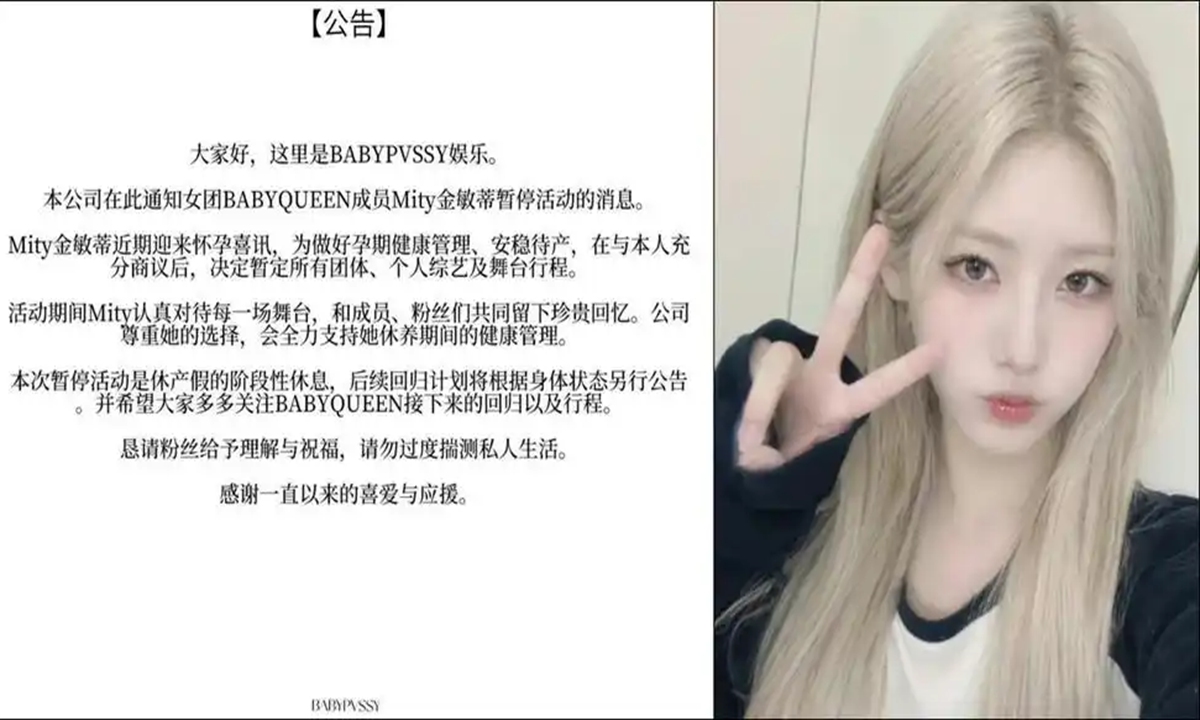
AI girl group BABYQUEEN has drawn widespread attention on China's social media after its virtual member, Mity, announced that she was pregnant and would temporarily suspend activities. Photo: Screenshot forom website
AI girl group BABYQUEEN has drawn widespread attention on China's social media after its virtual member, Mity, announced that she was pregnant and would temporarily suspend activities. A new-song teaser released by the group just an hour later prompted netizens to joke about Mity's "short maternity leave." The topic soon garnered more than 75 million views on Sina Weibo, China's Instagram-like platform.
Speaking in a subsequent post, the creator behind BABYQUEEN explained that the pregnancy storyline was fictional and had been used to write Mity out of the group because managing multiple AI characters alone had become too demanding. The creator acknowledged that the team had chosen an inappropriate reason to explain the character's departure.
"When I saw the announcement, I found it quite dramatic. It was like taking the familiar news tropes surrounding human idols and applying them to an AI character. But if the team simply wanted to adjust its operations, it could have said so directly," Liu Yue, a Beijing based fan of short drams, told the Global Times on Wednesday."The issue isn't simply that an AI character can't become pregnant. It is that the team used a personal-life storyline commonly associated with human idols to explain a real operational decision. When fiction is presented like real news, it raises questions of trust beyond its entertainment value," she said.For creators, such storylines are part of a broader effort to make virtual characters more engaging to audiences.
Zhao Yafeng, an AI film and video content professional based in South China's Guangdong Province, told the Global Times that storytelling around virtual characters was nothing new, but finding the right balance between drama and realism remains to be a challenge for creators.
Zhao cited virtual influencer Lil Miquela as an example. Last year, Lil Miquela featured in a video for a leukemia awareness campaign that simulated her receiving a leukemia diagnosis. Despite disclosures that she was a fictional character and the symptoms were dramatized, the campaign drew criticism from some viewers who considered the portrayal disrespectful to people living with the disease.
"The case shows that a virtual character's story is shaped not only by what its creators, but also audiences. When a storyline draws on serious real-world issues, even a creator who sees it as storytelling may be accused of exploiting real people's suffering," Zhao said.
Zhao shared a study published in Computers in Human Behavior, which examined how disclosure of a virtual influencer's identity and the use of emotional narratives affect audience perceptions. It explored perceptions of credibility and parasocial relationships — emotional connections people have developed with figures with whom they have no actual personal relationship.
"The findings offer a framework for understanding why the personal stories of virtual idols can attract attention much like news about human celebrities," she said.
However, criticism of a team's creative choices and operating practices should not turn into personal attacks. The BABYQUEEN creator said that the team had faced body-shaming and personal abuse after gaining popularity, with even family members reportedly being harassed.
For a team that started as a hobby, Zhao said, unexpected popularity brings not only attention but also operational pressure and scrutiny. Discussions about how AI virtual idols are created and managed should focus on specific practices rather than target creators and their families.
"As virtual characters become increasingly lifelike, knowing how to tell their stories and where to draw the line has become an unavoidable part of content management," she noted.
RELATED ARTICLES