China launches eight new satellites to advance space-based AI computing network
By Published: Oct 14, 2026 08:15 PM

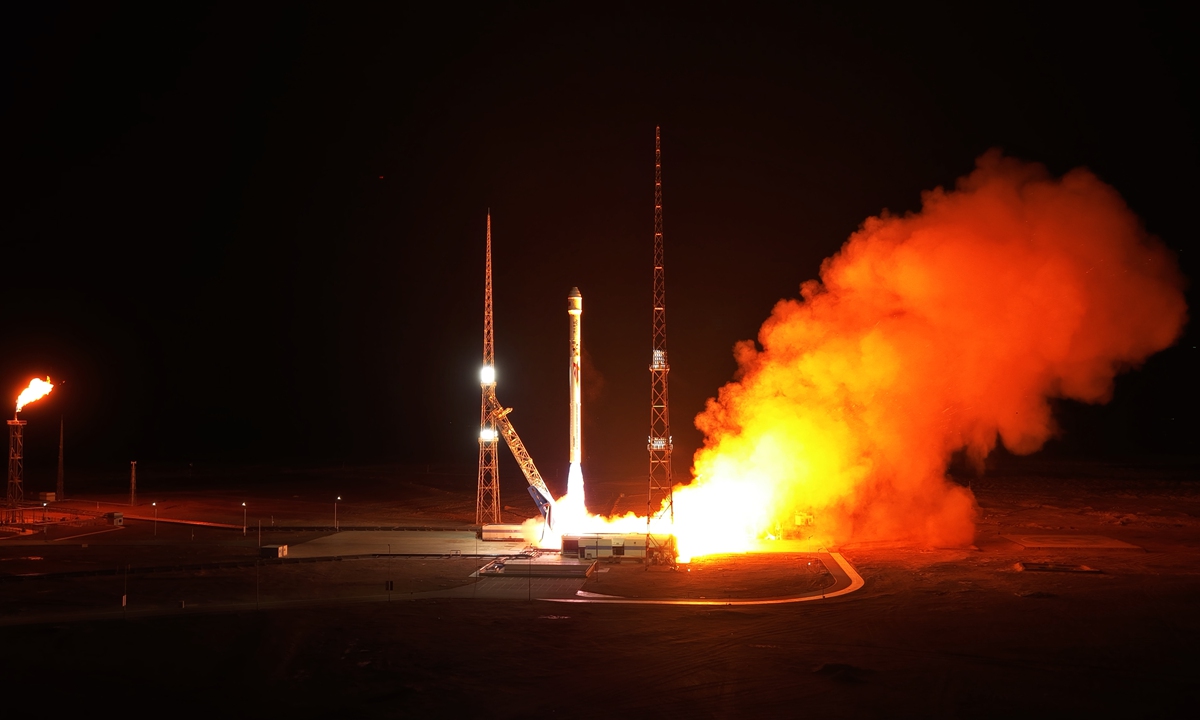
Photo: Courtesy of Landspace
China's plan to build a 2,800-satellite AI computing constellation in space took another step forward on Wednesday, as eight computing satellites were successfully launched into orbit to test technologies for AI model training, high-speed data transmission and advanced cooling technologies in space.
The satellites, developed by Chinese space AI company ADA Space, were among 10 spacecraft aboard a commercial Zhuque-2E Y4 carrier rocket from the Dongfeng commercial space innovation pilot zone in Northwest China at around 7:40 pm on Wednesday, mission insiders told the Global Times.
The launch marked the 10th flight of the Zhuque-2 rocket series, developed by Chinese commercial aerospace company LandSpace, and added to China's efforts to develop space-based computing infrastructure capable of supporting AI applications both in orbit and on Earth.
The eight satellites are from the first batch of the second group under ADA Space's "Star Compute" program, which envisions a constellation of 2,800 computing satellites, including 2,400 dedicated to AI inference and 400 to AI training.
The latest mission follows an earlier demonstration on how space-based computing could support applications on Earth. In April 2026, ADA Space announced that a system using AI models running aboard orbiting satellites to remotely control ground-based intelligent agents had passed 19 technical tests conducted by the China Academy of Information and Communications Technology.
Building on these earlier advances, the newly launched satellites will undertake a new round of in-orbit experiments, including training AI foundation models in space, high-speed laser communications and advanced cooling technologies. These experiments will explore key technologies needed to build a larger and more interconnected orbital computing network, ADA Space said in a statement sent to the Global Times on Wednesday.
Unlike conventional satellites that primarily collect data and transmit it back to Earth for processing, computing satellites are designed to perform complex calculations directly in orbit, potentially reducing dependence on ground-based data centers and enabling faster processing of space-generated information.
According to ADA Space, the newly launched satellites carry high-performance computing payloads, laser communication equipment and Earth observation instruments.
Among the most significant planned experiments is the training of AI foundation models directly in space, representing a further step beyond deploying previously trained AI models aboard satellites.
The satellites will also test a 10-kilowatt-class liquid cooling system and large deployable radiator panels. These technologies are essential for managing the substantial heat generated by high-performance computing equipment in the vacuum of space.
Unlike terrestrial data centers, which can use air circulation to dissipate heat, computing facilities in orbit must rely heavily on thermal radiation to release excess heat into space.
Another major focus is the development of an interconnected laser communication network, allowing satellites to exchange large volumes of data at high speeds and potentially enabling computing resources to be coordinated across multiple spacecraft.
The latest launch builds on China's earlier progress in developing space-based computing infrastructure.
In May 2025, ADA Space launched the first group of satellites under its "Star Compute" program. In November 2025, the company announced that it had successfully deployed the Qwen3 large language model aboard its orbiting computing satellites, demonstrating progress in operating general-purpose AI models in space.
These developments reflect a broader ambition to move beyond processing data collected in space and explore how orbital computing resources can also serve applications on Earth.
Under the company's roadmap, a network of approximately 1,000 satellites is expected to be deployed and enter commercial operation before 2030, with the full constellation targeted for completion before 2035.
In addition to the eight computing satellites, Wednesday's mission also carried two experimental laser communication satellites developed by Lanta Intelligent, which will test high-speed laser data transmission, integrated onboard processing and advanced solar power systems.
The company previously launched two experimental satellites in November 2024, which have since conducted laser communication and flexible solar array technology demonstrations.
Wednesday's mission came just 29 days after LandSpace's previous Zhuque-2E launch, reflecting efforts to increase launch frequency in China's commercial aerospace sector.
Ma Haijing, a LandSpace spokesperson, told the Global Times that the company has adopted parallel mission preparations, coordinated production schedules and standardized launch procedures to improve launch efficiency while maintaining strict quality control.
As China accelerates the development of satellite internet and space-based AI infrastructure, the ability to deploy multiple satellites efficiently is becoming increasingly important. The successful launch adds another eight computing satellites to China's expanding space-based AI infrastructure. Subsequent in-orbit testing will help assess progress toward putting a large-scale space computing network into practical use, ADA Space said.
RELATED ARTICLES