Chinese automakers accelerate European production plan, eye deeper local industry ties
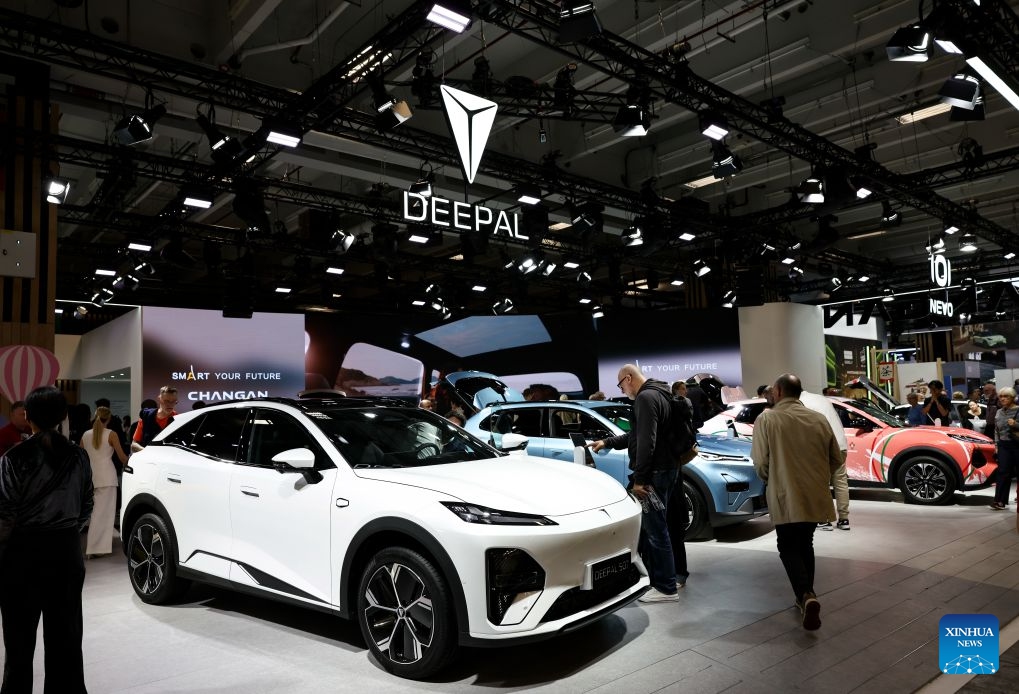
People visit the booth of Chinese automaker Changan during the 2026 Paris Motor Show in Paris, France, on Oct. 13, 2026. The 91st Paris Motor Show opened in the French capital on Monday, with a record number of Chinese automakers taking part to showcase their latest models and technologies. (Photo: Xinhua)
Chinese automakers are stepping up investment in European manufacturing and technology partnerships, moving beyond vehicle exports to establish a stronger local presence, a trend that builds on the latest China-EU trade consultation outcomes aimed at easing vehicle trade tensions, while helping Chinese carmakers strengthen their foothold in Europe and expand cooperation with local manufacturers and suppliers, analysts said.
The latest moves were highlighted at the 2026 Paris Motor Show, where BYD outlined plans to expand manufacturing in Europe and XPENG showcased its latest intelligent vehicle technologies, reflecting Chinese automakers' efforts to build a long-term presence in the European market.
BYD Executive Vice President Stella Li told French broadcaster BFM Business that the company was considering building a factory in France, Reuters reported on Monday. Mass production at BYD's Hungarian plant is expected to begin during the current quarter, and the company is exploring plans for additional factories in Europe, according to Reuters.
Chinese electric vehicle (EV) maker XPENG is also expanding its European manufacturing operations. According to a statement released on its official website on October 7, the company completed the first production trial of its G9L flagship sport utility vehicle at Magna's plant in Graz, Austria, making it the fourth XPENG model to be produced in Europe after the G6, G9 and P7+.
XPENG is also seeking to expand technology cooperation with global partners. According to a post on the company's official Weibo account on Tuesday, Chairperson and CEO He Xiaopeng introduced "XPENG AI ENGINEERING" at the Paris Automotive Summit, offering technological solutions covering vehicle research and development, manufacturing and after-sales services.
The localization drive is not limited to BYD and XPENG. Chinese automakers including Changan, Chery and GAC are also expanding their European production plans and industrial partnerships as the EU considers new local-content requirements, according to the companies.
The growing investment comes as China and the EU seek to manage automotive trade differences through dialogue. According to a joint statement released by China's Ministry of Commerce (MOFCOM) on October 9, the two sides held their second meeting under the China-EU trade and investment consultation mechanism in Beijing, agreeing to continue exploring the possibility of reducing tariffs on certain goods within the framework of World Trade Organization rules and work toward more stable and balanced bilateral economic ties.
In a statement published on its official WeChat account on Wednesday, BYD welcomed the consultation outcomes, saying that they had effectively managed trade differences and prevented an escalation of friction, while creating a stable, predictable and sustainable environment for China-EU hybrid vehicle trade.
Chery Automobile also welcomed the agreements, saying that the outcomes covering hybrid and electric vehicle (EV) trade would create a more stable, fair and predictable environment for deeper cooperation. The company said that the Chinese and European automotive industries are highly complementary, and that closer cooperation would benefit companies and consumers on both sides while supporting the stability of global vehicle supply chains.
Technology cooperation is also gaining ground. European carmakers including Stellantis and Volkswagen have been drawing on partnerships with Chinese manufacturers to advance EV development and improve engineering efficiency, Reuters reported on Tuesday, pointing to opportunities for cooperation alongside intensifying competition.
According to automotive market research firm Dataforce, registrations of Chinese vehicle brands stood at 97,639 in Europe in August, more than double the year-earlier level, lifting their market share to a record 11.7 percent from about 5.5 percent a year earlier.
Jian Junbo, director of the Center for China-Europe Relations at Fudan University's Institute of International Studies, told the Global Times on Wednesday that Chinese carmakers' expansion into European manufacturing marks a natural progression in their globalization, as years of international competition have strengthened their ability to operate overseas. "This is a shift from exporting vehicles to investing and producing locally, following a common path of international business expansion," Jian said.
The growing presence of Chinese vehicle makers could foster healthy competition in Europe's automotive market, encouraging local manufacturers and suppliers to accelerate innovation, Jian noted. Chinese investment could also create jobs and facilitate technology transfers, helping strengthen the competitiveness of Europe's car industry and related supply chains.
Jian said that the 16 outcomes reached during the latest China-EU trade consultations could help ease longstanding trade tensions by bringing disputes under more effective management and resolving some differences. Market stability and predictability are crucial to investor confidence, and the agreements could encourage further Chinese automotive investment in Europe and strengthen bilateral industrial cooperation, he said.
China and the EU held more than 30 rounds of intensive consultations on hybrid and EV trade, during which the Chinese negotiating team maintained an open attitude and kept up dialogue with the automotive industries on both sides, a source familiar with the talks told the Global Times on Tuesday.
The two sides reached an arrangement for upward adjustment based on the EU's 2025 imports of Chinese hybrid vehicles, with a fixed annual increase thereafter, ensuring room for Chinese automakers to maintain and steadily expand their exports, according to the MOFCOM on Monday.
The hybrid vehicle arrangement has drawn attention following foreign media reports suggesting that it could cut China's hybrid vehicle exports to the EU by more than half over the next four years compared with projected levels.
RELATED ARTICLES