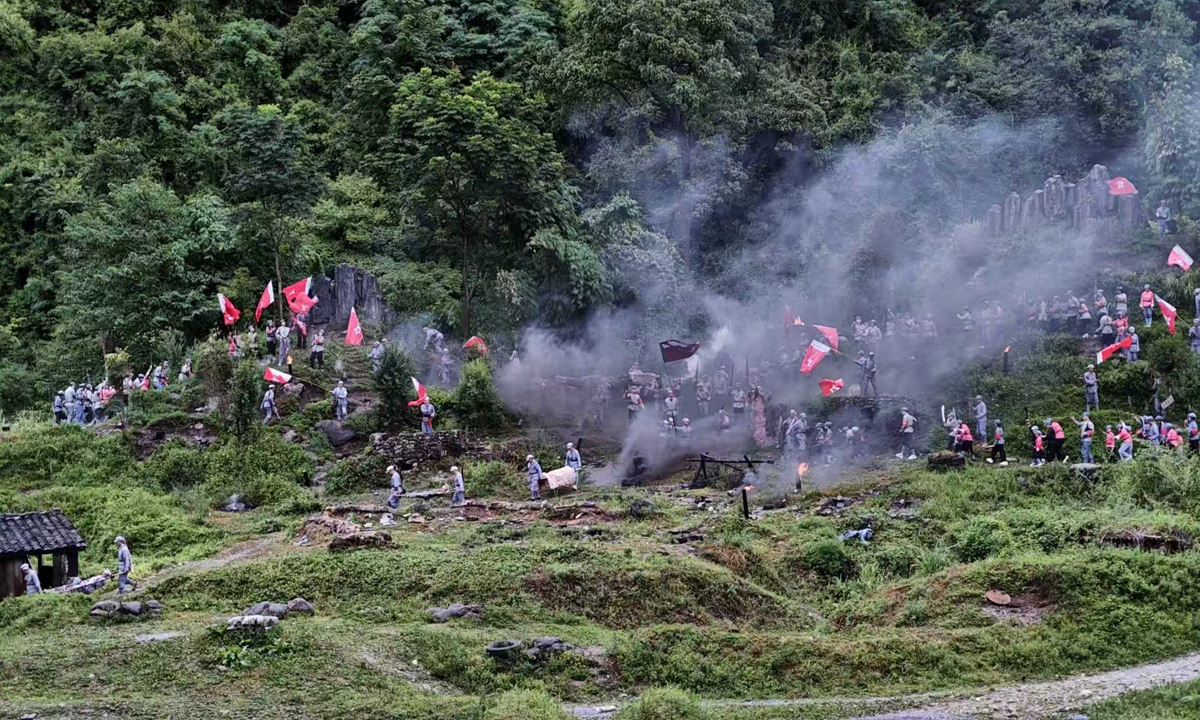
Actors and visitors perform in the immersive live-action production Victory at Loushan Pass at the foot of Loushan Pass in Huichuan District, Zunyi, Southwest China's Guizhou Province. Photos: VCG, Courtesy of Huichuan District Culture and Tourism Bureau
A group of American anti-war activists has recently come to China to walk the Long March route. The US anti-war organization CODEPINK announced that it has officially launched a 12-day trip to China this month, passing through Shanghai, Chongqing, Zunyi, Loushanguan, Maotai, and Guiyang. The group said they want both to visit sites related to China's revolutionary history, including red memorials and history museums, and to see firsthand China's high-tech infrastructure, contemporary development achievements, and the rural revitalization.
Why were a group of poorly equipped people, who found themselves in desperate situations several times, ultimately able to break out of encirclement and thereby profoundly change China's destiny? Not only Chinese people have been continuing to seek the answer; this question is attracting more and more foreigners. In the middle of this year, British travel YouTuber Mike Okay, who has over a million followers, and his American friend Conner came to Zunyi to take part in an immersive on-site experience of the "Loushan Pass victory." After they posted a video of themselves changing into Red Army uniforms, it quickly sparked heated discussion, with many overseas netizens leaving comments asking how they could go and experience it themselves. Loushanguan's popularity is not an isolated case. In 2025, the Memorial of the First National Congress of the Communist Party of China received nearly 100,000 visitors from outside the Chinese mainland, a record high. Special survey data released in May this year showed that American tourists accounted for 11.17 percent of all overseas visitors, ranking first among all countries. Among them, young people aged 15 to 34 made up 59.12 percent, visitors with a bachelor's degree or higher accounted for 74.76 percent, and more than 60 percent were visiting China for the first time.
This year marks the 90th anniversary of the victory of the Long March. Foreign friends such as members of CODEPINK, Mike and Conner choosing to visit China at this moment to learn about and experience the Long March up close cannot be called a coincidence. The Long March is widely recognized as a great feat in human history and has left an indelible mark on both world military history and the history of the human spirit. For foreigners who want to understand the code behind China's development, the Long March is a key.
What enabled a country to complete in a few decades the industrialization process that took other countries more than a century, and to lift hundreds of millions of people completely out of absolute poverty? It was precisely the spirit of "the Red Army fears not the trials of the Long March," and the resilience of refusing to stop even when climbing snow-capped mountains and crossing wetlands. Some African scholars have pointed out that the core keyword behind the attractiveness of China's development model to many developing countries is "stability," and behind this long-term stability lies the high degree of identification with and sustained commitment to common goals by the entire people. This spirit of "once the direction is set, take one step at a time" is precisely one of the most profound spiritual legacies that the Long March has left to contemporary China.
Foreign friends who come to China to "walk the Long March route" are welcome. Ninety years ago, the Red Army measured more than half of China with their feet and spread the sparks of revolution to the most remote corners. Ninety years later, more and more people from all over the world are following this "red ribbon of the earth" to explore "why China can succeed." And the answer to this question lies on the Long March route.
RELATED ARTICLES