Philippine military backs suspension of direct communication with China, raising risks of miscalculation, escalation: expert
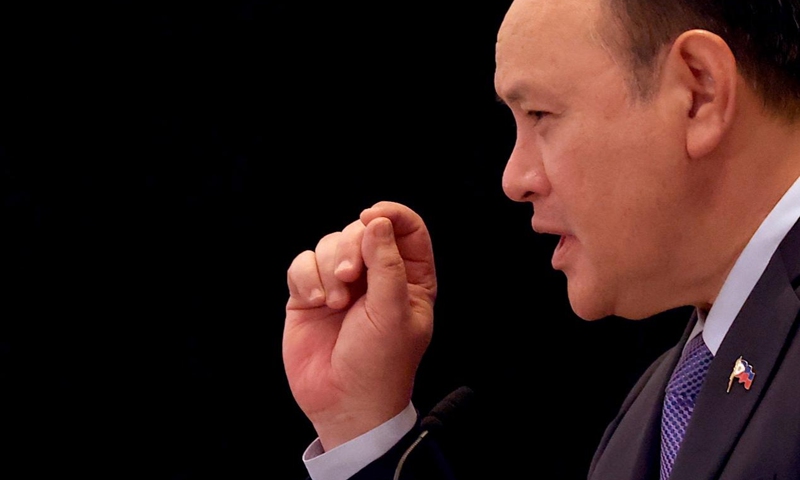
Defense Secretary of the Philippines Gilbert Teodoro Jr. File photo: VCG
The Philippine military has thrown its support behind Defense Secretary Gilberto Teodoro Jr.'s suspension of direct military-to-military communication channels with China, as the Chinese Embassy in Manila warned that shutting down such contact fuels mistrust and narrows the space for crisis management amid continuing tensions in the South China Sea. The Armed Forces of the Philippines (AFP) claimed Tuesday that it "stands solidly behind and firmly supports" Teodoro's move, according to a report from the Philippine News Agency on Tuesday.
A Chinese expert noted that the suspension of military-to-military communications between China and the Philippines would further undermine dialogue and mutual trust, while increasing the risk of misjudging each other's intentions. In the context of frequent maritime encounters, such miscalculations could severely weaken crisis management, raise the likelihood of sudden or unintended incidents, and expose frontline personnel on both sides to greater risks if tensions escalate unexpectedly because of less available communication channels.
The AFP spokesperson, retired Rear Admiral Roy Vincent Trinidad, claimed communication mechanisms could only work when based on what he described as mutual trust, sincerity and support for international law. He claimed bilateral dialogue had failed because "the messages" did not match "the actions on sea, air and ground," and accused China of using direct communication as a "smokescreen," a report in the Philippine Star said on Wednesday.
Trinidad also claimed that the AFP will continue to perform its sea patrol and "will keep performing rotation and resupply missions," according to the Philippine Star report.
The Chinese Embassy in the Philippines, responding to the suspension, said "communication channels should remain open to avoid miscalculation and prevent tensions from escalating." The Embassy criticized Teodoro for shutting down military-to-military communication for "political self interests," warning that the move "fuels mistrust, narrows the space for crisis management, and pushes frontline personnel closer to confrontation," according to the Embassy's Facebook account.
The current dispute indicates that the suspension did not begin this week. Coverage from Philippine-based media outlet the Daily Tribune said that Teodoro claimed on Tuesday that military-to-military communication with China had been suspended for nearly three years. In a May 2024 statement posted by the Philippine Department of National Defense, Teodoro said he had disallowed contact between the department and the Chinese Embassy since a courtesy call by then Chinese Ambassador Huang Xilian shortly after Teodoro took office in July 2023.
Although China and the Philippines maintain other communication channels, they cannot fully replace direct military-to-military contact. Diplomatic channels are mainly used for broader policy and strategic coordination, while coast guard communication focuses more on specific maritime law enforcement. Military exchanges, by contrast, deal with more specialized and sensitive issues involving defense policy, military strategy and security concerns, Chen Xiangmiao, a research fellow at the National Institute for South China Sea Studies, told the Global Times on Wednesday.
Chen noted that military communication serves as an important "backstop" for bilateral relations. Even when serious differences exist in the South China Sea, direct military contact can help clarify strategic intentions and security red lines, preventing specific maritime incidents from escalating into broader military confrontations.
Given that the Philippine military also plays a role in planning and directing some maritime operations, restoring effective military-to-military communication remains important if Manila genuinely wants to manage disputes and reduce risks, Chen said.
The latest military position comes as the Marcos administration stresses that the president intends to maintain engagement with Beijing. Palace communications undersecretary Claire Castro said that Manila would continue engaging with China, particularly in trade and investment, a report from News Watch Plus Philippines on Tuesday shows.
Just days earlier, Marcos said his "greatest fear" was that a mistake by a seaman or soldier could develop into "something that goes out of control," while stressing the importance of managing problems and preventing misunderstandings in the South China Sea.
The expert pointed out that the Philippine government's position appears to be internally inconsistent: while the presidential palace stresses dialogue and maintaining normal engagement with China, the defense establishment supports suspending direct military communication. Cutting such a channel would not make the Philippines safer, but would further weaken trust, increase the risk of miscalculation and ultimately impose greater security and political costs on Manila.
Chen said this reflects a "double-track" approach: Manila portrays itself as willing to communicate and maintain overall bilateral stability, while continuing actions in the South China Sea that undermine existing understandings and create new friction. If the Philippines genuinely wants to manage risks, it should stop provocative actions, return to dialogue and restore effective crisis-management channels, including military-to-military communication.
RELATED ARTICLES