India’s ‘victory narrative’ will only hit a wall on China-India border: Global Times editorial
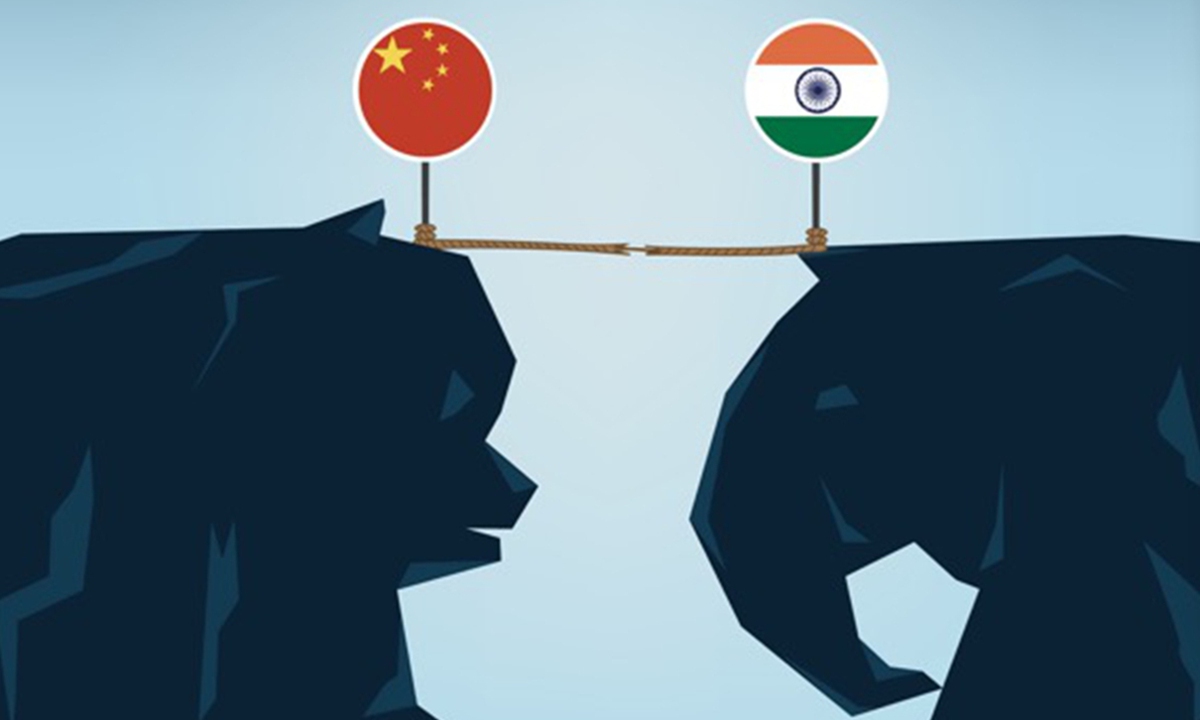
China, India Illustration: GT
By changing a few place names, creating some media hype, it projects a tough stance and creates the illusion that its territorial claims have been realized on the ground. Such petty scheming is, at its core, nothing more than psychological victory in the absence of real gains - a manifestation of the self-deluding "victory narrative" embraced by some in India, now projected onto the China-India boundary issue.
Some people in India are once again playing games with maps over the China-India border issue. Recently, India's Ministry of Home Affairs announced what it called the "standard names" for 28 locations in the so-called "Union Territory of Ladakh" and marked them on official Indian maps. Some of these locations lie in areas on the western sector of the China-India border that are under China's actual control. Including the 27 locations in China's Zangnan, Southwest China's Xizang Autonomous Region, that India illegally renamed unilaterally in August this year, India has forcibly slapped an "Indian label" on 55 locations along the China-India border in just two months.
This tactic is nothing new. First comes an administrative announcement, followed by the names being entered on official maps, and then repeated amplification through the media. The intent is not hard to discern: India hopes that, at minimal cost, it can gradually shape perceptions of the boundary issue among its own public and the international community, dressing up its unilateral claims as so-called "established facts." By changing a few place names, creating some media hype, it can project a tough stance and create the illusion that its territorial claims have been realized on the ground. Such petty scheming is, at its core, nothing more than psychological victory in the absence of real gains - a manifestation of the self-deluding "victory narrative" embraced by some in India, now projected onto the China-India boundary issue.
Naming a place cannot directly create territorial sovereignty, and a map is no final ruling on territorial sovereignty. In 2019, India unilaterally amended its domestic laws, revoked relevant constitutional provisions, and announced the creation of the so-called "Union Territory of Ladakh," deliberately incorporating Chinese territory in the western sector of the China-India border into its own administrative jurisdiction. China made its opposition clear at the time, and its position has remained firm and consistent ever since. If a country could simply pass a law unilaterally declaring its neighbor's territory to be its own, there would be no need for countries around the world to negotiate their border disputes. They could settle everything from behind a desk by redrawing maps, issuing notices, and stamping official documents. So, India's actions are unacceptable and have no legal effect.
The status quo along the Ladakh sector of the boundary is not a blank sheet of paper that can be altered at will. The western sector of the China-India border has historically belonged to China, and China possesses sovereignty over the relevant areas, including Aksai Chin region in Northwest China's Xinjiang Uygur Autonomous Region, and has ample historical and legal grounds for its claims. India's claims stem from illegal boundary demarcations inherited from the colonial era, which successive Chinese governments have never recognized. This is precisely why India's place-naming move, designed purely to assert sovereignty and expand its claims on maps, is fundamentally different from China's lawful standardization of place names in Zangnan. Chinese territory will not become Indian simply because India assigns it a name. Such wishful thinking does nothing to help resolve the China-India boundary issue properly.
The boundary issue has a bearing on the overall relationship between the two countries, and New Delhi also frequently speaks of the situation on border areas. When Prime Minister Narendra Modi met with Chinese leader in September this year, he called on the two countries to jointly safeguard peace and tranquility in the border areas. Earlier, India's ambassador to China, Vikram Doraiswami, wrote in the Global Times that peace and tranquility along the China-India border would help promote partnership and cooperation between the two sides. If that is indeed the case, India should exercise greater restraint on issues of this kind rather than provoke tensions. Some Indian politicians are now keen to stage political shows over the border issue to divert attention from domestic problems and pander to nationalist sentiment. Such behavior will only erode mutual trust between the two, do nothing to resolve the dispute, and create fresh obstacles to the improving China-India relationship. Ultimately, the negative consequences will also be borne by India itself.
For years, China and India have maintained communication through channels such as meetings between their special representatives on the boundary question, making sustained efforts to manage differences and advance negotiations.
The hard-won peace and tranquility in border areas deserve to be jointly safeguarded. China and India are important neighbors, major developing countries, and representatives of emerging economies. Their relationship extends beyond the bilateral sphere and carries global and strategic significance. Greater cooperation between the two countries within multilateral frameworks, including the United Nations, BRICS, the Shanghai Cooperation Organisation, and the G20, is vital to addressing global challenges and upholding international fairness and justice. India should work with China in the same direction and approach bilateral relations with a strategic vision and a long-term perspective, using the political wisdom of mutual respect and understanding to overcome disturbances.
China's commitment to improving and developing relations with India remains unchanged. We urge India to act in the broader interests of bilateral relations, exercise prudence in both words and actions on the boundary issue, and follow the important understandings reached by the two countries' leaders. India should strictly honor the relevant agreements between the two sides and take concrete steps to create a favorable environment for improving and developing bilateral relations, rather than take actions that further complicate the boundary issue. No unilateral move to alter the status quo can shake China's firm resolve to safeguard its sovereignty and territorial integrity, nor can it change the objective facts long established by history and the realities on the ground.
RELATED ARTICLES