SCI-TECH / DISCOVERY
Jurassic bird discovery by Chinese scientists challenges classic avian evolution view
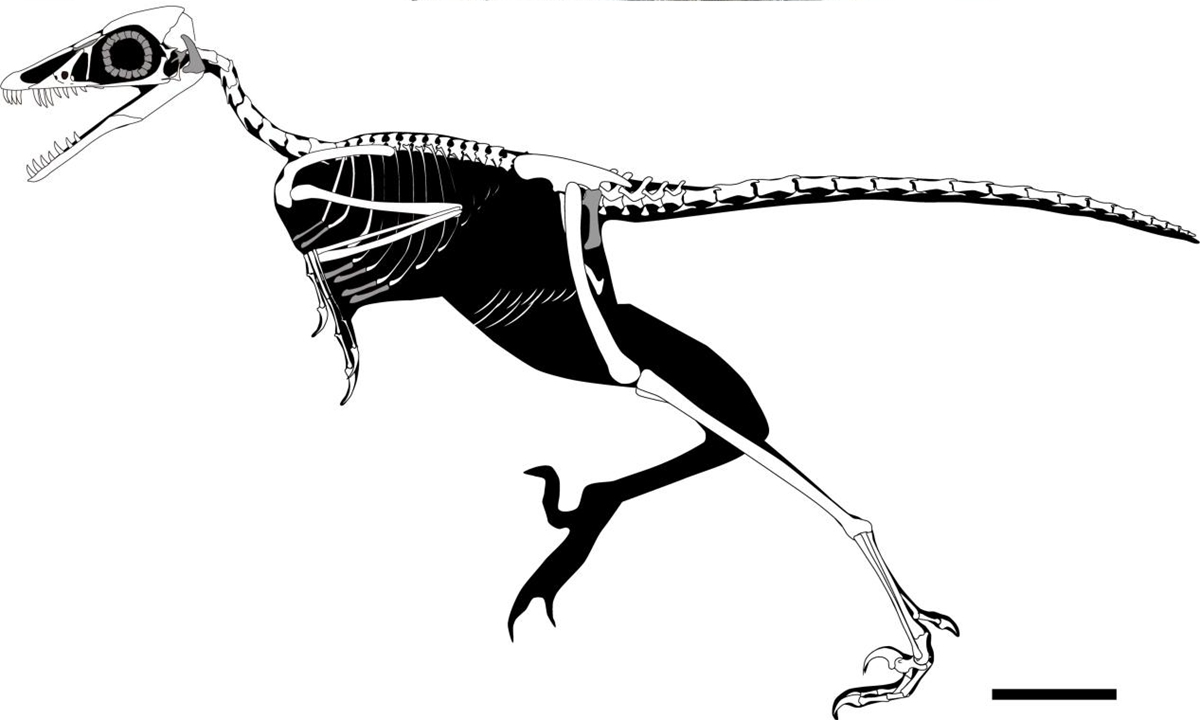
A skeletal reconstruction of Yangyuanornis Photo: Courtesy of Wang Min
Chinese researchers have identified a new Jurassic bird fossil - a discovery that challenges the conventional notion that the origin and early evolution of birds were primarily driven by adaptations for flight, according to a report released by the Institute of Vertebrate Paleontology and Paleoanthropology (IVPP) of the Chinese Academy of Sciences on Wednesday.
The new findings confirmed that ecological specialization for ground-dwelling and flightlessness had already emerged in the earliest stages of bird evolution. The new species also exhibits a striking combination of dinosaur-like and bird-like morphological features, researchers said.
The research results, conducted by a team led by researcher Wang Min at the IVPP in collaboration with the Institute of Geological Sciences in East China's Fujian Province, were published on Nature on Wednesday.
The discovery fills a critical gap in the temporal and evolutionary record of birds. As the earliest known flightless bird, it challenges the hypothesis of a unidirectional evolutionary trajectory toward flight, demonstrating that the evolution of the avian body plan did not follow a single, linear path toward improved flight capabilities, but instead involved a complex process of rapid ecological exploration, Wang said.
The new bird was named Yuezhuornis yangyuanensis, after Yangyuan township in Fujian, where the fossil was discovered. The second part of the name is derived from a mythical bird in ancient Chinese legends. It lived during the Late Jurassic period (150 million-148 million years ago), according to the report.
Researchers found that the new species fell outside the groups of tree-dwelling, aquatic and wading birds, instead clustering within the overlapping region of modern ground-dwelling birds and flightless birds. Combined with features such as a relatively wide angle between the clavicles and a trapezoidal coracoid, the findings indicate that it was a flightless, carnivorous bird adapted for running on land, the report said.
The transition from terrestrial dinosaurs to flying birds is one of the most remarkable events in the history of life. Macroevolutionary models suggest that birds originated and underwent their early diversification during the Jurassic. However, the fossil record of birds from this pivotal geological period remains extremely sparse, leaving scientists without clear fossil evidence of how the characteristic avian body plan emerged, the report said.
For decades, a prevailing view has been that selection pressures associated with flight was the dominant force driving morphological evolution in early birds. Yet gaps in the fossil record at critical phylogenetic and chronological junctures have limited scientists' understanding of the evolutionary pathways and ecological diversity of birds in the earliest stages of their history, said the report.
RELATED ARTICLES