ARTS / CULTURE & LEISURE
China-Tunisia archaeological project advances understanding of North African history
Exporting tech, not historical views
By Published: Oct 15, 2026 08:53 PM

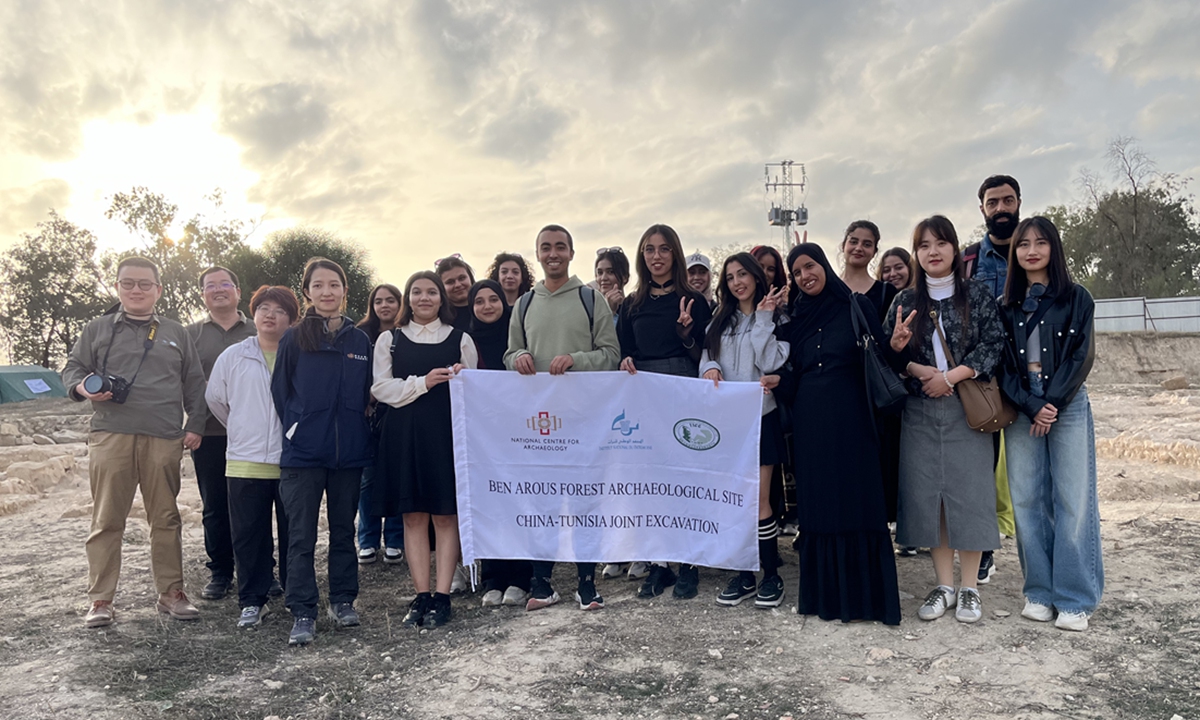
A group photo of the joint archaeological team between China and Tunisia Photo: Courtesy of China's National Cultural Heritage Administration
China and Tunisia are taking their archaeological cooperation deeper, combining Chinese fieldwork methods and digital technologies with a commitment to letting Tunisian research fellows shape the interpretation of their own past. The archaeological team working at the Ben Arous Forest site said the joint project offers a case study in how technical expertise can cross borders while building trust between partners.Accidentally discovered during construction of a Chinese-supported youth sports center in 2019, the Ben Arous Forest site contains remains spanning the third century BC to the seventh century AD that bear traces of Punic, Roman and later civilizations. In 2023, archaeologists from China's Archaeological Research Centre under the National Cultural Heritage Administration (NCHA) and Tunisia's National Heritage Institute along with several other institutions launched a four-year program to excavate, conserve and document the site.
"It is the first time Chinese archaeology has gone this deep into Punic-Roman sites around the Mediterranean, and the first systematic archaeological cooperation between Chinese and Tunisian heritage institutions," the project's Chinese leader, Yu Fei, also a deputy research fellow at NCHA, told the Global Times.
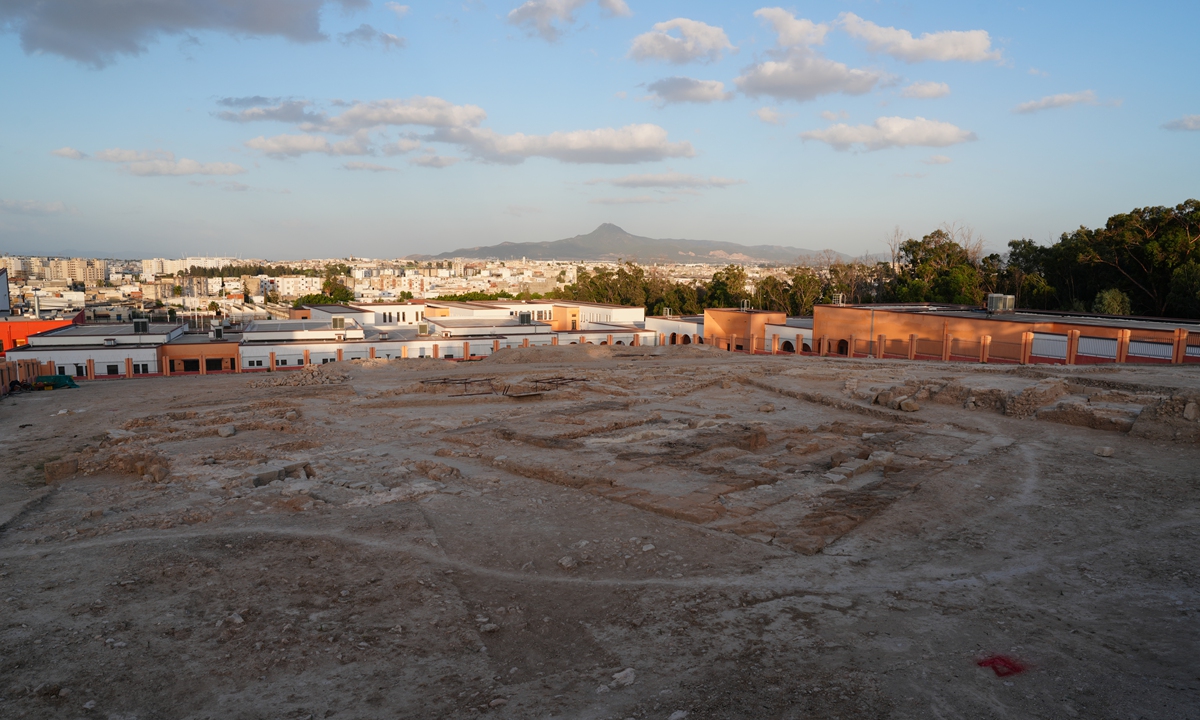
The?Ben Arous Forest site in Tunisia Photo: Courtesy of China's National Cultural Heritage Administration
A shared standard
For the Chinese team, working in Tunisia meant starting from scratch. With little previous archaeological fieldwork experience in the country and substantial differences between the two sides' working methods, establishing consistent procedures was an early priority.
Rather than transplanting Chinese practices wholesale, the team developed a framework adapted to local conditions. It drew up fieldwork standards covering excavation grids, stratigraphic divisions, artifact collection and documentation, while introducing a bilingual Chinese-English site database and standardized working templates in Chinese, English and French.
A digital recording tool enabled excavation logs, artifact inventories and stratigraphic information to be submitted and reviewed online, allowing team members working in different languages to follow the same procedures.
"Every day's excavation records are synced online. Chinese and Tunisian team members each enter their work in their own language, and the system cross-checks automatically: who did what, what came out, how it was recorded, all clear at a glance," said Wang Xiaodan, a Chinese team member. "That was hard to imagine in past joint digs."
The results have been substantial. The team has surveyed 130,000 square meters around the site and excavated 1,700 square meters, identifying four principal functional areas: a temple and ritual zone, residential quarters, public baths and craft workshops.
Building components, pottery, glassware and animal and plant remains have also been recovered, creating a body of evidence for studying urban life in the Punic and Roman eras in North Africa.
Amina Ferjani Ben Slimene, a staff member at Tunisia's National Heritage Institute, told the Global Times that the database, non-destructive testing equipment and three-dimensional reconstruction methods introduced through the project have enabled her colleagues to gain a more comprehensive understanding of modern archaeological practice.
Not prescribing history
For the Chinese team, they have been very aware of how to ensure that technical cooperation did not become an exercise in exporting historical interpretations.
The Ben Arous Forest site encompasses the Punic world associated with Carthage and the subsequent Roman era. Yu noted that archaeological narratives developed during Tunisia's colonial period placed Roman civilization at the center, leaving the independent significance of Carthaginian civilization comparatively marginal.
The joint project has taken a different approach. The Chinese side has concentrated on fieldwork standards, digital documentation, scientific analysis and conservation techniques, while leaving Tunisian researchers to shape their own perspectives on the country's history. Yu described this as an approach of "exporting technology, not historical viewpoints."
That distinction matters. Yu explained that archaeology is not only about recovering objects; it is also about deciding which questions to ask, how evidence should be interpreted and whose understanding of the past is represented. By contributing tools and methods without seeking to dictate the historical framework, the Chinese team has helped create space for collaboration on terms that respect Tunisia's own scholarly priorities.
The partnership has also invested in people. Chinese specialists have provided hands-on training at the excavation site, while Tunisian heritage professionals have been invited to China to study archaeological research, conservation and public engagement.
"What impressed me most was the way China has turned large archaeological sites into public cultural spaces, allowing ordinary people to understand and experience history," Nizar Ben Slimene, a staff member at Tunisia's National Heritage Institute, told the Global Times. He said the approach offered fresh ideas for heritage protection in Tunisia.
The four-year project is now providing a foundation for a broader phase of cooperation. From 2026 to 2028, the two countries are due to undertake joint archaeological work at the Punic port site at Carthage, extending the partnership from an inland settlement to a major maritime heritage site and adding underwater archaeology and the history of seaborne trade.
Plans also include a joint research center on ancient Tunisian civilization, an archaeological science laboratory and continued training for local specialists.
Looking ahead, Yu said, China and Tunisia will continue to deepen their archaeological cooperation across the Mediterranean.
"Along the ancient Silk Road, the partnership will seek to put equality, mutual learning, dialogue and inclusiveness into practice, demonstrating how the study of the past can help build a more open and respectful engagement between civilizations," he added.
RELATED ARTICLES