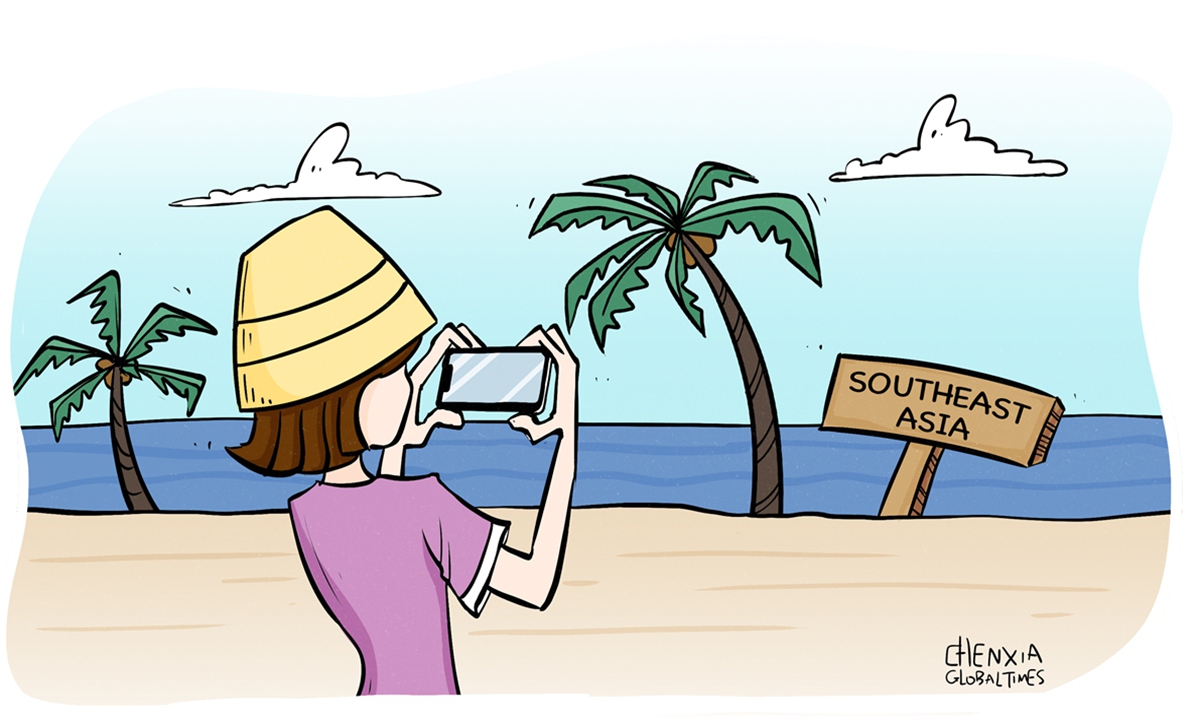
Southeast Asia Illustration: Chen Xia/Global Times
Recently, two employees of a hospital in East China's Zhejiang Province tragically drowned in a hotel swimming pool in Thailand. The incident quickly gained traction online, giving rise to some sensational rumors. According to an official statement released on October 15, online claims that the two had been murdered and their organs removed were false.
This heartbreaking accident serves as another reminder that people must never take their personal safety or the security of their property lightly when traveling abroad. However, some self-media accounts have exploited the tragedy by fabricating false information to attract online traffic. Such behavior not only inflicts further pain on the deceased and their families but also disrupts the online public discourse.
The emergence of such groundless rumors is not an isolated occurrence. For some time, the internet has been awash with reports and rumors about crimes targeting Chinese nationals in Southeast Asian countries. Some are based on actual incidents, while others, such as claims that "Chinese university students are being openly priced at between 200,000 yuan and 700,000 yuan in Southeast Asia," are rumors that can neither be verified nor definitively disproved.
Amid this wave of speculation, some voices have begun pushing the narrative that "Southeast Asia is the one place you should never visit," directly targeting people-to-people exchanges between China and these countries. This is a worrying trend that deserves attention.
It is absolutely necessary to remain vigilant against telecom fraud and other criminal activities. During the National Day holidays, China Central Television (CCTV) aired a documentary titled The Demise of Telecom Fraud in Northern Myanmar, exposing numerous shocking details of these criminal operations. As fraudsters constantly change and upgrade their tactics, it is both necessary and responsible to remind the public to beware of fraudulent high-paying job offers, stay alert to the risks of involvement in overseas scams, and ensure that anti-fraud information reaches every corner of society. This is also what the Chinese government has consistently been working to achieve.
However, "remaining vigilant against crime" and "demonizing an entire region" are two very different things. Travel safety risk ratings issued under China's Ministry of Foreign Affairs through the China Consular Service website and the China Consular Affairs app show that the vast majority of tourist destinations in Southeast Asia fall into the blue category, indicating low risk. It must be emphasized that every ordinary citizen has the legitimate right to choose where to travel or work abroad. But spreading rumors and demonizing a particular region in public discourse should never be encouraged under any circumstances. China itself has been a victim of rumor-mongering, smear campaigns and demonization by Western public opinion. We should consciously reject such practices rather than turn around and subject others to the same treatment.
People-to-people exchanges have always been an important cornerstone of China's relations with its neighbors. In 2025, tourist visits between China and ASEAN countries exceeded 45 million, while the overall volume of cross-border travel was even greater. Visits to relatives and friends, as well as tourism, help bring countless families together and sustain the livelihoods of countless businesses. If the fear-driven narrative of "never go to Southeast Asia" is allowed to dominate public opinion, the longstanding foundation of friendship between the Chinese people and those of neighboring countries will inevitably suffer over time.
There is no contradiction between remaining vigilant against criminal activities and maintaining an open attitude toward a region. We hope that every Chinese citizen who travels abroad returns home safely. We also hope that discussions of safety issues on the internet will be guided by greater rigor and restraint, rather than sensationalism and speculation.
RELATED ARTICLES