Philippines’ hype of Chinese ambassador’s remarks is an upgrade of undermining bilateral relations: expert
By Published: Oct 16, 2026 03:30 PM

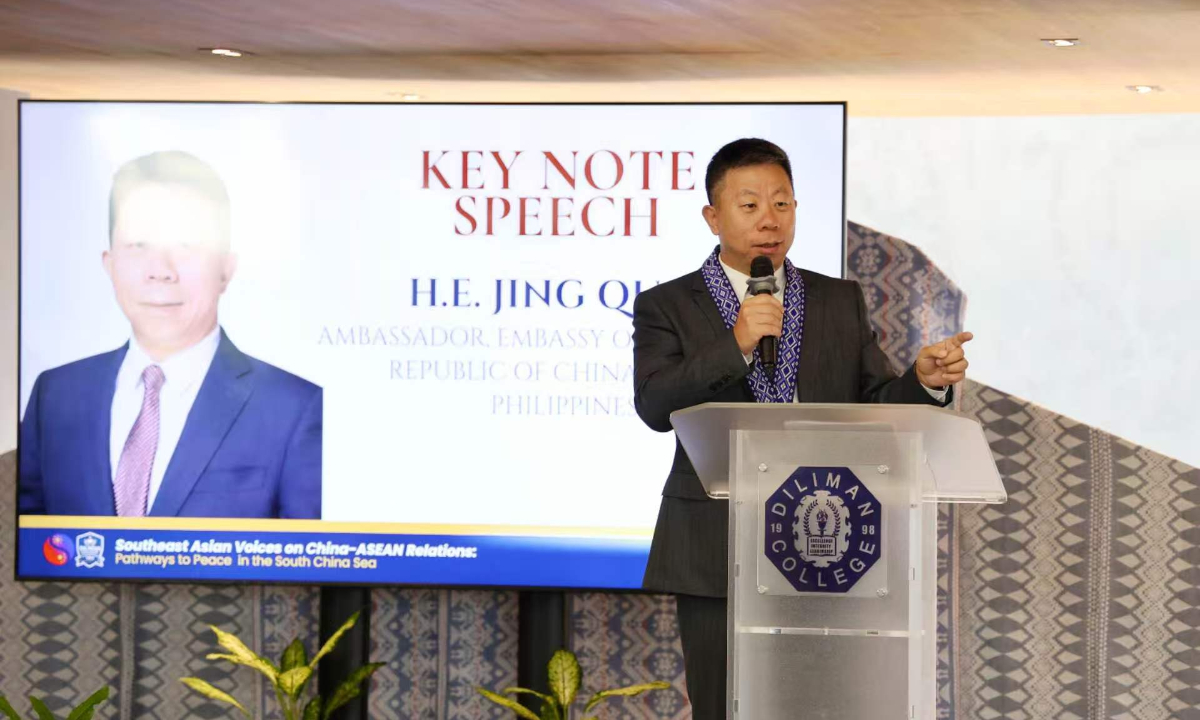
Chinese Ambassador to the Philippines Jing Quan delivers a keynote speech at the second Diliman Dialogues in Quezon city, the Philippines on October 15, 2026. Photo: website of the Chinese Embassy in the Philippines
The Chinese Embassy in Manila on Friday refuted the "selective quotation and overinterpretation" of the Chinese envoy's recent remarks by the Philippine Department of Foreign Affairs (DFA), and has urged the DFA to play a more responsible role in preventing actions that undermine normal exchanges and cooperation between the two countries, the Chinese Embassy in Manila said in a statement.
The statement was issued in response to a statement by the Philippine DFA a day earlier, which accused Chinese Ambassador Jing Quan of having "a poor choice of words" which seem to convey a "thinly veiled threat of the use of force" when answering questions from a group of Philippine reporters.
When attending the second Diliman Dialogues organized by the Philippines-China Studies Center of Diliman College in the Philippines' Quezon city on Thursday, Ambassador Jing told reporters on the sidelines of the event, "If we want to use force, we may easily win. No, we will not choose to use force. And we love peace. In this region, we share, we enjoy the peace."
Rejecting the "troublemaker" tag for China, Jing said the Philippines "should feel fortunate" to have a neighbor like China in the region.
"It is regrettable that the Department of Foreign Affairs has issued such a statement. This kind of selective quotation and overinterpretation demonstrates that there is still a long way to go in fostering effective communication and dialogue between China and the Philippines," the statement released by the Chinese Embassy in Manila read.
"Diplomacy must be honest and straightforward in order to reduce misunderstandings and prevent misjudgments," it said.
"Ultimately, the fundamental purpose of diplomacy is to resolve differences and disputes and to avoid conflict or even war," it added.
Ambassador Jing's remarks have been selectively chosen and hyped by both politicians and the media of the Philippine side.
Philippine Defense Secretary Gilberto Teodoro Jr. on Friday backed the DFA assessment of Ambassador Jing's words, claiming his statement about the use of force was a threat meant to intimidate the Philippines.
Jay Tarriela, a spokesperson for the Philippine Coast Guard, resorted to crude language on social media, launching an attack on Ambassador Jing and labeling his remarks "coercion."
According to Philippine media report, Philippine President Ferdinand Marcos Jr claimed the Jing's remarks "sound very much like a threat."
Yang Xiao, a research fellow at the Institute for Peace and Development of the Chinese Academy of Social Sciences, told the Global Times on Friday that the words from Ambassador Jing should by no means be characterized as a "threat."
"It is common in the international community that we compare the strength between a major power and a relatively small country, and the gap in strengths is an objective analysis. This has nothing to do with military threats," said Yang.
In his keynote speech at the dialogue, Ambassador Jing called on the Philippine side to avoid letting maritime disputes dictate or define the trajectory of bilateral relations. When differences arise, the two sides should sit down to talk and find ways to effectively manage them, the ambassador said.
The ambassador also acknowledged the complexity of Beijing-Manila relations, saying they could not simply be described as good or bad. He urged both sides to separate areas of disagreement from other aspects of their relationship and encouraged more exchanges.
Yang told the Global Times that it is clear the ambassador's remarks serve to stabilize China-Philippine relations, and his wording, hyped by some Philippine forces, actually aims to deter any actions that seek to jeopardize bilateral relations.
Yang said the latest spat over Ambassador Jing's remarks shows how easily these forces in the Philippines could jeopardize the relationship, and their manipulation of the remarks of the Chinese envoy is an upgrade of undermining the relations by the Philippine side.
