Global People Annual Gala forum explores new opportunities in sodium-ion batteries
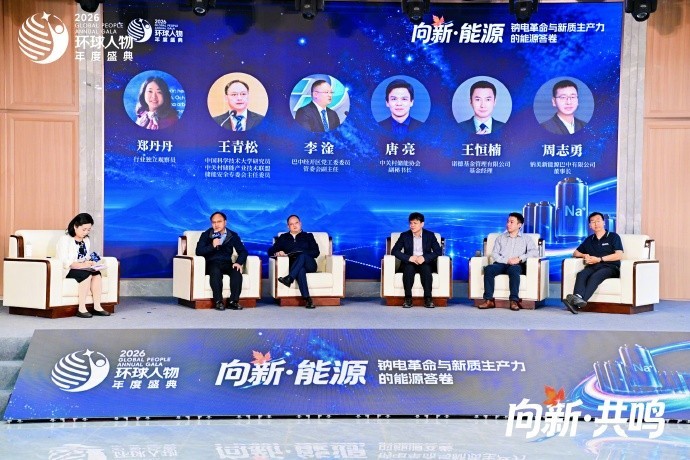
A forum on sodium-ion batteries brought researchers and industry representatives together in Bazhong, Southwest China’s Sichuan Province, on October 16 to discuss new opportunities and ways to support the industry’s growth.
The forum was held ahead of that evening’s annual gala of Global People, a magazine published under the People’s Daily. Discussions focused on the sodium-ion battery industry’s role in developing new quality productive forces.
Wang Qingsong, a researcher at the University of Science and Technology of China and chair of the China Energy Storage Alliance’s energy storage safety committee, outlined the advantages of sodium-ion batteries during the opening keynote address, noting sodium is abundant and readily available, battery materials cost less, and that the batteries can operate across a wide temperature range, including at minus 40 degrees Celsius. His team is providing technical support for the design and improvement of safety measures for sodium-ion batteries, he said.
During a panel discussion, Tang Liang, deputy secretary-general of the China Energy Storage Alliance, called for common benchmarks to assess sodium-ion batteries’ low-temperature performance, rate capability and cycle life.
“By maintaining safety standards and using consistent testing criteria, downstream companies can better understand product characteristics and identify suitable applications,” Tang said.
Wang Hengnan, a manager at Nuode Asset Management, said developing industrial clusters is essential for the industry to establish a lasting presence in a locality. Local governments need supportive, consistent industrial policies to foster clusters and economies of scale, helping businesses to take root, Wang said.
Zhou Zhiyong, chairman of Namey, a Chinese sodium-ion battery developer and manufacturer, said the industry’s central challenge is making the economics work. The overall cost of sodium-ion batteries remains relatively high, and there is limited room to cut costs through materials alone, he said.
The industry needs to expand practical applications so that demand for deployment at scale drives cost reductions and efficiency gains throughout the supply chain, Zhou said. This would create a positive cycle in which applications, production capacity and costs reinforce one another, supporting steady growth and ultimately winning acceptance in the end market.
Global Times
RELATED ARTICLES