Paraguay tech minister’s response to China’s countermeasures a deliberate attempt to shift responsibility
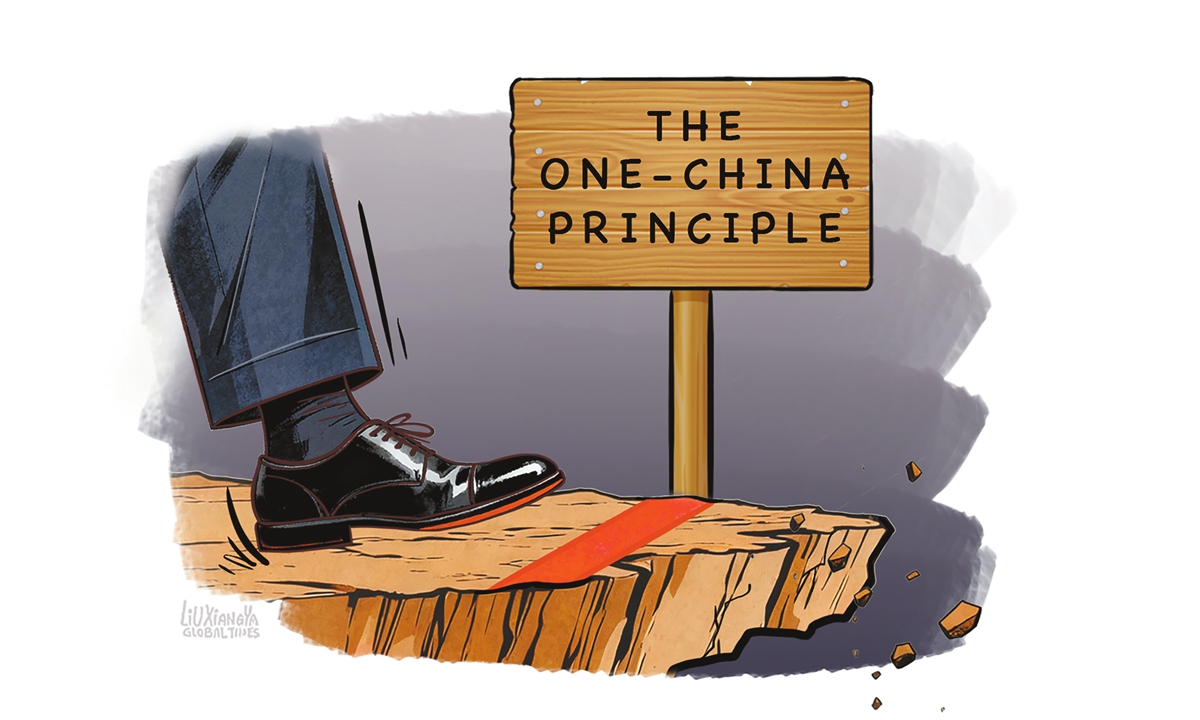
Illustration: Liu Xiangya/GT
Days after China announced countermeasures against Paraguay's Minister of Information and Communication Technologies Gustavo Emigdio Villate Samaniego over his wrong moves on the Taiwan question, he wrote lengthy posts on social media, which Chinese experts describe as an attempt to shift responsibility by framing the move over his own misconduct as targeting the entire country.
In a post on his X account, Villate called the countermeasures “a certification that what we have been doing since 2023 is the correct path.” He also declared that Paraguay's relationship with the Taiwan region would "never be on the table as a bargaining chip."
His remarks may sound defiant, but they turn cause and effect on their head: They recast interference in China's internal affairs as "sovereign diplomacy," and portray collusion with separatist forces as "cooperation between two democracies."
Here is why China took the countermeasures against Villate and Belize Minister of Foreign Affairs and Foreign Trade Francis Fonseca. In announcing the measures, a spokesperson for the Chinese Foreign Ministry pointed out that certain politicians in Paraguay and Belize willingly serve as chess pieces for Taiwan's Democratic Progressive Party (DPP) authorities in their pursuit of independence by soliciting external support.
"Their visits to Taiwan and reception of 'Taiwan independence' separatist forces in their countries constitute severe interference in China's internal affairs. They also attacked and smeared China by spreading the 'Chinese cyberattack' disinformation, causing egregious impact in the world," the spokesperson said.
Apparently, the word that apparently struck a nerve with Villate was chess piece, or "pawn" as he puts it in his social media post.
Villate’s decision to speak out loudly several days after the countermeasures were announced was an attempt to salvage his credibility after being exposed for his collusion with “Taiwan independence” separatist forces, Xin Qiang, director of the Taiwan Studies Center at Fudan University, told the Global Times on Monday, adding that Villate is putting on a stunt for people in Paraguay and DPP authorities to gain support.
Villate seeks to turn China’s countermeasures against him into a political narrative about Paraguay "defending its right." Yet his refusal to reflect on his erroneous actions, and his determination to "accelerate" them, only further reinforce the impression that he is acting as a “pawn,” Xin noted.
Villate also sought to frame his attempt to pursue certain so-called technology cooperation projects with DPP authorities as being in the interest of Paraguay, despite what experts describe as limited benefits and enormous costs in various fields.
“Villate wants to convince people that his actions will bring prosperity to Paraguay, but there is no such thing as a free lunch,” Zhang Wensheng, deputy dean and a professor at the Taiwan Research Institute at Xiamen University, told the Global Times, adding that the move actually puts Paraguay's national interests and its people's welfare at risk.
For years, voices within Paraguay's agricultural sector have called for reconsidering the country's diplomatic policy, hoping to gain access to China's market for beef, soybeans and other products. For a developing country seeking to expand agricultural exports, attract investment and upgrade its industries, the absence of normal diplomatic relations with one of the world's largest economies creates tangible obstacles.
There is one thing Villate gets right: Beijing's message "deserves careful reading." Unfortunately, he has read it entirely backward.
Being the only country in South America that still maintains so-called diplomatic relations with the Taiwan authorities is hardly a badge to boast about. Rather, it highlights how far Paraguay has moved against the prevailing international trend.
More troublingly, the erroneous actions of certain politicians like Villate will also be borne by the country and its people. Ordinary people across the world want to pursue better lives through good jobs and development rather than by interfering in other countries’ internal affairs.
Binding one's future to "Taiwan independence" separatist forces is not a path toward greater autonomy. It is a dead end that risks forfeiting development opportunities and leaving a country increasingly isolated internationally.
The author is a reporter with the Global Times. opinion@globaltimes.com.cn
