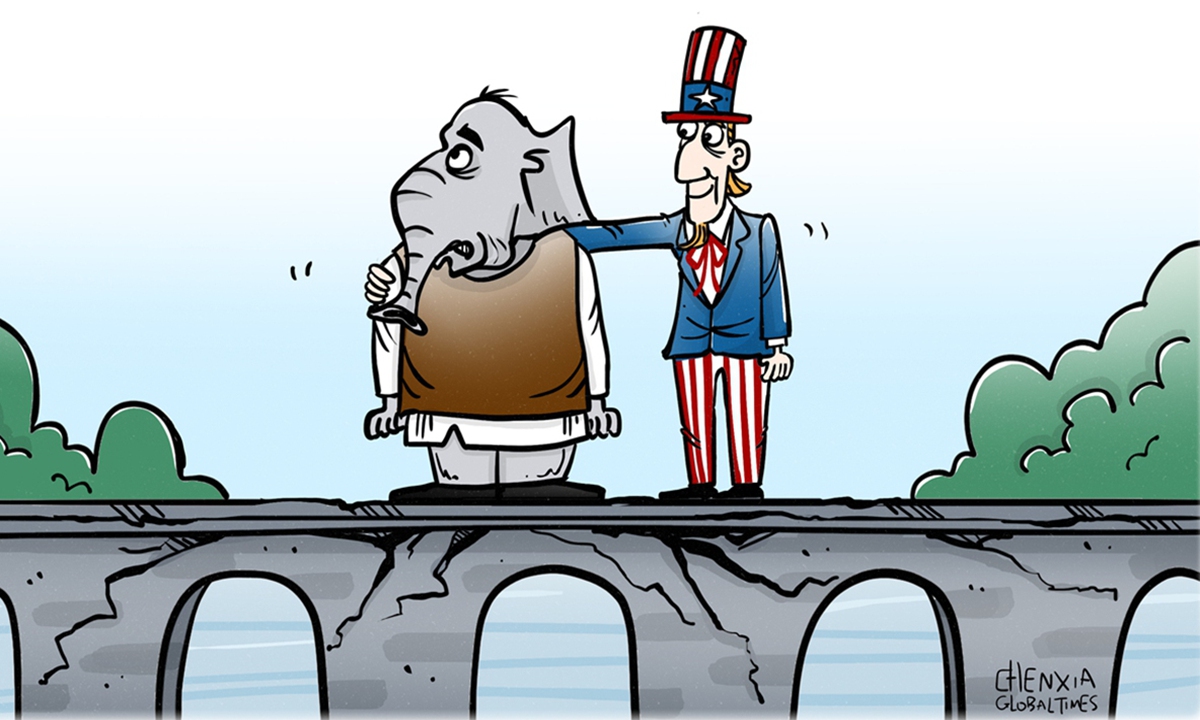
US, India Illustration:Chen Xia/GT
The US-India relationship has once again laid bare the exercise of great power leverage - Washington is playing an ancient game: first using strategic commitments to take you hostage, then using economic coercion to suppress you.
Indian media reports say US Secretary of State Marco Rubio is about to visit India, marking his second visit this year. Washington wants to talk about a "strategic partnership," while New Delhi wants to talk about tariffs. The two sides are working from completely different menus.
Nine months have passed, and the US-India trade framework agreement reached in February remains unsigned.
India's finance minister says negotiations have hit a "plateau." The US Trade Representative says an announcement is "not imminent." Translation: they're stuck, and neither side is willing to budge further.
Washington's rhetoric has always been polished. Through references to the "Indo-Pacific Strategy", shared values and the Quad - Washington portrays India as its most trusted partner in the Asia-Pacific. But when it comes to trade realities, the tone shifts: high tariffs on Indian steel, sustained pressure on Indian pharmaceuticals, barriers against Indian IT services. Meanwhile, Japan, South Korea, and Australia are receiving far more favorable treatment during the same period.
This tells us a lot about the problem. Washington ranks its "strategic partners" by usefulness. When it needs India to take sides in the Indo-Pacific, it calls you a partner; when it needs to protect its own industries, the tariff club swings freely. Japan and South Korea are military allies; Australia is part of the "Five Eyes"; India, in Washington's ledger, is simply a card whose value can be adjusted at any time.
What particularly alarms New Delhi is that the current US administration is demanding that India take three major steps: reduce Russian oil purchases, open agricultural markets, and increase American energy imports. And reportedly, this time they want India to buy more Venezuelan oil - oil over which the US has already established monopoly control.
Each demand is no minor matter. Energy security affects the nation's lifeline; agriculture involves the livelihoods of hundreds of millions of small farmers; Russian oil helps keep costs down for Indian industry. US' subtext is clear: You must play by my rules. It's hard to believe such demands come from a "partner."
Of course, the US has long used geopolitical leverage to "manipulate" its relationship with India, using the Quad and the "Indo-Pacific Strategy" to reinforce India's position while trying to restrict India's room for maneuver.
But India has not fully accepted the hand dealt.
For India, the value of being designated an American "strategic partner" is diminishing. Meanwhile, with tariff policies mired in legal challenges, India is even more hesitant to make commitments - will policy change again next year? India's exports have grown strongly in 2026. If American tariffs rise back to 25 percent, that growth trajectory will be destroyed. India would rather not sign an agreement than accept terms that damage its long-term prospects.
So the situation has become this: the US applies pressure; India drags its feet. The delay is not passive submission - it is a form of resistance with boundaries. India cannot easily abandon US' security card, but it refuses to put all its chips on the table. The trade agreement remains unsigned for this reason.
Whether this agreement gets signed or not, India has already seen through America's real agenda.
Behind this lies a larger question: What does Washington's "strategic partnership" actually offer India?
India's example makes the answer clear. The US doesn't want an equal partner - it wants a partner willing to follow its strategic lead and sacrifice economic interests on American terms. The moment the other side's interests conflict with American domestic politics, "partnership" gives way to tariffs. Such a relationship is difficult for any nation conscious of its own interests to accept long-term.
For India, the American "strategic partner" label is losing value. This doesn't mean India will turn toward some other great power. Still, it means New Delhi will more firmly chart its own course, strengthen ties with Russia, Iran, and others, and place "strategic autonomy" more prominently in its dealings with major powers.
The deadlock in US-India trade negotiations is more than a commercial dispute. It exposes the limits of a model of relations between major powers: prioritizing exploitation over equality; demanding cooperation while denying respect. How far such a relationship can go - India is answering that question in its own way.
RELATED ARTICLES