The Takaichi government is increasingly resembling an extremist cult: Global Times editorial
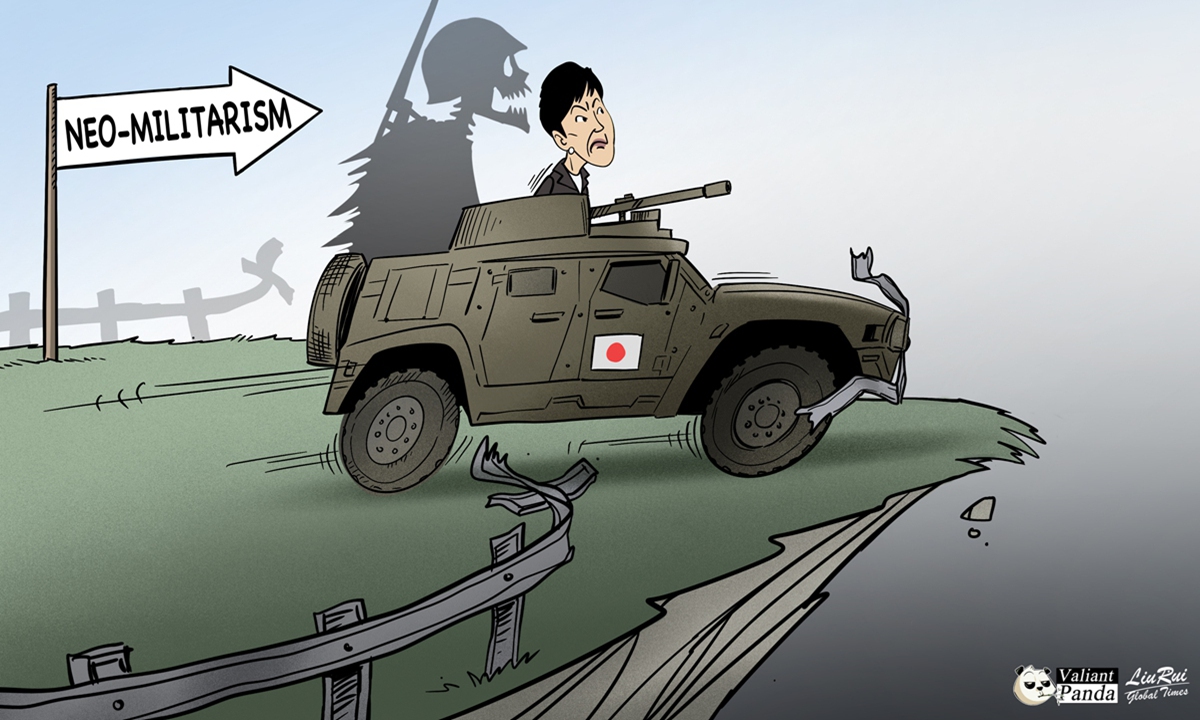
Militaristic emblem Illustration: Liu Rui/GT
It is precisely because the Takaichi government has tolerated and encouraged these forces that right-wing elements in Japanese politics are becoming more brazen than ever. They have even constructed a narrative of a "holy war for history," attempting to repackage the specter of militarism as a "spiritual legacy" of which the Japanese people should be proud. An increasingly dangerous Japan has long been on the radar of its neighbors, who remain wary of its actions.
On Saturday, Japanese Prime Minister Sanae Takaichi made an offering to the Yasukuni Shrine as prime minister. This marked the fourth time this year that Takaichi had made an offering or donated ritual funds to the war criminals' shrine, a frequency rarely seen among Japan's former prime ministers. On the same day, several cabinet ministers and lawmakers also visited the shrine to pay their respects. The pattern of "the prime minister sending offerings while her subordinates make the pilgrimage" is becoming a familiar ritual in Takaichi's cabinet.
Some Japanese right-wing figures argue that Takaichi has not visited the shrine in her capacity as prime minister since taking office, as if this were sufficient to address concerns over Japan's historical record. Yet Takaichi refrains from visiting in person while making offerings in the name of the prime minister; cabinet ministers and senior Liberal Democratic Party officials make the pilgrimage on her behalf, while she pays her respects from afar. Tokyo is pursuing an opportunistic strategy: Preserving its right-wing support base, avoiding the political fallout of a direct visit, and exploiting historical revisionism to justify military expansion and preparations for war. In fact, during nearly a year in office, Takaichi has consistently sent signals to Japan's domestic right-wing forces, seeking to systematically erode the postwar consensus against war, undermine the legitimacy of Japan's pacifist constitution, and lay the psychological groundwork for constitutional revision, military buildup, and arms expansion.
The Takaichi government seems particularly fond of such deceptive tactics. Japan has repeatedly sent the wrong signals on the Taiwan question, effectively closing the door to dialogue while proclaiming internationally that it is "willing to communicate with China." More recently, Takaichi has described China as an "important neighbor" while refusing to retract her erroneous remarks on the Taiwan question. On the one hand, she is publicly putting on a show of eagerness to travel to Shenzhen to attend the APEC meeting. On the other, she is staging a political charade of her own, hinting that the Diet might not approve her attendance. These deceptive maneuvers are, in essence, attempts to exploit ambiguities and find room to maneuver for Tokyo's risky drive toward remilitarization.
It is precisely because the Takaichi government has tolerated and encouraged these forces that right-wing elements in Japanese politics are becoming more brazen than ever. They have even constructed a narrative of a "holy war for history," attempting to recast Japan's war of aggression during World War II as a supposedly righteous campaign to "liberate Asia" and portray Class-A war criminals, whose hands were stained with the blood of people across Asia, as "spirits of the war dead who sacrificed themselves for their country." Cabinet members and lawmakers under Takaichi's government frequently visit sites associated with war criminals, using their political power to lend legitimacy to this "holy war" narrative and whip up public support for military expansion and preparations for war. Through repeated offerings, shrine visits, and a sustained propaganda campaign, they seek to gradually erase the just verdicts of the Tokyo Trial and repackage the specter of militarism as a "spiritual legacy" of which the Japanese people should be proud.
More alarming still, this "holy war for history" narrative is closely intertwined with the Takaichi government's efforts to revise Japan's pacifist constitution and dramatically expand its military capabilities and preparations for war. This exposes the Takaichi government's deeply extremist, cult-like nature. Once historical responsibility for wartime atrocities is recast as "national sacrifice," the pacifist constitution can be portrayed as "a shackle holding back the nation's development," and military expansion and preparations for war can be given a supposedly "legitimate" justification. The erosion of historical understanding ultimately leads to a shift in national security strategy. This is precisely the most insidious and dangerous path toward Japan's remilitarization. Japanese politicians have openly discussed introducing nuclear-powered submarines and allowing US forces to bring nuclear weapons into Japan, while the "Three Non-Nuclear Principles" - a cornerstone of Japan's postwar nuclear policy commitments to the international community - have come under increasing pressure.
Some Japanese right-wing figures believe they can blur the line between history and present-day realities, invoke "threats from neighboring countries" as a pretext for military expansion, and dress up that expansion as a reasonable national security measure. They seem to think this will allow them to pull the wool over the world's eyes and dismantle the postwar order in its entirety under the international community's very nose. But since Takaichi took office, Japan's relations with neighboring countries have deteriorated sharply. China, South Korea, and other countries that suffered under Japanese aggression have repeatedly lodged strong protests over her shrine-related actions and historically revisionist remarks, while expressing clear concerns about her moves to push beyond Japan's established exclusively defense-oriented policy. Russia and North Korea, too, remain highly vigilant about Japan's military buildup, preparations for war, and efforts to repudiate the postwar order, having issued explicit warnings through diplomatic channels on multiple occasions. An increasingly dangerous Japan has long been on the radar of its neighbors, who remain wary of its actions. Tokyo will find it far from easy to get away with its "deception tactics."
Masahiko Shimizu, a professor of constitutional law at Nippon Sport Science University, has bluntly stated that Japanese politicians visiting Yasukuni Shrine is akin to German leaders tending Adolf Hitler's grave - a blatant desecration of historical justice. The analogy may not be entirely precise, but it is one that the US and Western public opinion, which have long tolerated the rhetoric and actions of Japan's right wing and even lent credibility to Japan's "peaceful" facade, would do well to heed.
The 14 Class-A war criminals from WWII were convicted of war crimes by an international tribunal in accordance with the law. The wars of aggression they planned, launched, and carried out inflicted immense suffering on countries across Asia. As long as Japanese politicians continue to pay homage to these war criminals, this chapter of history can absolutely not truly be closed. No matter how the Takaichi government tries to repackage its actions or twist the facts, any attempt to whitewash militarism or resume military expansion will ultimately expose its dangerous nature before the entire world, provoking resolute opposition and ending in complete failure.
RELATED ARTICLES