China lodges strong protest over Takaichi’s offerings to war shrine
Repeated Yasukuni offerings mark brazen provocation: expert
By Published: Oct 19, 2026 03:09 PM

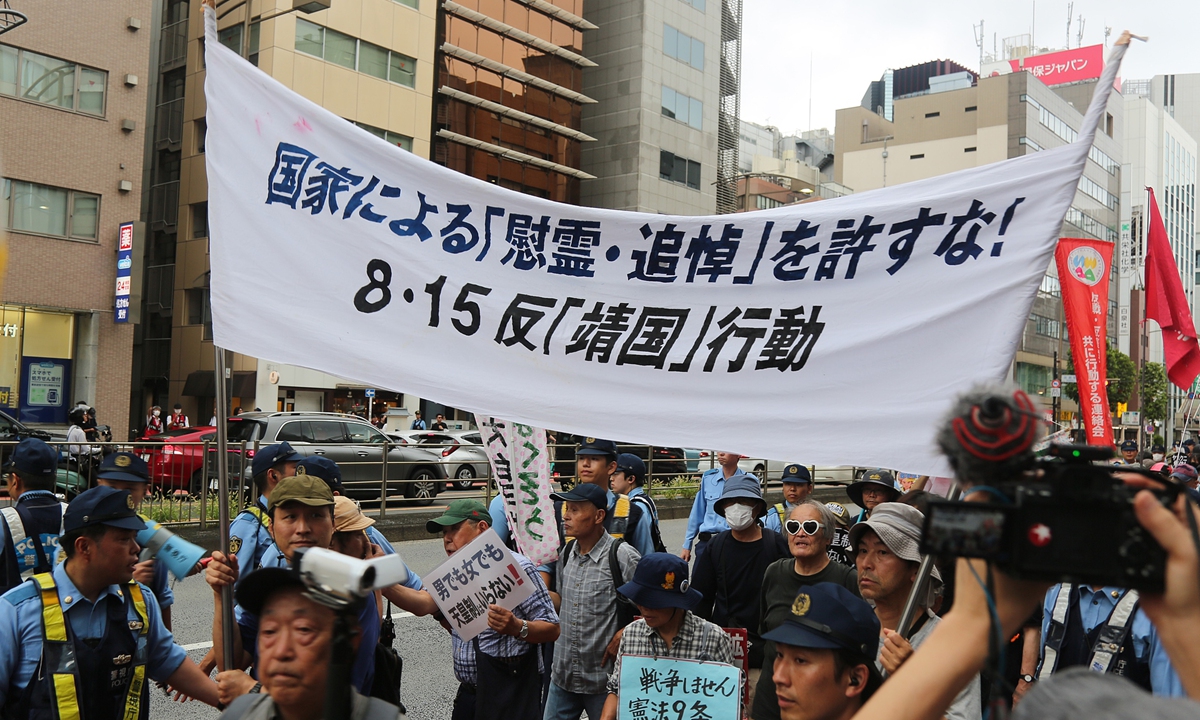
Japanese citizens hold a protest march near Awaji Park in Tokyo on August 15, 2026, opposing politicians offering ritual fees to or visiting the notorious Yasukuni Shrine, which enshrines Class-A war criminals from World War II. Photo: VCG
China has lodged solemn representations and a strong protest with Japan over Prime Minister Sanae Takaichi's offerings to the Yasukuni Shrine and recent visits by Japanese officials and lawmakers to the war shrine, Foreign Ministry spokesperson Mao Ning said on Monday, stressing that such moves exposed Japan's attempts to absolve war criminals, whitewash aggression and pave the way for remilitarization.
"The Yasukuni Shrine is a spiritual tool and symbol of Japanese militarism's wars of aggression against other countries. It honors 14 Class-A war criminals who bore grave responsibility for those wars. Japanese leaders and politicians know this full well, yet continue to make offerings and visit the site, exposing their deeply rooted, erroneous understanding of history and their sinister intentions to absolve war criminals, whitewash aggression and pave the way for remilitarization," Mao said.
"This year marks the 80th anniversary of the opening of the Tokyo Trials. We once again solemnly demand that Japan face up to history, reflect on its culpability, stop reversing the course of history and earn the trust of its Asian neighbors and the international community through concrete actions," she said.
The remarks came after Takaichi made a monetary offering to the notorious Yasukuni Shrine on Monday, while a cross-party group of Japanese lawmakers also visited the war shrine, Japanese media reported.
Takaichi, as leader of the ruling Liberal Democratic Party, paid for the offering out of her own pocket, according to Hiroshi Kajiyama, who heads the party's General Council, Japanese media The Mainichi reported on Monday. The report also noted that Takaichi "is expected to forgo a visit during the shrine's three-day autumn festival ending Monday." It also reported that on the same day, a cross-party lawmakers' group visited the site.
Despite strong opposition from China and South Korea over her Saturday offering, Takaichi made another offering to the notorious site on Monday, which amounts to a brazen provocation toward countries victimized by Japan during WWII, Da Zhigang, a research fellow at the Institute of Northeast Asian Studies of the Heilongjiang Academy of Social Sciences, told the Global Times.
On Saturday, Takaichi made a ritual masakaki tree stand offering to the Yasukuni Shrine in her capacity as prime minister, which has already drawn firm criticism from China and South Korea.
In a statement on Saturday, a spokesperson for the Chinese Embassy in Japan said that the so-called Yasukuni Shrine enshrines 14 Class-A war criminals directly responsible for the wars of aggression and is a spiritual tool and symbol of Japanese militarism. "The relevant erroneous actions are an affront to historical justice, a challenge to the foundational norms of civilization, and a provocation against the postwar international order," the spokesperson said.
The South Korean government also criticized the move on Saturday. In a statement, Seoul's foreign ministry said it "once again expresses deep disappointment and regret" that Japanese leaders have "repeatedly sent offerings to or visited Yasukuni Shrine, which glorifies Japan's past war of aggression and enshrines war criminals," according to The Korea Herald.
Monday's move is Takaichi's fifth offering this year to the Yasukuni Shrine, which honors Class-A war criminals — a frequency rarely seen among previous Japanese prime ministers. Da said that amid Japan's rightward shift, historical revisionism and accelerating remilitarization, Takaichi's repeated offerings carry significance far beyond "ritual or tradition."
They are calculated efforts to use historical symbols to reshape public narratives, revive Japan's militarist past and advance current political, diplomatic and military goals, Da said, adding that such repeated acts risk steadily eroding Japan's postwar consensus on peace.
Such actions also further deepen uncertainty in China-Japan relations and limit prospects for improvement. Japan cannot expect diplomatic dialogue to deliver domestic political gains while glorifying war criminals, distorting history, accelerating remilitarization and infringing on other countries' core interests, said the expert.
Since Takaichi took office, Japanese lawmakers' visits to Yasukuni Shrine have become increasingly brazen, signaling a dangerous trend. "Given Japan's history of external aggression, neighboring countries and regions must remain highly vigilant," Da said.
RELATED ARTICLES