China's satellite internet moves closer to operational use after Arctic route test
By Published: Oct 19, 2026 03:19 PM

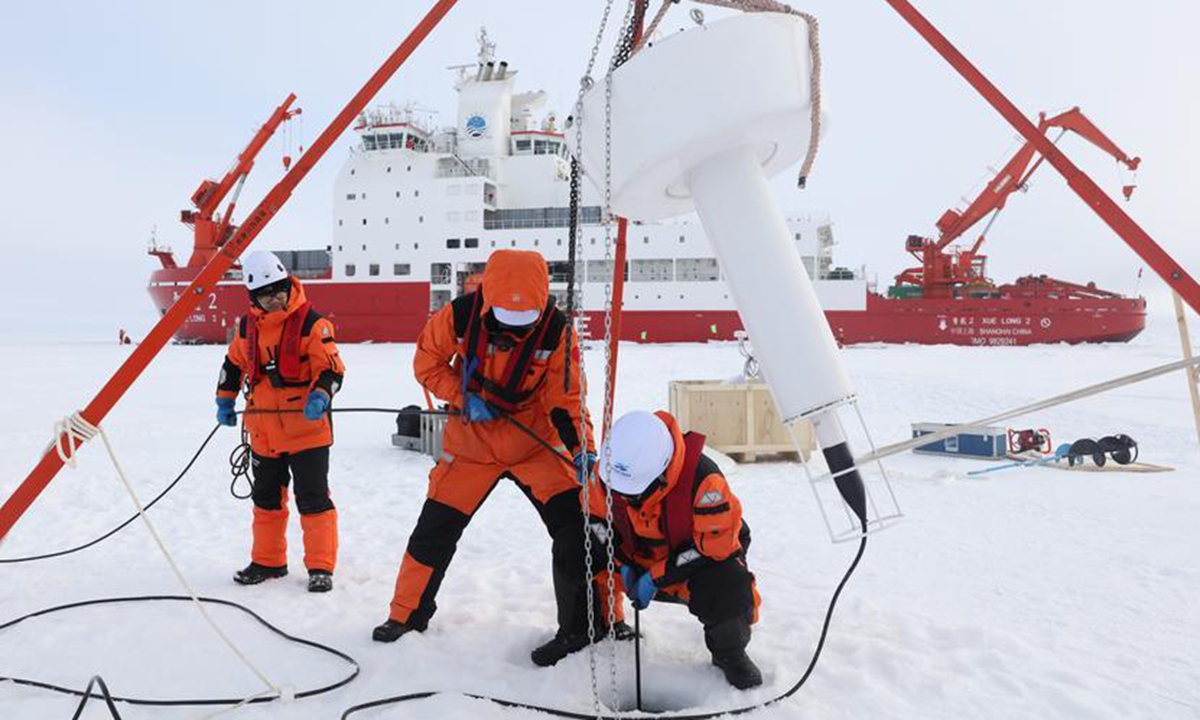
Members of China's 16th Arctic Ocean scientific expedition team work on the ice surface of the Arctic Ocean on Aug. 9, 2026. Photo: Xinhua
China has successfully completed a near-operational application test of its domestically developed satellite internet system along an Arctic shipping route, achieving breakthroughs in cross-regional communications, remote medical consultations and real-time scientific data transmission, according to information China's Ministry of Natural Resources provided to the Global Times on Monday.
The research vessel Jidi, currently carrying out China's 16th Arctic expedition, has completed the test, demonstrating the system's ability to support real-world operations in some of the world's most challenging environments.
With the joint efforts of the Polar Research Institute of China and other participating institutions, the expedition successfully conducted its first network connectivity test linking Arctic, Antarctic and Southwest China's Xizang Autonomous Region.
During a video conference linking the Jidi, China's Qinling Station in Antarctica, Lhasa in Xizang region and the North Sea Bureau, participants experienced clear and smooth audio and video transmission.
The test demonstrated the domestically developed satellite internet system's ability to provide low-latency, high-bandwidth communications across widely separated regions, while verifying its operational stability under a range of harsh conditions, including extreme cold, high altitudes, strong winds and sandstorms, and icy fog.
The achievement marks progress in China's efforts to overcome persistent communication blind spots in remote regions where conventional terrestrial networks cannot provide reliable coverage.
Pang Zhihao, a senior space expert, told the Global Times on Monday that near-operational application testing represents an intermediate stage between experimental verification and formal deployment. During this stage, a system's performance is evaluated under real-world conditions to prepare it for its routine operations.
The results demonstrated that the Chinese-developed satellite and ground infrastructure can operate reliably under extreme conditions, including freezing temperatures, icy fog and high altitudes, while addressing long-standing communication challenges in high-latitude polar regions, Pang noted.
One of the most significant breakthroughs came in the field of medical support, with the expedition conducting its first remote medical consultation via an online connection using China's domestically developed satellite internet system.
When a member of the expedition experienced sudden physical discomfort, the vessel used the domestically developed satellite internet broadband network to conduct a high-definition video consultation with medical experts at a hospital in Qingdao, East China's Shandong Province, using the satellite broadband network.
The consultation enabled doctors and experts onshore to assess the crew member's condition remotely and provide timely medical guidance, demonstrating how reliable satellite connectivity can serve as a critical lifeline for personnel operating thousands of kilometers away from conventional healthcare facilities.
The successful consultation illustrated the practical value of satellite internet beyond routine communications, particularly for scientific expeditions operating in isolated and potentially hazardous environments.
Another major achievement involved the domestically developed marine intelligent sensing drifting buoy, known as Zhigan, which for the first time enabled China to independently control the entire process of collecting and transmitting ocean observation data.
During testing conducted while the vessel was underway and during buoy deployment, communication indicators, including data transmission speed and quality, met practical operational requirements.
The system enabled real-time transmission of ocean observation data through China's domestic satellite internet network, replacing the international satellite services traditionally used for such operations.
The breakthrough marked an important step toward achieving independent control over communications for China's marine scientific instruments and reducing reliance on overseas satellite systems to transmit oceanographic data, according to the natural resource ministry.
As stated by the expedition team, the satellite internet system has already supported the transmission and reception of more than 300 files containing over 100 gigabytes of data, as well as more than 40 video conferences during the voyage.
The tests covered a broad range of operational scenarios, including voice calls, large-volume file transfers, ship-to-shore video conferences, the transmission of scientific instrument data via domestic satellites, and the continuous online operation of forecasting platforms.
Together, these applications demonstrated the system's ability to provide communications support throughout the voyage, helping address the long-standing challenges of information isolation during polar scientific expeditions.
The latest results build on earlier achievements in China's efforts to establish independent satellite communications capabilities in polar regions.
According to state-owned space contractor China Aerospace Science and Technology Corporation (CASC), China's domestic satellite internet system successfully supported video communications between the Arctic and Antarctic in tests reported on October 9.
The tests involved Chinese research vessels Xuelong, Jidi and Tansuo-3, as well as Qinling Station in Antarctica, using China's Guowang satellite internet constellation.
The system achieved peak communication speeds of approximately 30 megabits per second, with video latency remaining below one second, demonstrating the potential of China's emerging satellite internet infrastructure to support communications across vast geographical distances.
Kang Guohua, a senior member of the Chinese Society of Astronautics and a professor of aerospace engineering at Nanjing University of Aeronautics and Astronautics, told the Global Times on Monday that the real significance of the test lies in demonstrating the feasibility of using inter-satellite laser links to relay data from a low-Earth orbit satellite constellation in polar regions without relying on ground stations.
"Near-operational application" means that the system has not yet entered full operational service, as China's national satellite internet constellation is still under construction and has not been fully deployed. In this sense, the Jidi research vessel is among the early users testing the system's capabilities.
Looking ahead, Pang said China's satellite internet industry still faces challenges before achieving large-scale commercial operations, including insufficient constellation deployment, relatively high terminal costs and the need to improve operational and maintenance systems.
Kang drew a parallel with China's BeiDou Navigation Satellite System and the US Global Positioning System (GPS), suggesting that China's Guowang and G60 Qianfan constellations could eventually compete with SpaceX's Starlink.
According to a CASC report on October 9, China's Guowang satellite internet constellation plans to deploy approximately 1,300 satellites by the end of 2029, with the full constellation of 12,992 satellites scheduled for completion by 2035.
Kang predicted that China could develop satellite internet capabilities comparable to Starlink's within the next three years, although full deployment of the country's satellite constellations is expected to take longer.
RELATED ARTICLES