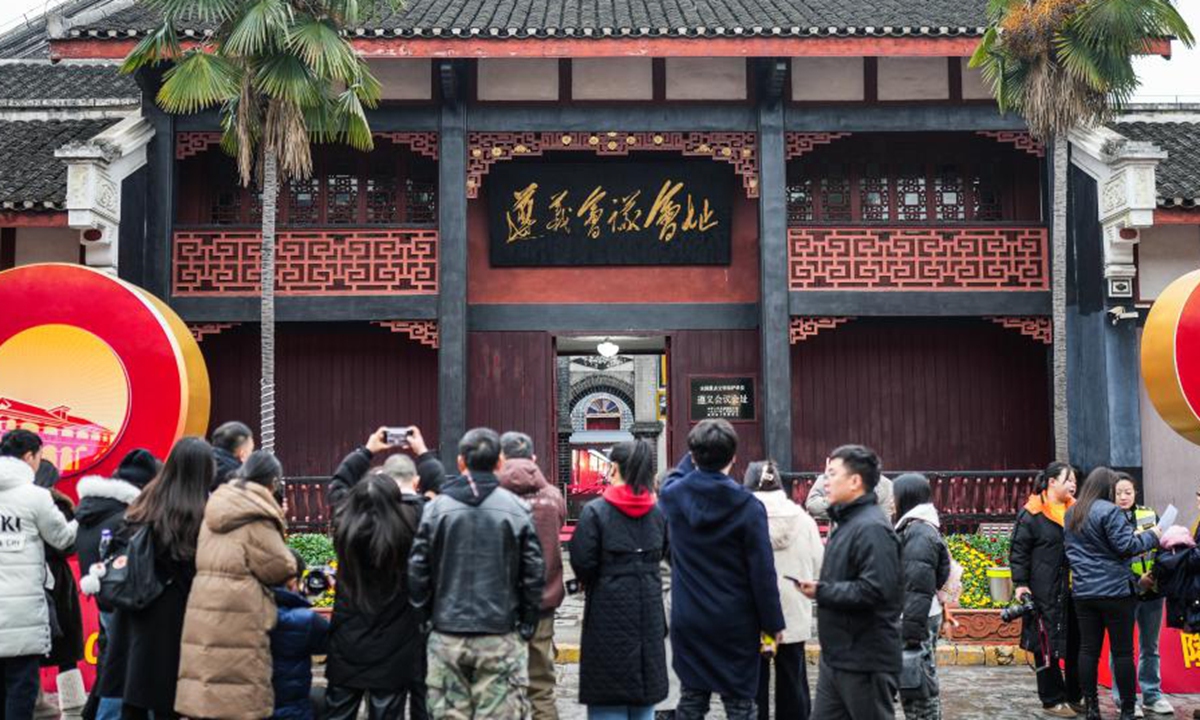
Tourists visit the venue of the Zunyi Meeting in Zunyi, Southwest China's Guizhou Province. Photo: Xinhua
As the host of a Long March documentary, I once traveled the historic routes through Southwest China's Guizhou and Sichuan Provinces, standing where one of humanity's greatest stories of perseverance unfolded.
I remember the early morning fog on the mountain slopes as I followed the Red Army's path along steep Guizhou trails. My legs ached with every step, and in the quiet, I could almost sense the exhaustion and hope that kept Red Army soldiers moving nearly 100 years ago. By the Chishui River, I met a local historian who told me how Chinese revolutionary leaders led the first crossing during the campaign's famous four crossings. As I made my way along winding mountain roads, crossed rivers on old ferries, and visited preserved battle sites, I didn't just watch history - I felt the Long March's living spirit.
As China celebrates the 90th anniversary of the victory of the Long March, the key battles and decisions made in Guizhou and Sichuan continue to influence the country's progress today.
The Long March was much more than a military retreat. Surrounded by enemy forces, the Chinese Workers' and Peasants' Red Army, led by the Communist Party of China, set out on a tough 12,500-kilometer journey through mountains, rivers, and dangerous grasslands. What started as a retreat became a turning point that saved the Chinese revolution. The events in Guizhou and Sichuan were especially important, changing the Red Army's future and setting the stage for their final victory.
During my journey along the Long March routes, at Yihai Lake, I met Sha Mayu, whose grandfather Shama Erge was the local Yi ethnic
group's ritual priest during the historic alliance. Sha told me how Yi chieftain Xiao Yedan and Red Army General Liu Bocheng made their brotherhood oath with lake water, since there was no wine in the mountains. This spirit of respect and unity helped the Red Army cross Sichuan's toughest terrain. Their brave crossing of the Dadu River and the charge across Luding Bridge overcame huge challenges and kept their mission going.
These revolutionary stories are not just memories from the past - they have given southwestern China valuable lessons and inspiration for today's development. Research and modern government practices show that the Long March spirit, shaped in Guizhou and Sichuan, still drives strong growth in the region. Guizhou's poverty relief efforts along Long March routes have helped many mountain communities by encouraging local leadership, using new technologies, and supporting community projects. In Sichuan, rebuilding after the 2022 Luding earthquake showed the same Long March determination, as people worked together to restore their communities and face new challenges.
Besides, modern transport links have made Guizhou's mountainous communities more accessible. It follows the spirit of the Zunyi Conference, held during the Long March, of seeking truth to push forward rural renewal, protect the environment, and support sustainable growth. Sichuan also continues the Long March's spirit of unity and strength, supporting the growth of ethnic minority areas, restoring mountain and grassland environments, and encouraging balanced economic progress. The unity built between the Red Army and local ethnic groups 90 years ago still supports southwestern China's stable and harmonious development.
Every generation faces its own "Long March" of challenges. The struggles that Red Army soldiers overcame in Guizhou and Sichuan still inspire people in China to face today's difficulties. I felt this strongly while standing on a viewing platform in Dawujiang Town in Guizhou, looking at five bridges, including a high-speed railway bridge, crossing just two kilometers of the
Wujiang River. This modern infrastructure has ended the isolation that once held back local growth. As China works toward new technologies, better environmental management, balanced growth, and national rejuvenation, the practical and brave Long March spirit continues to guide the country.
While filming the documentary, I got a real, firsthand sense of this legacy through my own challenges. Hiking snowy slopes near the Siguniang Mountain (literally Four Sisters Mountain) in straw shoe replicas and carrying medical gear along Yaoguan Village's trails gave me a small taste of the risks and uncertainty Red Army soldiers faced every day. These behind-the-scenes struggles deepened my connection to this history. I realized the Long March is much more than a story in a textbook. It is a living legacy. Its courage, wisdom, and strong faith will keep driving China forward in the years to come.
The author is a reporter at Alianza Informativa Latinoamericana and is based in South China's Guangdong Province. opinion@globaltimes.com.cn
RELATED ARTICLES