Unitree shares surge 16.15%, market value tops 200b yuan amid China's robotics commercialization efforts
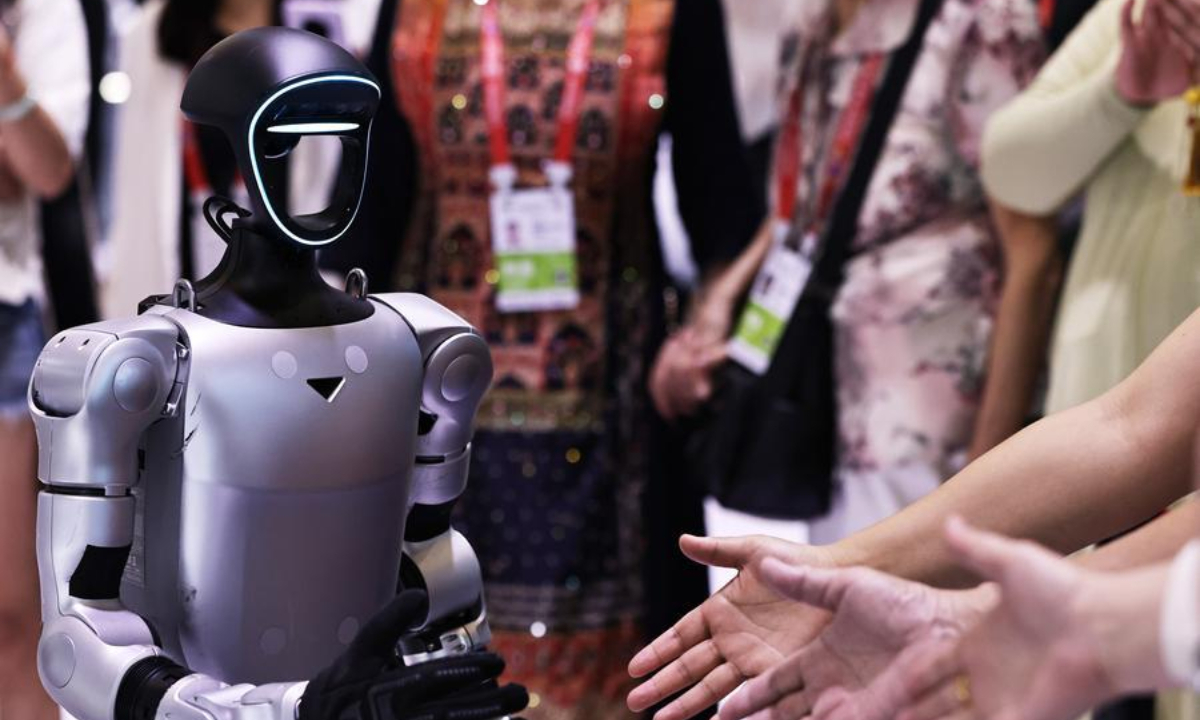
Visitors interact with a robot from Unitree Robotics during the sixth China International Consumer Products Expo (CICPE) in Haikou, south China's Hainan Province, April 14, 2026. (Xinhua/Gao Jing)
Shares of Chinese robotics company Unitree Robotics surged 16.15 percent on Monday, marking their biggest single-day gain since their August 19 debut on Shanghai's STAR Market, excluding the first trading day, drawing renewed attention to the growth prospects and valuations of China's rapidly expanding embodied artificial intelligence (AI) industry.
Unitree closed at 495.92 yuan per share, lifting its market capitalization back above 200 billion yuan ($28.1 billion) to 200.58 billion yuan. The stock was up as much as 19.21 percent during trading.
The rally followed a steep sell-off that saw Unitree shares hit a post-listing low of 404.03 yuan on October 15, down more than 60 percent from their opening price on the first trading day, highlighting significant volatility in investor sentiment toward the sector.
The rebound has also renewed debate over whether elevated valuations in China's embodied AI industry are supported by commercial progress, as robotics companies accelerate expansion while facing mounting pressure to deliver sustainable earnings.
Wang Peng, an associate researcher at the Beijing Academy of Social Sciences, told the Global Times on Monday that the sharp price fluctuations of the shares reflected a correction driven by short-term trading sentiment and longer-term industry expectations, rather than a fundamental shift in the sector's development prospects.
Wang noted that the industry was experiencing a period of inflated valuations, with capital markets pricing in future growth potential prematurely. Investors should return to the fundamentals of industrial applications and take a rational, long-term view of the sector, he said.
The industry's biggest commercialization challenge remains a mismatch between technological maturity and real-world demand, Wang said, adding that some companies' heavy reliance on related-party transactions and declining research and development intensity reflect the industry's early stage of development.
Unitree remains a prominent player in China's humanoid robotics industry, despite the fluctuations. Unitree shipped more than 5,500 humanoid robots to end customers in 2025, excluding unfulfilled orders, while production exceeded 6,500 units, according to the company.
However, according to figures cited in Chinese media reports, Unitree's revenue rose 48.54 percent year-on-year in the first half of 2026, while net profit excluding non-recurring gains and losses fell 19.34 percent to 244 million yuan, indicating profitability pressures despite continued revenue growth.
Wang said that sustainable business models had yet to take shape across the industry, and further market consolidation and business-model adjustments would be necessary before large-scale deployment could become commercially viable.
Unitree's performance comes amid broader expansion in China's robotics industry, supported by advances in artificial intelligence (AI), increasingly sophisticated manufacturing capabilities and growing demand for industrial automation.
China produced 794,781 industrial robots in the first nine months of 2026, up 29.1 percent year-on-year, while service robot output reached approximately 15.59 million units, rising 7.9 percent, according to data released by the National Bureau of Statistics on Monday.
China also remained the world's largest industrial robot market in 2025, accounting for 59 percent of global installations, with approximately 354,000 units installed, up 20 percent year-on-year, according to the International Federation of Robotics.
China's embodied AI industry needs to shift from capital-driven expansion toward practical applications, with companies balancing technological innovation and commercialization, focusing on genuine operational needs and building sustainable growth, Wang said.
China has officially approved and released its first six national standards for humanoid robots, which will take effect on April 1, 2027. The standards comprise five sets of technical requirements and a technical specification for humanoid robot simulation testing platforms.
Unitree Robotics is reportedly scheduled to release its third-quarter 2026 financial results on October 29, marking its first earnings report since going public. According to a sales document previously released by the company, cumulative production of its humanoid robots (bionic bipedal models) had reached approximately 18,000 units as of July, according to media reports.
RELATED ARTICLES