What’s behind robotics firm’s stock halving from its debut peak after a blockbuster listing
By and Zhang Weilan Published: Sep 10, 2026 10:04 PM

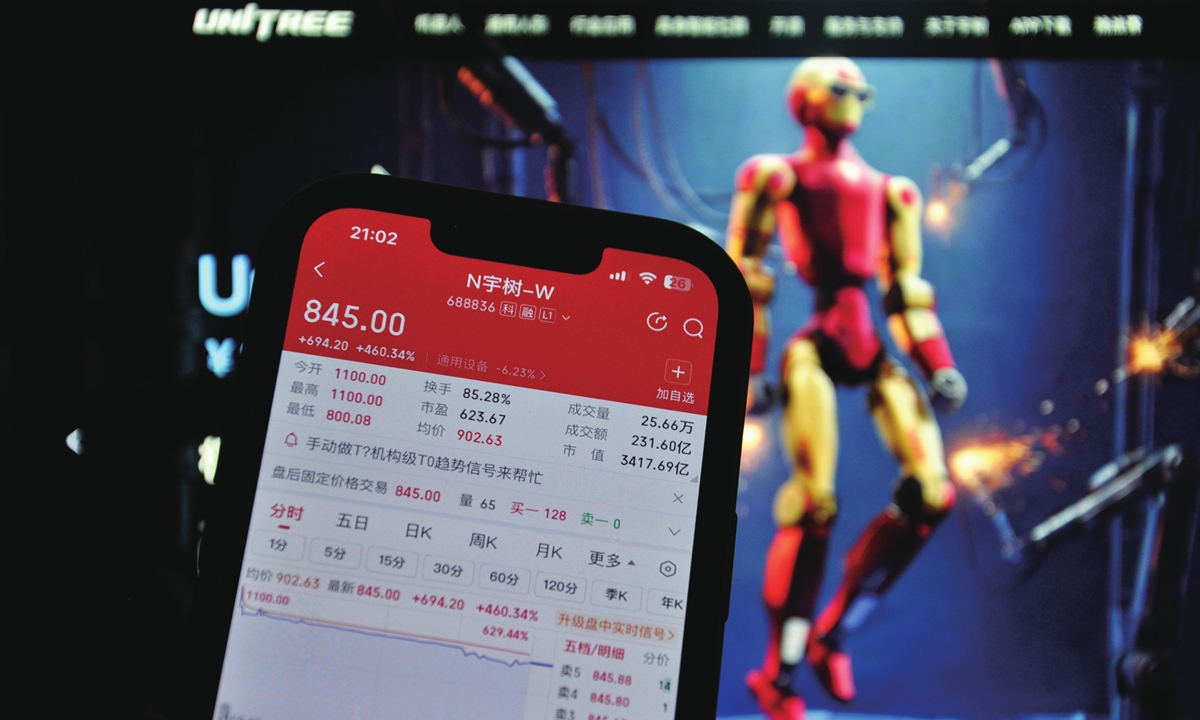
Unitree Robotics made its A-share debut on August 19, 2026, closing at 845 yuan per share, up 460.34 percent. Photo: VCG
On August 19, as Unitree Robotics made a stunning debut on Shanghai's Nasdaq-style STAR Market, the hall roared and investors grinned—yet when the camera cut to founder Wang Xingxing, his expression barely moved.
His impassive expression may have reflected a sober reading of the listing itself: a blockbuster debut that priced in a future the company had not yet earned. By Wednesday's close, the stock had fallen from an intraday high of 1,100 yuan ($163.99) on August 19 to 513.93 yuan - more than halving in value and wiping out roughly 237 billion yuan in market capitalization from the peak.
Industry insiders draw a clear line between the capital market fluctuation and the strength of the real industry. Unitree's stock dive, they stressed, only represents a repricing of one stock after an inflated listing, not a write-down of the tech prowess of the star company - which itself being not only the first humanoid-robot stock on China's A-share market, but also a world champion in global shipments and the firm that put fighting and dancing robots on the Spring Festival Gala before a worldwide audience.
The market tape is also still less a verdict on China's humanoid robotics industry, which is booming, still gathering pace and has ample rooms for future growth.
Valuation debate
Observers said that the real debate in the market is not whether Unitree is a high-quality company, but how much a robotics firm with over 1 billion yuan in annual revenue — and in an industry still in its infancy — ought to be worth.
"The market appears to have taken a more cautious view: Unitree's early valuation had already priced in a great deal of future growth, well ahead of its current revenue and earnings. The later pullback looks more like a reset of those expectations than a simple rejection of the company," Liu Shaoshan, director of Embodied AI at the Shenzhen Institute of Artificial Intelligence and Robotics for Society, told the Global Times.
Liu believed the market valuation of the Hangzhou-based company during its first few days of trading was clearly in a bubble. "In fact, there is no industry-wide bubble as the long-term market for humanoid robots could be exceptionally large. The problem is that capital markets have already priced the next five to ten years of success into today's high valuations. So the real issue is treating a general-purpose robot platform as if it already exists, when that stage of development remains elusive," Liu explained.
What the financial books and the factory data present is mixed: the company is still in front — but it is too early to call the race won.
In 2025, Unitree booked about 1.70 billion yuan in revenue, up more than 332.64 percent. Net profit swung from a loss of 18.02 million yuan in 2023 to a profit of 590.75 million yuan in 2025. According to a Forbes report, the fact that the company is itself profitable is a distinction shared by almost none of its humanoid peers, foreign or domestic. While that lead still sustains, the pace of revenue growth cooled, with the company's revenue increasing 48.54 percent in the first six months of 2026, a sharp slowdown from the 332.64-percent growth rate recorded in 2025.
Another positive indicator is the gross margin, which rose from about 44.22 percent in 2023 to about 60.13 percent in 2025. The elevation is also attributed to Unitree's manufacturing strengths. According to a report by Nomura, the company develops and produces key components including motors, reducers, encoders and driver boards in-house, while externally sourced parts account for only 14 to 18 percent of costs.
Unitree's quadruped and humanoid robot lines have for years sat at or near the top of the global market, yet the shipment ranking has begun to shift as well. In the first half of 2026, Chinese robot firm AGIBOT overtook Unitree for the No. 1 position in terms of humanoid robot shipments, capturing a 44 percent share of global shipments, compared with Unitree's 31 percent, according to a report by market research firm Smart Analytics Global. Analysts said that open question is whether the star Chinese company can hold its global lead in the face of intensifying competition and rapid technological iteration.
While Unitree's record-breaking scores in competitions continue to make headlines, a set of data suggests that those rosy achievements have not translated into repeatable, large-scale industrial deployments. Much of the revenue still comes from research, education, exhibitions and pilots.
According to the most comprehensive publicly available information on Unitree's business, in the first nine months of 2025, research and education accounted for 73.6 percent of Unitree's humanoid-robot revenue, commercial and consumer sales for 17.39 percent, and industrial applications only 9.01 percent, according to a report on financial news site jrj.com on Monday.
Wang, the Unitree founder, also struck a cautious tone regarding the prospects for market commercialization. He said during the 2026 World Robot Conference, although robots can currently perform some tasks, their overall efficiency still lags behind that of humans, and the "ChatGPT moment" for embodied intelligence remains two to 10 years away. The remarks were made several days after Unitree's public debut.
Rational valuation
Since Unitree's public debut in late August, a number of media outlets have been chasing every swing in the stock, with some seizing on that slump to question whether China's entire humanoid robotics boom is a bubble.
In late August, a South China Morning Post article suggested that Unitree's stock slump "strokes fears of a bubble in Chinese humanoid robotics." A Forbes report, while describing how robots have saturated Chinese daily life in a way that has no American parallels.
However, an executive of a Shenzhen-based humanoid robotics company, who spoke on condition of anonymity, stressed that the capital move would only stay in the market, and that its impact on the industry itself is limited.
"Across Shenzhen, Chinese robotics firms are still carrying out their R&D as usual. [Unitree's stock slump] is not some watershed moment proving the industry has stalled," the executive told the Global Times on Thursday. Shenzhen is home to the country's "Robot Valley" with a cluster of highly valued robotics unicorns that have reportedly either applied to list or are preparing to do so.
That distinction matters. In a latest report released in June, Morgan Stanley has upgraded its forecast for China's humanoid robot shipments for a second time this year, expecting 50,000 units to ship this year, nearly double its previous projection. The bank said the industry's shift from demonstration to commercial deployment has proved faster than expected, according to a CNBC report.
The report indicates greater room for future growth in the humanoid robot industry, and industry insiders are optimistic that China - given its complete supply chain, advances in AI models and wider real-world application, coupled with the speed with which Chinese firms receive fundraising support compared with foreign peers - would gain an overwhelming edge in sustaining and widening this leading position.
Unitree was founded in Hangzhou, East China's Zhejiang in 2016, with seed-round valuation of 13.33 million yuan. In less than a decade it listed on the STAR Market, with valuation jumping more than 4,500 times. In the US, companies such as Figure AI and Boston Dynamics have yet to launch a clear IPO process, according to media reports.
The South China Morning Post report said that after the recent decline in stock price, Unitree's market capitalization is more than four times the top of the range indicated by lead underwriter Citic Securities. The company's trailing price-to-earnings (P/E) ratio stands at 355 times based on Wednesday's closing price, versus roughly 19 times for leading battery-maker CATL, which analysts said indicates that there could be further downside before the valuation returns to a more rational range.
Tian Feng, former dean of SenseTime's Intelligence Industry Research Institute, told the Global Times that "a rational valuation" of Unitree should have been based on a combination of indicators such as revenue growth, gross margin, actual shipments, the share of industrial customers, and cash flow.
"If we apply the valuation framework of China's manufacturing industry, a top-level humanoid robot-maker that can sustain high growth and has simultaneously built revenue at scale should trade at a P/E multiple of several dozen times," Tian noted.
In August, Nomura initiated coverage with a "buy" rating but set a target price of 370 yuan, based on a 25-times forecast 2027 price-to-sales multiple.
The executive said that he believes a rational stock price for Unitree should be 150 yuan or above at the time of listing, and the recent price dive represents "a normal valuation reset, with retail enthusiasm for the robotics theme returning to a more reasonable range."
"What really merits closer attention is the role Unitree plays across the embodied-AI primary market. The company's share price decline is not just about its own market value, and in the broader picture, it is sending a repricing signal down the entire primary-market valuation chain—which is why sentiment has traveled far faster than any change in the fundamentals themselves," Tian noted.
For Unitree, the next few years will be a test of speed: whether it can shift from selling to schools to factories and households; whether its price tags can convert into profits at scale; and whether it can raise its R&D-to-sales ratio high enough to defend its lead in cutthroat competition.
Those questions will determine how the stock is ultimately valued, as a long-term compounder, or as a concept the market has already paid for too soon, analysts noted.
RELATED ARTICLES