China’s Pinglu Canal cargo throughput hits 1m tons since mid-Sep opening
By Published: Oct 19, 2026 11:20 PM


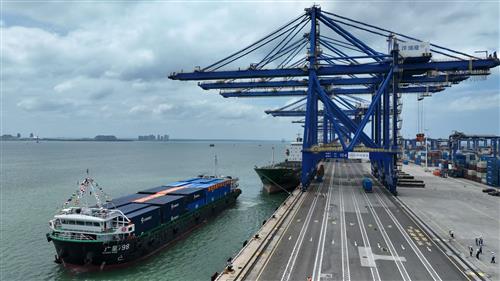
A vessel sails along the Pinglu Canal near the Madao hub. Photo: Courtesy of Pinglu Canal Group
The total volume of cargo transported through the Pinglu Canal in South China's Guangxi Zhuang Autonomous Region since it opened to navigation on September 16 has exceeded 1 million tons, the Xinhua News Agency reported on Monday, citing Beibu Gulf Port Group.
Analysts said that the canal's initial performance was in line with expectations and predicted that cargo volumes would grow further over time as more companies benefit from the waterway.
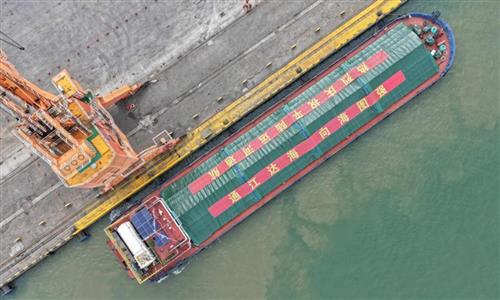
The milestone was achieved at about 9 am on Saturday, when the vessel Guigang Haitong 6688 sailed upstream out of the ship lock at the canal's Madao hub, Xinhua reported.
The 134.2-kilometer Pinglu Canal is the first canal planned and coordinated at the national level since 1949 to connect a river with the sea. It provides southwestern China with the shortest, most economical, and most convenient access to the sea.
It is a backbone project of the New International Land-Sea Trade Corridor, which is connected to the Belt and Road Initiative and marks a major addition to China's river network.
The Pinglu Canal accommodates vessels of up to 5,000 metric tons and shortens the inland waterway route to the sea by 560 kilometers compared with the traditional route via Guangzhou, South China's Guangdong Province.
The project has set four world records among comparable canals: the greatest navigation capacity, the fastest vessel passage through a ship dock, the greatest lift for a water-saving ship lock, and the largest water-saving ship lock on an inland waterway.
It is estimated that the canal will help regions along the corridor save more than 5.2 billion yuan ($777 million) annually in transportation costs.
According to Beibu Gulf Port Group, its subsidiary Nanning Port handled more than 668,000 tons of cargo in September, a new monthly high since the port's establishment.
Moving beyond traditional bulk cargoes such as mineral ores, construction materials and grain, the port has expanded its container handling and other services, including loading high-calcium limestone into containers.
Industry experts said that the canal will fundamentally reshape the logistics landscape in Southwest China.
Zheng Ping, the chief analyst at chineseport.cn, a Chinese shipping and port industry news portal, told the Global Times on Monday that the traffic data of the canal's first month of operation indicated a promising start.
"But the canal's potential is far from fully utilized. As an artificial waterway, it will take shipping companies time to secure a supply of goods, while cargo owners will need some time to assess the commercial benefits of shifting from traditional road and rail transport to water transport," Zheng said, noting that the cargo throughput is expected to increase further as more businesses recognized the canal's cost advantages.
He Junhui, director of the engineering management department of the Pinglu Canal Group, told the Global Times in August that the canal's cargo throughput was expected to reach about 5 million metric tons in 2026 and 40 million metric tons in 2027.
"With combined river-sea transport, cargo can go from Qinzhou Port all the way up to Nanning, Guigang, Liuzhou, and even Baise and via ship lifts to Funing Port in Yunnan, giving that province a long-sought outlet to the sea," He Junhui said.
Guigang, an inland river port in the Xijiang River basin, and Liuzhou, an industrial hub in Guangxi, are among the cities that will be connected by the Pinglu Canal. Baise, a former revolutionary base, will also benefit from the new waterway.
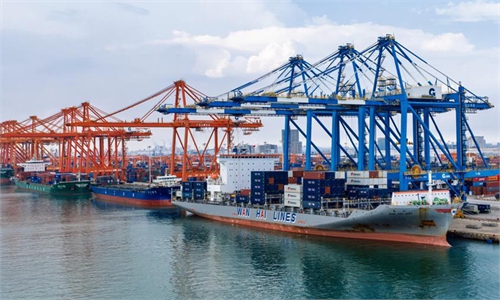
During the National Day holidays, daily cargo throughput at the Qinzhou Terminal, located at the sea entrance of the Pinglu Canal, peaked at 67,800 tons, setting a new record since the canal opened to navigation.
A total of 13 berths have been upgraded to enhance river-to-sea cargo handling capacity by 32 million tons, according to the Beibu Gulf Port Group.
RELATED ARTICLES