Protests over living costs spread across France and other European countries, exposing deepening economic and social strains: expert
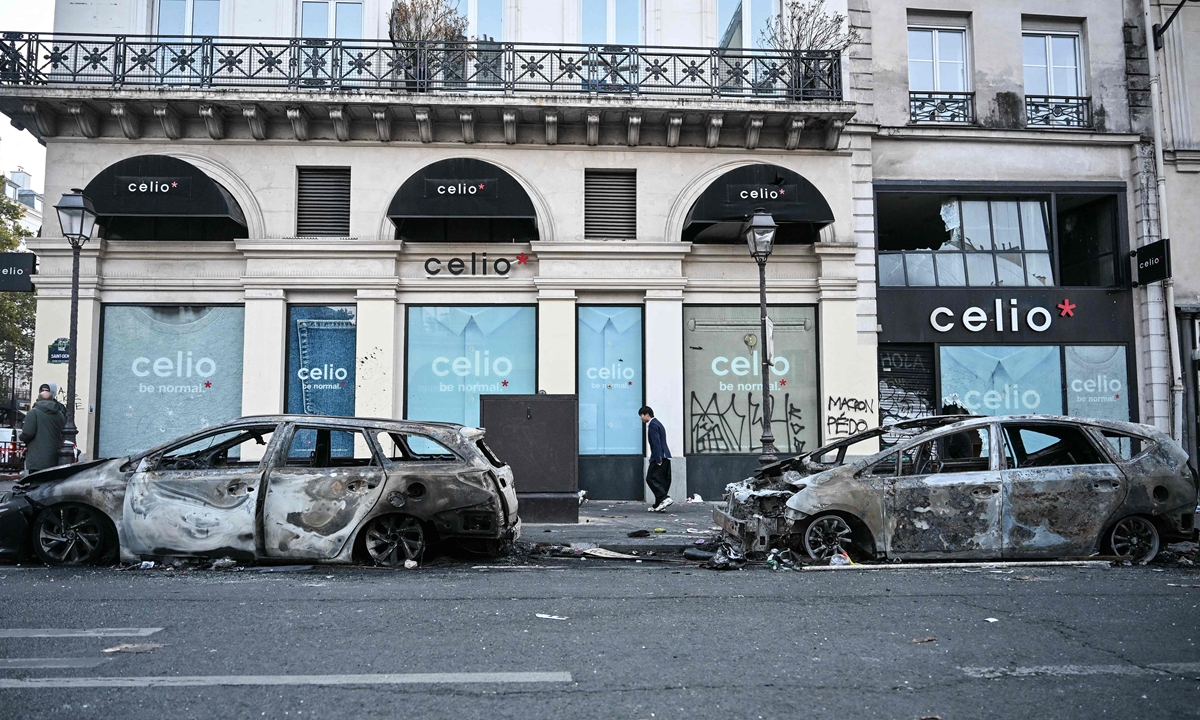
A pedestrian walks past two burnt vehicles parked on a street in Paris, France on October 18, 2026,a day after nationwide protests against the "high cost of living." Photo: VCG
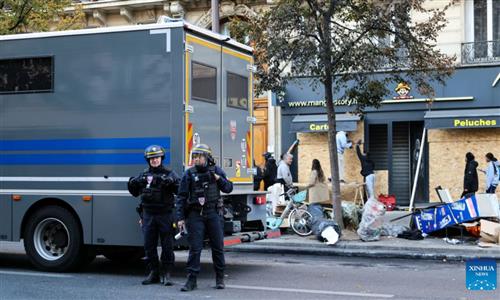
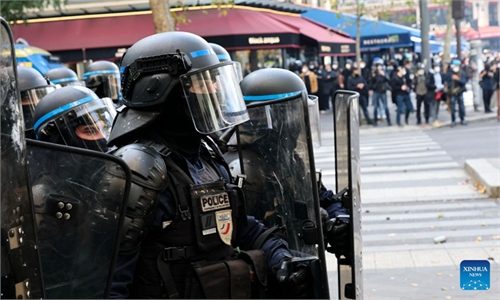
Protests over the rising cost of living and strained public services swept across Paris and several other French cities on October 17, with violent clashes, looting and arson reported in some areas, according to media reports. The unrest reflects mounting economic and social pressures in France, where sluggish growth, a widening fiscal squeeze and growing public expectations have left the government with limited room to address popular grievances, Chinese experts said.
French Prime Minister Sébastien Lecornu said on Saturday evening that about 1,200 people in the protests had been arrested and 150 police officers and gendarmes injured, reported French newspaper Le Monde. France's Interior Ministry put the nationwide turnout at approximately 550,000, while organizers estimated that 800,000 people had taken part.
The Chinese Foreign Ministry and Chinese diplomatic missions in France on Monday evening urged Chinese citizens traveling to France to remain alert to potential risks and closely monitor local developments. They advised Chinese nationals to avoid protest areas and to contact local police and Chinese diplomatic missions for assistance in an emergency. The Hong Kong Special Administrative Region Government also advised Hong Kong residents to avoid all non-essential travel to areas where protests are taking place.
Yang Zi, a Chinese student who is studying in France, told the Global Times that the protests had disrupted campus life, with most university teaching buildings closed and classes moved online, making daily life inconvenient and leaving students reluctant to go out. Seeing the city where they live damaged and ordinary people's lives disrupted had also left the student feeling uneasy, Yang said.
Yao Meng, a special correspondent for the Global Times based in France, said that many individuals dressed in black who had criminal records also infiltrated the demonstrations. They were not genuine protesters but mingled with the crowds to engage in vandalism, looting, and other criminal activities.
Yao observed that local Chinese business owners did not appear to be particularly under panic. However, if a demonstration was passing directly in front of a shop, it was advisable to close the business temporarily, as looters might target expensive items inside.
The demonstrations reflect growing public frustration over the living cost, education and working conditions in public services.
In interviews with Reuters on Saturday, students and healthcare workers described the financial pressures and difficulties they faced. One student said he was "living in precarious conditions," while a young healthcare worker at a public hospital said that "We are the ones keeping public hospitals running, but we work in very poor conditions."
Zheng Ruolin, a senior Chinese media professional and European studies expert who has lived in France for several years, told the Global Times on Tuesday that the unrest reflected deep-rooted economic and social pressures in France.
France's major problem is the gap between public spending commitments and its fiscal capacity, Zheng said, noting that the country's budget deficit and debt burden have constrained its ability to sustain social welfare and education spending at previous levels.
French public discontent had already become apparent during the Yellow Vest movement in 2018, when protests erupted over fuel taxes and broader economic grievances. But the current wave of demonstrations differed in several respects, Zheng said.
The latest protests involved younger participants, including students, and had gained support from labor unions, bringing a wider range of social groups into the movement. Economic conditions had deteriorated compared with the period of the Yellow Vest protests, while the approach of France's 2027 presidential election has added a political dimension to the unrest, he said.
France is far from alone in seeing protests over the cost of living and public concern about the consequences of rising energy prices.
Al Jazeera reported that hundreds of thousands of Europeans have taken to the streets in separate, uncoordinated demonstrations to protest against the rising cost of living in their countries.
In Italy, a march against wars and rising living costs began peacefully, but masked protesters threw stones, paving blocks and other objects at riot police and set fire to barricades made from bar tables, Al Jazeera reported. In Belgium's capital, Brussels - which has already seen weeks of protests by students against university registration fees - police fired tear gas and water cannon to disperse protesters, whom they accused of launching missiles at them and setting fires.
A Chinese tourist who visited Spain during the past China's National Day holidays also described encountering demonstrations in several cities. The tourist, identified by the username Bin on RedNote, told the Global Times that a local guide told him that demonstrations of varying sizes take place around that time of year and that some local residents had become accustomed to them.
Experts said the protests should not be treated as a single, coordinated European movement. An Al Jazeera analysis described them as several protests taking place simultaneously, with some shared grievances, including underfunded education, rising living costs and uncertainty over employment prospects among young people.
Although the specific circumstances differ from country to country, the latest demonstrations point to broader pressures facing European governments as they seek to address rising living costs, housing affordability and public service demands while operating under fiscal constraints, Zheng said.
RELATED ARTICLES