Chinese expert calls Japan’s six reports on PLA activities over two days sensationalism aimed at justifying own military buildup
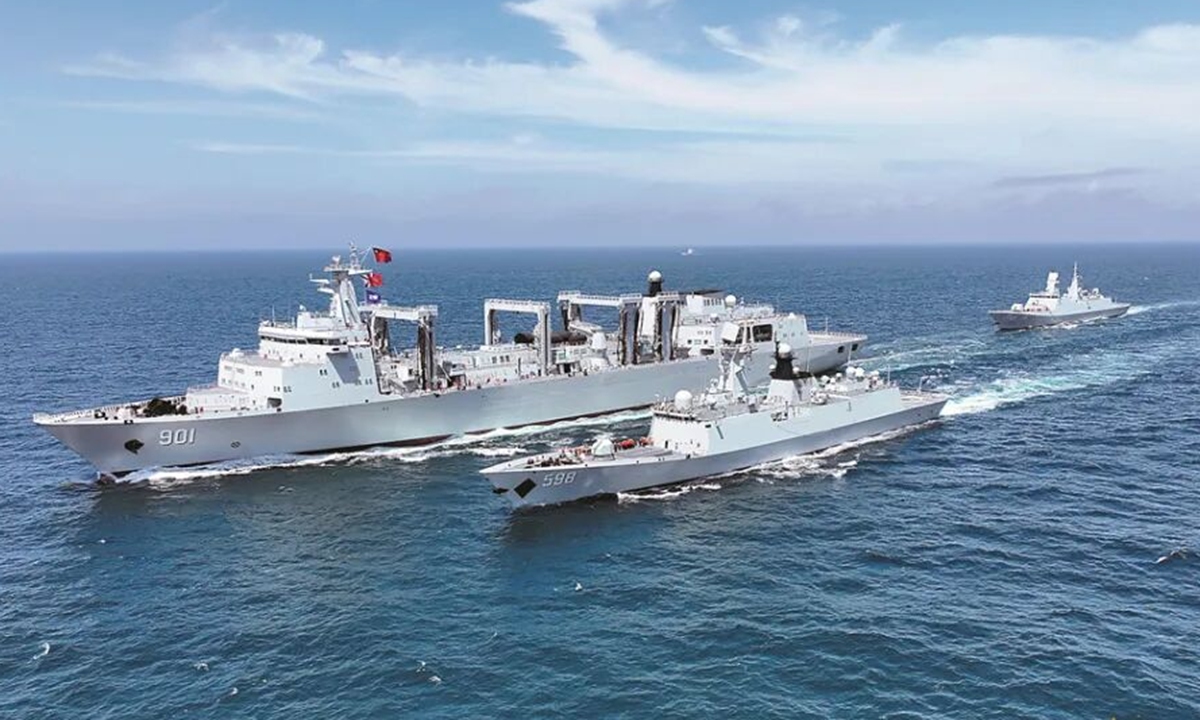
The Type 901 sea-going comprehensive replenishment ship Hulunhu (Hull 901) conducts an underway replenishment drill. Photo: China Military Online
Japan's Defense Ministry issued six consecutive reports on Chinese People's Liberation Army (PLA) ship and aircraft movements on Monday and Tuesday, covering the 48th escort task group, a supply ship, electronic reconnaissance vessels and reconnaissance aircraft. A military expert said that, with the Liaoning carrier group training in the far seas and the large US-Japan "Keen Sword 27" exercise underway, the frequent disclosures amount to alarmism aimed at justifying Japan's military buildup.On Tuesday, the ministry claimed the PLA Navy's Type 054A guided-missile frigate Jingzhou (Hull 532) had transited the Osumi Strait toward the Pacific on Monday.
Monday's five reports included one claiming that on Saturday, the PLA Navy's Type 052D destroyer Tangshan (Hull 122), Type 054A frigate Daqing (Hull 576) and Type 903A comprehensive supply ship Taihu (Hull 889) passed through the Miyako Strait into the East China Sea.
These vessels make up the PLA 48th escort task group, which set sail on October 11, 2025, and handed over duties to the 49th task force on September 7, according to reports from state media outlets. The group has not yet returned home, meaning the deployment has now exceeded a year.
The Japanese ministry also claimed on Monday that the Type 052D destroyer Qiqihar (Hull 121) and the Type 901 sea-going comprehensive replenishment ship Hulunhu (Hull 901) transited the Osumi Strait into the Western Pacific on Saturday.
Two other notices claimed the PLA Navy's electronic reconnaissance ship 796 entered the Western Pacific through the Miyako Strait on Saturday, while electronic reconnaissance ship 798 passed through the Osumi Strait into the Western Pacific between Saturday and Sunday.
A fifth notice said that on Monday, a PLA BZK-005 reconnaissance drone and a Y-9 intelligence-gathering aircraft flew from the East China Sea through the Miyako Strait into the Pacific, circled over the ocean and returned. The same day, a PLA TB-001 reconnaissance/strike drone flew from the East China Sea through the area between Yonaguni Island and Taiwan island into the Pacific.
Zhang Junshe, a Chinese military affairs expert, offered his analysis of the reports.
The Hulunhu is a new-generation comprehensive supply ship independently developed by China to world-class standards, capable of providing underway replenishment for carrier groups and far-sea maneuver formations, Zhang told the Global Times.
A carrier group typically consists of an aircraft carrier, destroyers, frigates, logistics support ships and a nuclear submarine. Japan had already released reports on two Type 055 destroyers and a Type 052D, and has now added a large comprehensive supply ship. This likely means the Hulunhu could subsequently join the Liaoning carrier group conducting far-sea training in the Western Pacific.
The PLA Navy sent the Liaoning carrier task group to the Western Pacific on October 14 for training, the PLA Navy said in a statement. This is the Liaoning's second far-sea training deployment to the Western Pacific this year, which also marks the 10th anniversary of its first such deployment in late December 2016, more than four years after the carrier entered service.
The Hulunhu can quickly conduct both alongside and vertical replenishment of large volumes of supplies with high efficiency, supporting carrier operations far from shore. If it joined the Liaoning group, the formation would gain sustained training and extended far-sea presence without port calls, enabling longer exercises and more complex drills, and improving the carrier group's ocean-going endurance, presence and combat capability, Zhang said.
Meanwhile, a large US-Japan exercise is currently underway. The US and Japan were set to launch the large-scale "Keen Sword 27" military exercise, involving more than 50,000 personnel from the SDF and US forces, on Monday, the Kyodo News reported on Saturday.
Against the backdrop of the Liaoning's far-sea training and the US-Japan drills, Zhang said, the Chinese reconnaissance aircraft and ships could provide situational awareness and intelligence support for the carrier group to a certain extent. This multi-layered reconnaissance setup reflects the PLA Navy's approach to system-based far-sea training and joint operations.
First, it builds a far-sea comprehensive support and situational awareness system, improving the carrier group's sustained combat capability and information advantage in complex waters far from base.
Second, complementary reconnaissance platforms enable three-dimensional, real-time battlefield awareness, improving information acquisition and responsiveness in complex electromagnetic environments and high-intensity confrontations.
Third, it tests and improves system-based combat effectiveness in realistic conditions, reflecting a combat-oriented training approach, the expert explained.
Zhang noted Japan's frequent releases of PLA ship and aircraft movements, sometimes multiple notices in a single day, amount to making a fuss out of nothing.
During past training, Chinese naval formations have consistently handled tracking, surveillance and harassment by foreign parties, especially Japan, in accordance with laws and regulations. The Western Pacific is not any country's backyard, and international waterways are not anyone's doorstep. Additionally, Japan's sensationalism cannot hinder the normal development of China's national defense, Zhang added.
RELATED ARTICLES