China-Europe financial cooperation in focus at Financial Street Forum, with participants highlighting green bonds, tech investment
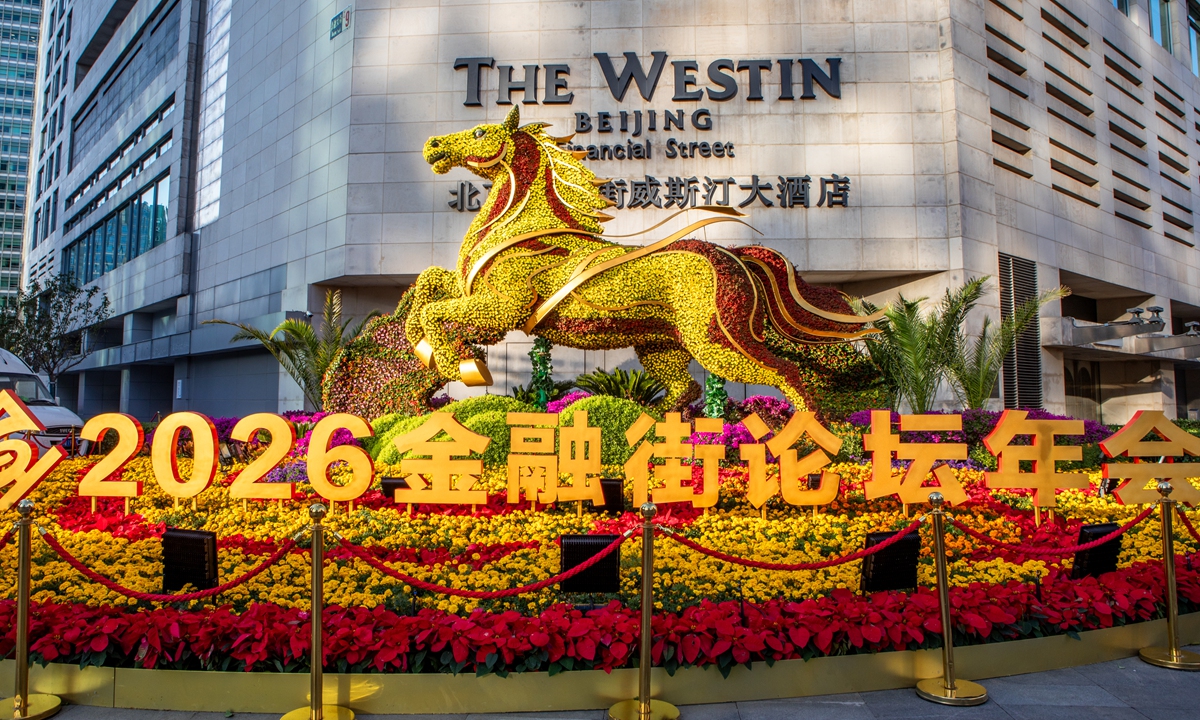
A floral installation stands at Beijing Financial Street in Xicheng District, Beijing. The 2026 Annual Conference of the Financial Street Forum opened in Beijing on October 19, 2026. Photo: VCG
China and Europe have significant potential to deepen financial cooperation, expand two-way investment and strengthen industrial ties, Chinese officials and business representatives said at a forum in Beijing on Tuesday, highlighting the role of financial connectivity in supporting businesses amid global economic uncertainties.
The China Europe Financial Investment Forum, themed "Expand Multi-faceted Cooperation, Chart a New Path," held simultaneously in Beijing and Paris as a branch forum of the Annual Conference of Financial Street Forum 2026, focused on cross-border industrial investment, supply chain resilience and sustainable development.
"As Europe's largest asset manager, we see platforms like the Financial Street Forum as part of this architecture. They let regulators, central banks and investors build the trust that cooperation depends on," Vincent Mortier, global chief investment officer of Amundi Asset Management, told the Global Times during the forum.
The discussions came as China and Europe seek to maintain economic and trade cooperation through dialogue and consultations, despite trade disputes. Their extensive commercial links provide a foundation for further cooperation, particularly in the financial sector, officials and experts said.
Sun Shuo, vice mayor of Beijing, said that China-Europe economic and trade relations are rooted in complementary advantages and mutual benefits, and that the two sides should and can achieve a dynamic balance through development.
Sun highlighted opportunities in new energy, biomedicine and high-end equipment, saying that Beijing would promote two-way investment in technological innovation and encourage cooperation in artificial intelligence and advanced manufacturing.
Beijing would also support green bonds, climate investment products and cross-border green finance platforms, while encouraging Chinese and European institutions to jointly identify promising technology projects and provide financial support to help companies move from research and development (R&D) to commercialization, according to Sun.
Also at Tuesday's forum, Liao Lin, chairperson of the Industrial and Commercial Bank of China (ICBC), said in a speech that geopolitical tensions, global debt, climate change and rapid technological development have compounded risks facing financial markets, making stronger macroeconomic policy communication and market coordination increasingly important. China and Europe should improve risk management, make better use of capital markets and long-term funding, and strengthen financial support for the green transition and digital development, Liao said.
ICBC would continue to support cross-border trade and two-way investment, deepen cooperation with European financial institutions in asset management, green finance and digital transformation, and promote the international use of the yuan, Liao said.
The potential for closer financial ties is also reflected in China-France economic relations. Wang Dong, minister at the Chinese Embassy in France, said that bilateral trade between China and France rose 14.4 percent year-on-year in the first eight months of 2026, while cumulative two-way investment had exceeded $28 billion, according to his speech.
Wang called for both sides to extend investment cooperation into R&D, industrial supporting facilities and supply chain coordination, while creating a fair, transparent, non-discriminatory and predictable business environment. He also encouraged closer connectivity in financial sectors between both sides.
Echoing Wang's call for closer financial cooperation, Li Xingqian, vice chairperson of the China Council for the Promotion of International Trade, said that Chinese and European financial institutions could expand cooperation in financial technology, green finance and cross-border supply chain finance to meet businesses' growing demand for diversified financial services.
Tuesday's discussions took place amid continued efforts by China and the EU to manage economic differences through dialogue. During recent high-level talks in Beijing, the two sides reached a 16-point consensus covering trade and investment, export controls, intellectual property rights and World Trade Organization reform, marking concrete progress in efforts to manage bilateral economic differences.
The consensus marked progress in efforts to address bilateral economic and trade concerns. Against the backdrop of global economic uncertainty, deeper cooperation could help China and Europe manage differences, strengthen supply chain resilience and inject greater certainty into the global economy, creating new opportunities for mutually beneficial development, Hu Qimu, a professor at the Maritime Silk Road Institute of Huaqiao University, told the Global Times.
RELATED ARTICLES