More foreign institutions eye panda bonds as renminbi green financing gains appeal: financial expert
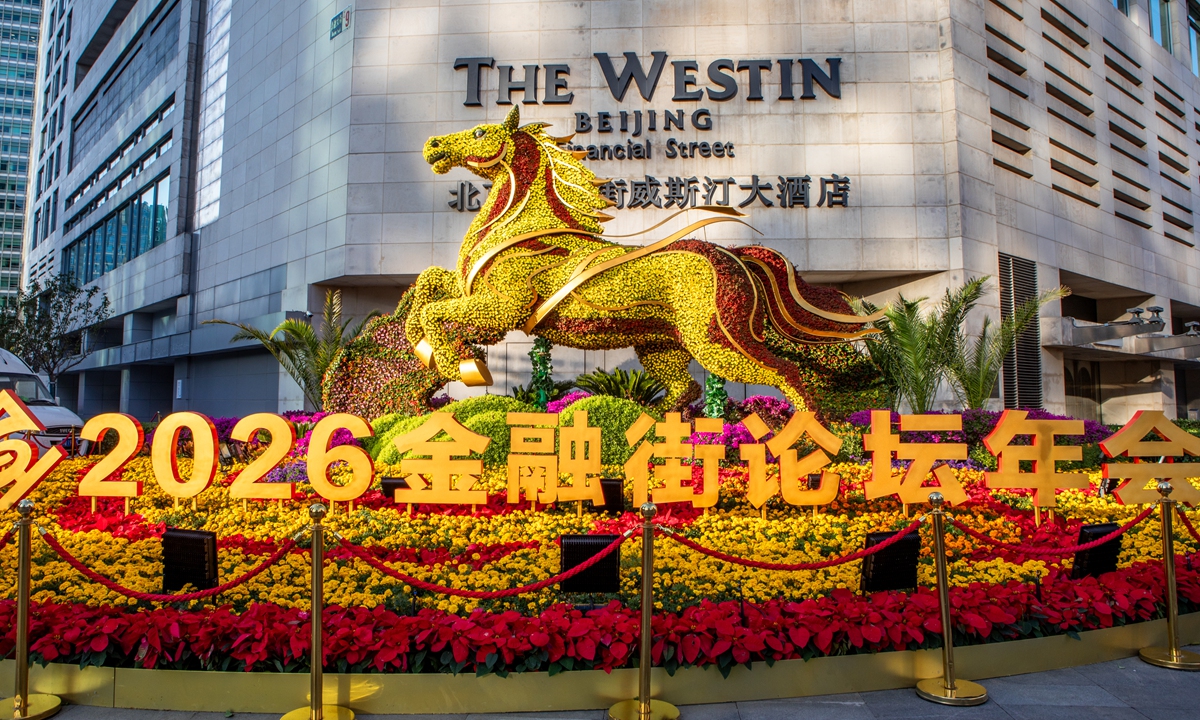
A floral installation stands at Beijing Financial Street in Xicheng District, Beijing. The 2026 Annual Conference of the Financial Street Forum opened in Beijing on October 19, 2026. Photo: VCG
More foreign institutions are expressing interest in issuing panda bonds in China, reflecting growing confidence in the country's financial opening-up, green financial system and cross-border investment and financing channels, Ma Jun, Co-Chair of the GIP Steering Committee and President of the Beijing Institute of Finance and Sustainability, told the Global Times during the Annual Conference of the Financial Street Forum 2026 on Tuesday, stressing that China's development of green finance carries important implications for other developing nations.
"In recent years, sovereign entities, corporates and financial institutions from countries including Pakistan, Egypt, Brazil and Indonesia have all tapped the panda bond market. This trend is set to accelerate. We are already in contact with many overseas institutions - at least a dozen - inquiring about how to issue bonds in China's onshore and offshore markets, and their interest is particularly strong in green and sustainable bonds," Ma said.
Panda bonds are yuan-denominated debt securities issued by overseas entities in China and are a vital financing channel for overseas institutions.
There are multiple factors behind the trend including lower renminbi financing costs. In the panda bond market, for instance, some issuers can raise capital at rates 200-300 basis points below equivalent US dollar bonds, making China's bond market increasingly attractive, Ma said. Domestically, many banks have also stepped up efforts to provide cross-border renminbi project loans to Chinese enterprises expanding overseas, with a rising number of cases involving export buyer's credit and export factoring facilities, he said.
Another important backdrop is the growing appetite among Belt and Road countries for China's green technologies and production capacity, Ma said.
China now accounts for the majority of global manufacturing capacity in solar equipment, electric vehicles (EVs) and batteries, at highly competitive costs. There are essentially two models for China's international green economic cooperation. The first is exporting products. The second model is outbound direct investment, which involves investing in production facilities abroad in sectors such as solar, wind, biomass, EVs and batteries. "In fact, I have heard firsthand from officials in countries including Indonesia, Malaysia, Thailand and Pakistan expressing a strong desire for Chinese companies to invest in their markets," Ma said.
Looking ahead, the expert identified three priorities to deepen cross-border green finance cooperation. The first is stronger promotion by Chinese financial institutions of renminbi bond markets overseas. "Many countries have never heard of panda bonds," Ma said, citing recent visits to Central Asia where some local banks expressed strong interest only after learning about the instrument.
Second, multilateral development institutions should provide guarantees to overcome rating bottlenecks for developing-country issuers. The recent case of the Asian Infrastructure Investment Bank and the Asian Development Bank guaranteeing panda bond issuance for Pakistan offers a useful template. The New Development Bank could also serve as a potential guarantor, according to Ma.
Third, regulators should advance compatibility and mutual recognition of green standards across jurisdictions. With more than 40 countries and regions now having their own green taxonomies, issuers face high costs from duplicate certification and relabeling when tapping the Chinese market. Greater alignment between standards would significantly reduce friction, he said.
"Overall, China's green development - encompassing both green finance and green technology - carries profound significance for other developing countries," Ma said.
China is itself a developing economy that has embarked on this path relatively recently. Other developing nations see themselves in China's experience, making Chinese models more relevant and practically applicable. On another level, China's green finance market is vast and offers relatively cheap capital, placing it in a strong position to support large-scale low-carbon transitions across the Global South, the expert stressed.
RELATED ARTICLES