Japanese-linked company involved in the China-Mongolia border fire should also apologize to China
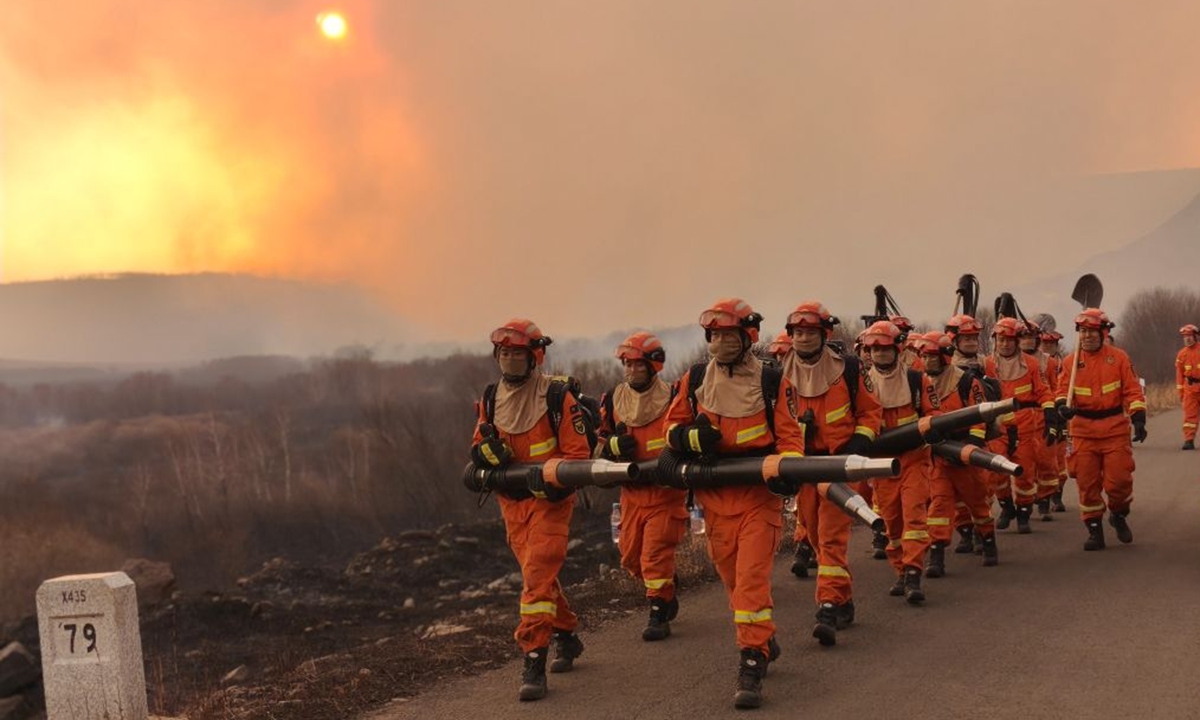
Firefighters patrol with fire extinguishing equipment at the border area in north China's Inner Mongolia Autonomous Region. More than 2,000 personnel were deployed in north China's Inner Mongolia Autonomous Region to contain a grassland fire spreading from Mongolia, local authorities said on October 11. Photo: Xinhua
The grassland fire that emerged in Mongolia on October 9 and posed a risk of entering Chinese territory has now been effectively contained, with no casualties on the Chinese side. Yasuhiro Ochi, the Japanese CEO of Mongolia's MobiCom Corporation, who is suspected of entering a protected area by vehicle to fish for the critically endangered taimen and thereby sparking the blaze, has publicly apologized to the Mongolian people and pledged to cover the damages in accordance with the investigation findings. The Mongolian government has also stated that it will hold those involved accountable and order compensation. However, as of now, the relevant Japanese-linked company has made no statement whatsoever to China, which was likewise affected by the fire.
The fire scorched a vast area and inflicted severe damage on Mongolia's Numrug Strictly Protected Area. At one point the blaze approached the border, so its impact on China was real. China did not stand by idly; instead, it bore the public cost of cross-border fire prevention. To stop the fire from spreading, China deployed more than 3,400 rescue personnel, strengthened defenses in sections, and fought for several days along a border stretching hundreds of kilometers, finally bringing the fire under control outside the border on October 13.
This inevitably raises the question: When the facts already clearly point to violations by executives of a Japanese-invested company, why does the narrative of apology and compensation cover only Mongolia, while China - the side that likewise bore enormous fire-prevention costs - has not even received a single formal statement?
It has to be said that this series of evasive and half-hearted actions is "too Japanese." The Japanese company involved first remained silent, then offered a perfunctory expression of "regret" and "compensation"; overall, its attitude has been to shirk responsibility whenever possible and delay whenever possible. Japanese media displayed an astonishing level of coordinated silence: mainstream outlets showed a striking and sustained absence in the early days of the incident, only beginning limited follow-up after public pressure had built up.
On Tuesday, a warning posted on social media by University of Tokyo scholar Megumi Ikeuchi provoked further reflection. The scholar wrote that, regarding this fire incident, Japan might launch a cognitive-warfare operation attempting to frame it as "China's cognitive warfare." That is, although the fire was caused by Japanese personnel's violations, because of Japanese media's "selective blindness," right-wing elements might next incite public opinion to smear the matter, accusing information about the fire of being China "setting the narrative" or even "waging cognitive warfare to smear Japan," thereby shifting the focus of the contradiction onto China.
Some netizens also commented that they could not understand why a fire whose burned area exceeded twice the size of Tokyo had almost gone unreported in Japan, and pointed out that the incident had an extremely negative environmental impact on both Mongolia and China.
It can be said that the arrogance and buck-passing Japan displayed years ago in the face of the Fukushima nuclear accident is being replayed today in the China-Mongolia border fire. Japan has long emphasized its "culture of apology," yet in this major fire, has that "culture of apology" been reduced to mere performance? The Japanese companies and responsible individuals involved should apologize to China. This is the basic bottom line for clarifying their own responsibility and responding to the legitimate concerns of a neighboring country's public; there is no room for evasion.
RELATED ARTICLES

