China-Pakistan drill features Type 08 IFV with roof cage, grilles
Drone, counter-drone training highly combat-oriented: expert
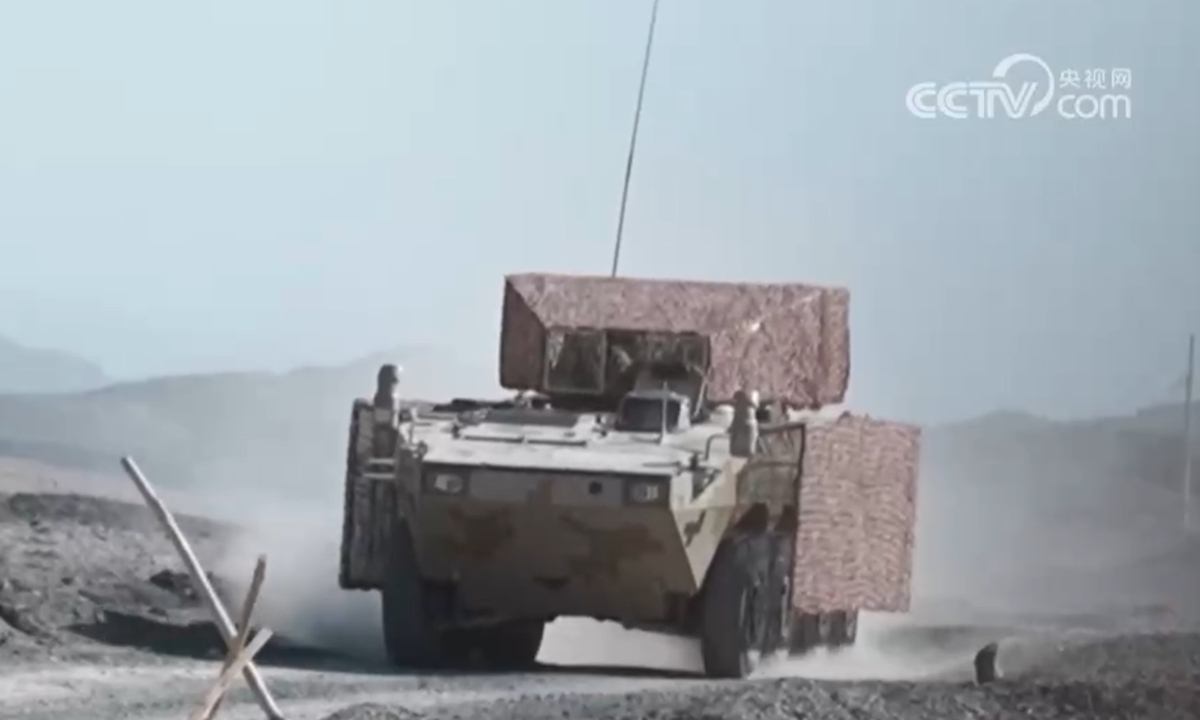
A Type 08 infantry fighting vehicle fitted with a roof cage and side grilles drives down a road during the China-Pakistan Karakoram 2026 joint army training in Korla, Northwest China's Xinjiang Uygur Autonomous Region. Photo: Screenshot from the CCTV News
The ongoing China-Pakistan Karakoram 2026 joint army training exercise in Korla, Northwest China's Xinjiang Uygur Autonomous Region, has moved into its segmented drill phase, with mixed units completing a full reconnaissance, strike and clearance sequence, CCTV News reported on Wednesday.
Highlights of the report include footage of a Chinese Type 08 infantry fighting vehicle (IFV) fitted with a roof cage and side grilles, alongside drone swarms and robot dogs deployed in live drills. A Chinese expert said such adaptations reflect lessons drawn from real combat.
Over the past few days, Chinese and Pakistani troops have moved into the segmented phase, which involves missions ranging from air-ground reconnaissance and concentrated fire strikes to search and clearance, with mixed units completing multiple tactical actions and honing joint counter-terrorism skills, reported CCTV.
At the start of the drill, reconnaissance vehicles and drones deployed simultaneously to monitor targets inside the camp, tracking the terrorists' force disposition and movements in real time. Once intelligence was gathered, the fire strike phase began immediately.
Snipers seized vantage points for long-range kills. Drone swarms launched suicide strikes on exposed targets, while ground armor fire followed to ensure full coverage.
The Type 08 IFV then carried the assault team forward, a signal that the fire strike phase had ended, said CCTV. Notably, the vehicle's roof was fitted with a metal grille, with grilles also added to its sides, specifically designed to counter drone attacks.
The roof cage on the Type 08 is a rapid tactical adaptation to drone threats, Song Zhongping, a Chinese military affairs expert, told the Global Times on Wednesday. The Russia-Ukraine and Middle East conflicts have shown militaries worldwide just how serious that threat has become. Adding roof protection to armored vehicles is a direct response, drawing on battlefield lessons to improve equipment performance.
According to Military Watch Magazine on September 12, the Russia-Ukraine conflict has substantially altered the configuration of Russian tanks. First-person view drones and other unmanned systems have made the upper surfaces, rear sections and engine compartments of tanks particularly vulnerable, with vehicles having consequently appeared with increasingly elaborate roof protection, additional armor and electronic warfare equipment intended to interfere with drone attacks.
Earlier, in November 2025, the Xinhua News Agency cited a report from German news channel n-tv that said to better protect vehicles from suicide drone attacks, Russian forces have continued to develop new countermeasures. After the introduction of improvised "turtle shell" and "porcupine" armor, photos of a novel device have circulated on social media, with military bloggers calling it the "hedgehog tank" based on its appearance.
Returning to the China-Pakistan drill, CCTV reported that once the IFV reached its position, assault troops dismounted immediately and moved into the terrorist camp, followed by several more Type 08s carrying clearance teams. As soon as they stopped, the troops dismounted. Their mission is to push deeper into the camp to eliminate remaining terrorists. These troops coordinated with robot dogs, which scouted building interiors ahead of them, reducing the risk of casualties.
Song noted that this joint training exercise is themed on joint counter-terrorism and clearance operations in high-altitude areas. However, even during counter-terrorism drills, plateau units make full use of asymmetric assets like drones. Terrorist groups also might use drones for sabotage operations, and the PLA must have sufficient means to counter the threat and challenges posed by these drones.
In high-altitude environments, drones and counter-drone tactics might see new approaches, and a set of drone and counter-drone tactics suited to plateau terrain needs to be developed. Realistic drills are essential to solidifying tactics and training, Song said.
The report noted that despite the language barrier, days of continuous skill training have built tactical chemistry among the mixed teams.
"What impressed me most about this joint training is that the Pakistani military has real combat experience, so many of their lessons are worth learning. When we enter a building and throw a grenade, we throw it far; they throw it at the ground so it bounces at speed, ricocheting two or three times instead of staying in one place. That effectively stops the enemy from picking it up and throwing it back," Pan Li, a member of a unit under the Xinjiang military command, was quoted by CCTV as saying.
Through days of training, the two sides have learned from each other's tactics, shared combat experience and further refined their skills, effectively improving joint counter-terrorism capabilities, the report said.
On October 10, Senior Colonel Chen Xi, a spokesperson for the Chinese Ministry of National Defense, announced that in mid and late October, Chinese and Pakistani armies will hold Karakoram 2026 joint army training in Korla, Xinjiang region. Focusing on joint counter-terrorism operations in high-altitude areas, the activity will include skill training in UAV operation, on-the-move target search and firing, and long-range sniping, as well as cover joint command and live-force exercises. This is the first joint army training to be carried out by the two countries, which will help the two sides deepen cooperation and strengthen interoperability in counter-terrorism.
On October 14, CCTV Military channel emphasized in a report that all weapons and equipment were provided by China, including Type 191 rifles, Type 201 squad machine guns, Type 11 armored assault vehicles, Type 08 infantry fighting vehicles, as well as artillery, unmanned and anti-unmanned systems.
RELATED ARTICLES