Unitree unveils H2-X Kung Fu Legend Guardian, sparking discussion on potential of humanoid robots serving as security guards
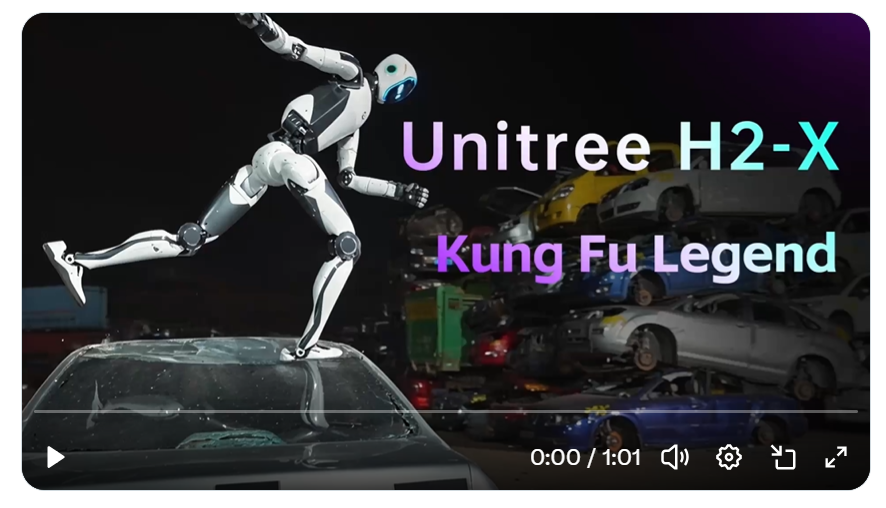
Unitree's H2-X "Kung Fu Legend Guardian." Photo: screenshot of Unitree's demonstration video
Chinese robotics company Unitree Robotics unveiled its new H2-X humanoid robot Kung Fu Legend Guardian on Wednesday. The humanoid robot showcases martial-arts-style movements in the official demonstration video, while also showing how it can potentially be applied in security and rescue scenarios - such as shielding a person from an attack, lifting the front of a car with its bare hands, and responding to a simulated traffic accident.
Unitree said that the robot has a maximum operating time of about eight hours, compared with approximately three hours for the standard H2 model. The release, coming at a time when humanoid robots move from labs to factories, sparked heated discussion among Chinese and international users overnight over the strong physical capabilities demonstrated by the Chinese company, with some netizens expressing hope that "one day, having one humanoid robot as a security guard to watch the house will be more than enough" at the rate the industry is developing.
On Chinese social media platform Weibo, the topic "Unitree robot demonstrates lifting a car to rescue people" sparked heated discussion among netizens and appeared on Weibo's trending list on Thursday.
A Weibo netizen named Wangxiumeihui said on Thursday that the latest application in a rescue scenario is "very practical."
"It is a natural development trend to manufacture humanoid robot security guards. The key lies in control technology — to do good, not harm," a Chinese Weibo user named Lu Xixin said in a post on Thursday.
Another netizen commented that "I still remember three years ago this thing could barely stand steady. I'm already starting to look forward to next year's Spring Festival Gala." Unitree's humanoid robots have appeared on the Spring Festival Gala multiple times, demonstrating more complex and agile movements each year.
Most users on the Weibo platform were amazed by the prowess of China's humanoid robot technology and how it increasingly unfolds a wide range of real-world applications. Some users praised the robot's energetic movements, and expressed hope that its combination of strength and agility could eventually prove useful in rescue and protective operations.
On X, one user named Ray Wang commented in Japanese that "the H2-X was developed on Unitree's H2 platform for applications including security, emergency response and patrols, highlighting its martial-arts movements and athletic performance."
Another user named Darius Dawid called the endurance figure impressive but argued that the future of humanoid robots will be determined by a number of factors including autonomy, safety and reliability. "China is moving incredibly fast. Now show us what this machine can do in the real world," the user noted.
Unitree founder Wang Xingxing said at a conference on Thursday that embodied intelligence could reach its "ChatGPT moment" as early as next year, when robots achieve a breakthrough in understanding and executing real-world tasks, pushing the industry into a new stage.
"Physical artificial intelligence is already showing signs of a breakthrough, most likely within the next one to two years, or two to three years," Wang said in a speech at the 2026 World Physical AI Conference and Unitree Partner Ecosystem Conference held in Hangzhou, East China's Zhejiang Province on Thursday, according to media reports.
Commercial service applications will land faster than those in households and industry, he said. According to Wang, Unitree's G1 robot has had roughly 10,000 to 20,000 units roll off the production line since its launch in May 2024, making it the world's best-selling humanoid robot.
Global Times
RELATED ARTICLES