ARTS / CULTURE & LEISURE
'He felt he was coming home': US art historian James Cahill’s daughter remembers his dialogue with China
Homecoming of legacy
By Published: Oct 22, 2026 09:04 PM
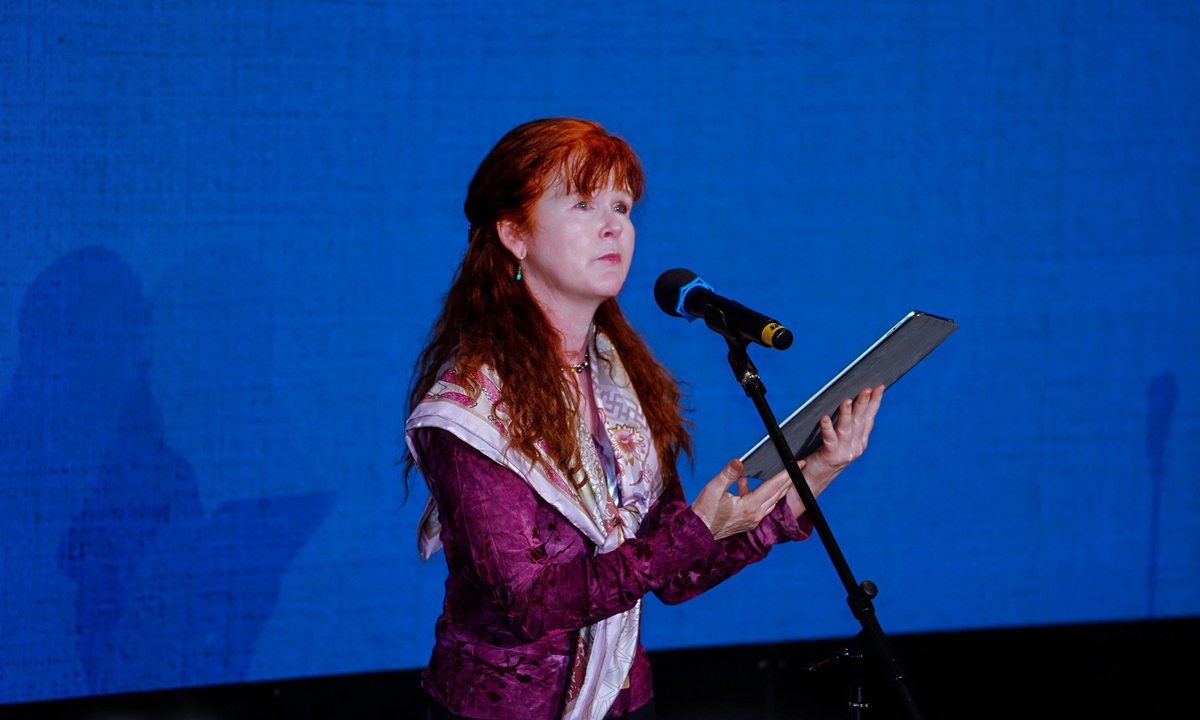
Sarah Cahill, daughter of American art historian James Cahill Photo: Courtesy of China Academy of Art
When Sarah Cahill arrived in Hangzhou on October 17 for events marking her father James Cahill's birth centennial, she unveiled a bronze bust of the US art historian on the campus of the China Academy of Art (CAA).
James Cahill was one of the most influential overseas scholars of Chinese art history since the mid-20th century. The inscription beneath the bronze bust described him as "a towering peak in Western scholarship of Chinese art history." Yet, according to Sarah, the tribute that would have moved her father most was simpler: the thousands of students who still read his books and watch his lectures.
"When I met students at the symposium who were engaging with my father's books and video lectures, and saw them published in translation in China, in beautifully conceived editions made accessible to students, that was, for my father, a dream come true," she said in a recent interview with the Global Times.
Sarah was in Hangzhou for Stones from Other Hills, a series of events commemorating her father (1926-2014). The program included an international symposium on his legacy, an exhibition of his donated books and archives, and the premiere of a documentary on his life.
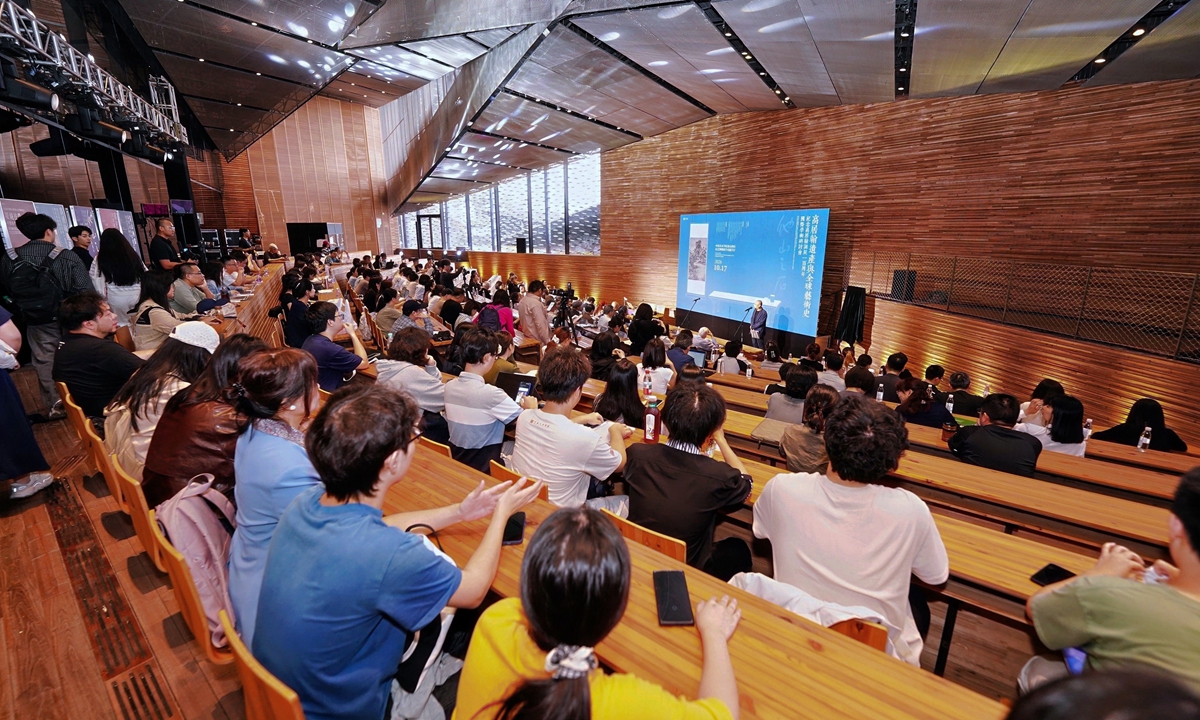
Students attend events in Hangzhou on October 17, marking the centennial of James Cahill's birth. Photo: Courtesy of China Academy of Art
Letters from the West Lake
Her father first saw the West Lake in 1973, at the end of his first journey through China as a member of one of the first US art and archaeology delegations after President Richard Nixon's historic visit. He wrote home that the light on the water looked "just like a Southern Song painting."
"It was deeply affecting to read his descriptions of the West Lake after he had made a lifetime study of the painters from that region," Sarah said. "He could see firsthand, finally, the landscape and terrain that had inspired some of his favorite artists. In his letters, he describes the lake in painterly terms, in tones of great excitement."
China had fascinated him long before he ever set foot there.
"Western organized religion didn't interest him. He always said he was far more interested in Confucianism and Taoism than in any Western religion," she recalled. "Since the 1940s he had been immersed in Chinese art and culture, and I can imagine how astonishing it was for him to visit China for the first time in 1973."
James returned in 1977 as head of a US delegation. In the early years of China's reform and opening-up, he began what became a 30-year friendship with the China Academy of Art. In 1994 he became the first incumbent of the academy's Pan Tianshou Lecture.
"He freely admitted that he had some unorthodox ideas about Chinese painting, which met with some resistance from scholars and colleagues in the United States, and also some in China," his daughter said. "The China Academy of Art welcomed him and understood what his scholarship was trying to achieve. He felt at home among like-minded intellects."
What did that friendship give him and her family? "He was delighted to create such a close connection to the CAA, where he could engage in cross-cultural exchange," she said.
In 2012, James sent his lifetime library - 112 boxes of books, slides and more than 12,000 images, from Berkeley to Hangzhou, insisting that the collection become a working research library.
"He was highly impressed by the caliber of scholarship and intellectual debate, and felt a closer connection to the CAA than to most colleges and universities in the United States," Sarah said. "He felt his books would be valued."
"He was very proud that his library of books are now at the CAA. When Professor Zhang Jian and his team came to Berkeley and spent several weeks organizing, packing and shipping his library, my father was very happy spending time with them, talking about the books and about future generations of students who could find them helpful."
Art beyond borders
After her father's death, Zhang's team returned to Berkeley and shipped many more boxes of books. "It is so meaningful to become friends over the years," she said. "Now I have other great friends at the CAA and in Hangzhou and elsewhere in China, and hope to welcome them in California soon as well."
Asked what she hoped China would do with everything her father had recorded - the books, the letters, the free video lectures he taped in his final years, the blog he updated until two days before his death - her answer was characteristically generous.
"I think what he wanted was for China to use whatever might be helpful in his books, video lectures, letters and various materials - to be inspired, open-minded, receptive. He wanted everything to be accessible to everyone, and it is wonderful that the CAA is carrying on that legacy."
Growing up, she often felt she was sharing her father with a country. "If he wasn't traveling, he was writing his books or delivering lectures. It didn't seem fair," she admitted. "It wasn't until much later, when I was already in my 40s, that I truly understood his strong engagement with China."
She said that, in an era when headlines often widen the distance between the West and China, art reaches something the news never can.
She recalled her father's habit of placing paintings side by side: Leonardo da Vinci's Mona Lisa fills almost the entire canvas, while in Lu Hui's Waterfall on a Cold Cliff, two figures stand in the mountains, water and pines.
"It is far better to understand our humble place in nature rather than conquer it so we can take over the whole picture," she said.
"Looking at Chinese painting, and respecting that ancient culture, is of critical importance to those of us in the West who believe in the power of art, music and literature to build bridges between the East and West."
RELATED ARTICLES