IN-DEPTH / IN-DEPTH
The Journey of Xinjiang cotton: Mechanized, smart farming drives Xinjiang’s cotton harvest, countering ‘forced labor’ narrative
By , Tan Furong and Fan Lingzhi in Shihezi, Bayingolin and Aksu Published: Oct 22, 2026 10:55 PM

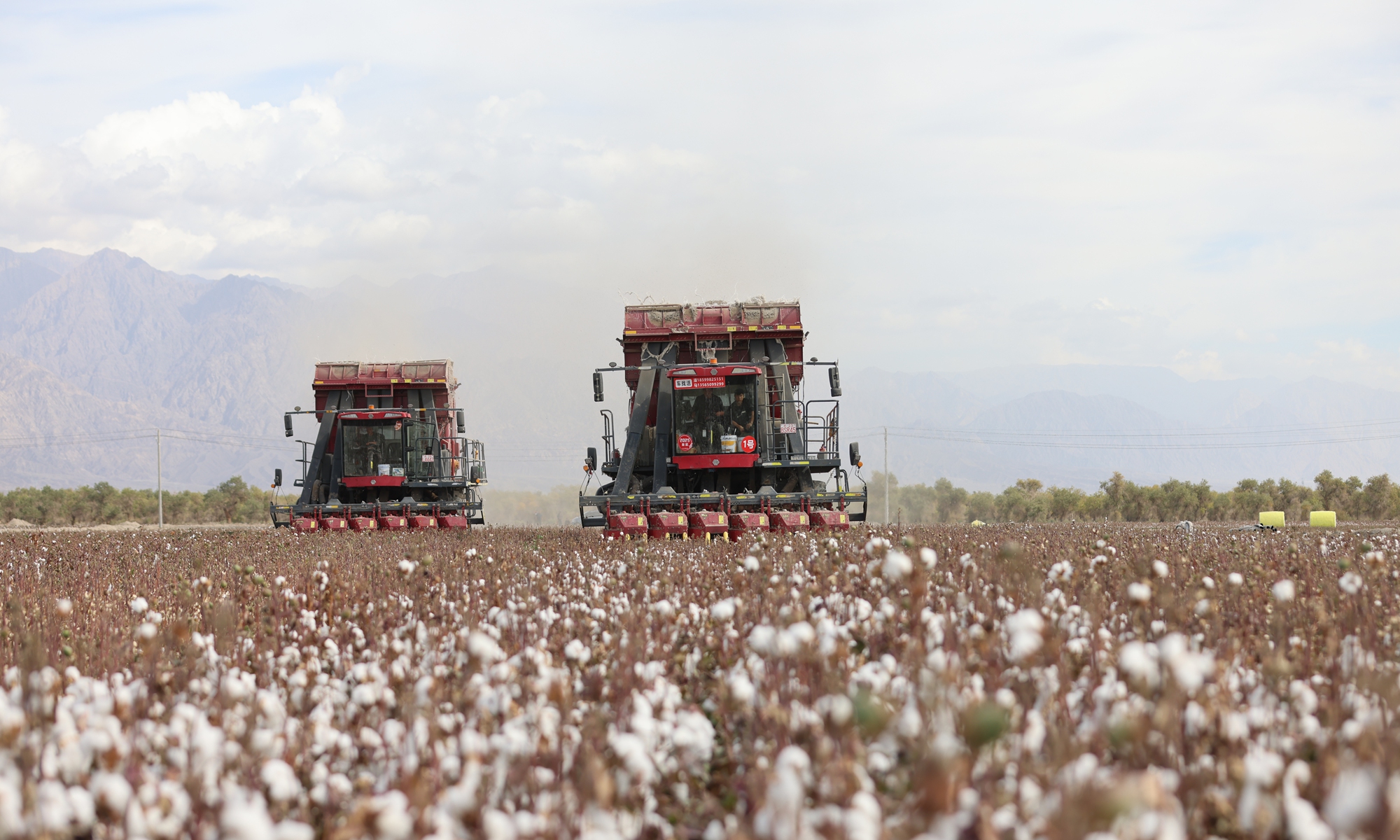
Large cotton harvesters move through a cotton field in Yeyungou village, Luntai county, Northwest China's Xinjiang Uygur Autonomous Region, on October 10, 2026. Photo: Courtesy of Tursun Osman
Golden October brings cotton harvest season to Tohula village in Luntai county, Northwest China's Xinjiang Uygur Autonomous Region. Standing beside the endless cotton fields stretching at the foot of the Tianshan Mountains, Global Times reporters saw integrated harvesters shuttling back and forth, completing harvesting, compaction and baling. Behind them sit round modules of seed cotton, each weighing around 1.5 tons.
Hundreds of kilometers to the south, workshops at a textile firm in Shaya county of Aksu Prefecture hum with continuous high-speed blow-room, carding, drawing and spinning lines. Only a handful of workers patrol and monitor the lines, while the roar of machinery fills the air. The harvested seed cotton is ginned and spun here into cones of premium yarn, before moving along industrial chains to textile hubs and markets across China and beyond.
This is the journey of a single cotton boll in Xinjiang: sprouting from saline-alkali soil, turned into yarn in smart factories and woven into the fabric of high-quality development.
Super cotton field
"We now manage 200 hectares of land with just two people," said Ai Haipeng, a post-90s farmer, who runs a smart farm in Yuli county, the Bayingolin Mongolian Autonomous Prefecture, proudly introducing his "super cotton field" to the Global Times.
Under traditional farming practices, 20 workers would have to live on-site, with each tending to 10 hectares of land to handle fertilization, irrigation and other farm chores. "Now intelligent devices and robots do all the work. Managers only need to oversee the equipment," said Ai.
Five years ago, Ai and his fellow post-90s partner Ling Lei installed soil sensors, farm activity loggers and other devices across the cotton field of the smart farm. They developed a low-labor, near-unmanned management model for this 200-hectare high-standard farmland. After the upgrade, the farm yields over 500 kilograms of cotton per mu, while overall costs drop by roughly 254 yuan ($38) per mu - a 22 percent reduction.
Ai gave an example: crop-spraying drones can now refill chemicals, recharge and carry out operations autonomously with no human input. The hardware is almost entirely domestically developed and manufactured, and "it is very reliable," he said.
Cotton growers across Xinjiang have long reaped the benefits of mechanization and smart farming. Luntai county, also in Bayingolin Mongolian Autonomous Prefecture at the southern foot of the Tianshan Mountains, was once a key hub and supply station along the central route of the ancient Silk Road. Today it stands as a major high-quality cotton production base in Xinjiang. Hu Qiguo, head of Xingyu Agriculture in Tohula village, told the Global Times that machine picking costs 0.5 yuan per kilogram of cotton, compared with 2 yuan per kilogram for manual picking.
"Cotton harvest season used to be our biggest headache. Manual picking was slow, labor costs kept rising and we had to scramble to recruit pickers. Machine harvesting now costs around 160 yuan per mu, and a 100 mu (6.7-hectare) cotton plot can be fully harvested in roughly six hours," said Hu.
The drop from 2 yuan to 0.5 yuan per kilogram reflects an agricultural technological revolution spanning decades. In Luntai county, the mechanized cotton harvesting rate exceeds 96.7 percent. In 2025, Xinjiang region's overall mechanization rate for cotton planting, field management and harvesting hit 97 percent, with the machine-harvesting rate staying steadily above 90 percent.
"Local residents can collect the cotton left behind by machines in the fields, with wages settled every five days," said Abulizi Tuerdi, Party branch secretary of Tuohula village in Luntai. "Workers can earn roughly 2,000 yuan in 10 days, and anyone willing to work is welcome."
Public research data from the Xinjiang Academy of Agricultural and Reclamation Science and the Institute of Cotton Research of the Chinese Academy of Agricultural Sciences shows mechanically harvested cotton normally achieves a picking cleanliness rate of 93 to 95 percent. Those few percentage points of cotton missed by harvesters account for nearly all the remaining manual picking work in Xinjiang today.
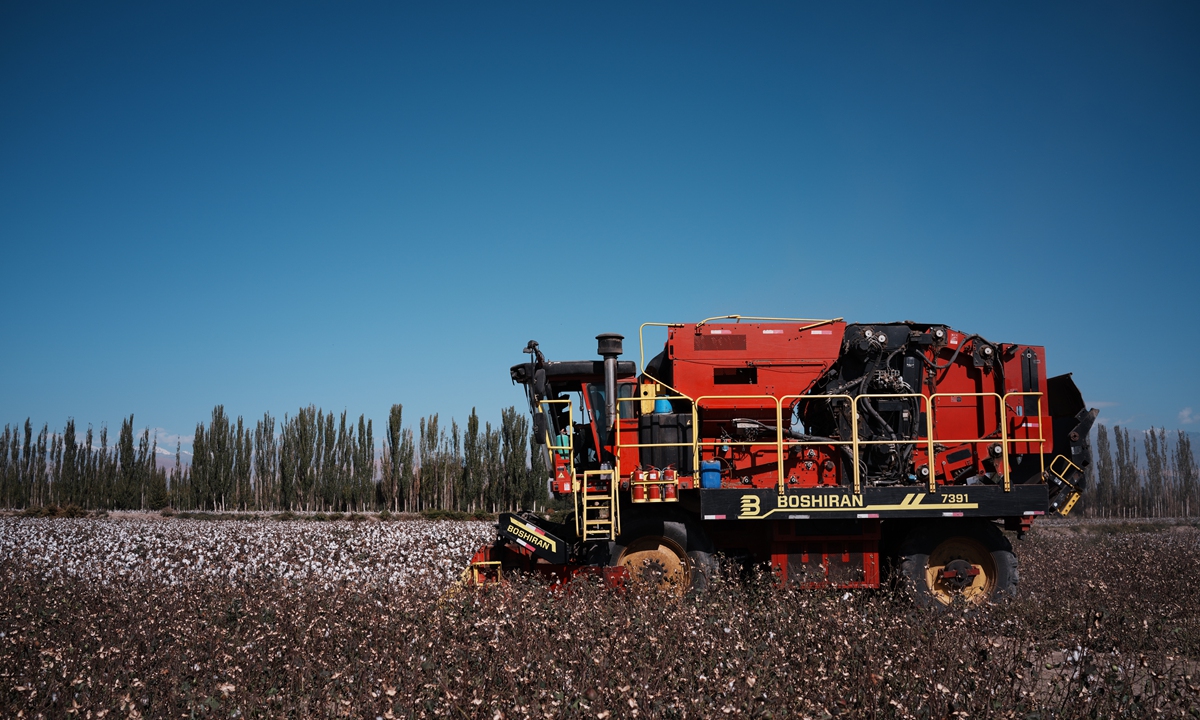
Large cotton harvesters carry out mechanized harvesting operations in a cotton field in Bayingolin Mongolian Autonomous Prefecture, Xinjiang. Photo: Fan Lingzhi/Global Times
Hard-fought path
"Be careful as you walk through. Each plot here grows a different cotton variety. We need to collect samples separately for research and must not mix them up," Dr Long Yilei from Xinjiang University reminded the Global Times reporters during their visit to the experimental fields at the modern agricultural innovation center in Kuqa city, Aksu Prefecture.
Plump, heavy cotton bolls hang thick on the plants across the trial plots. These flourishing cotton bushes stand as a testament to the years of dedicated work by Xinjiang University's machine harvestable cotton breeding team, which has set up a base at the innovation center and rooted itself in southern Xinjiang region. Professor Ai Xiantao, head of the School of Smart Agriculture at Xinjiang University and deputy secretary general of the cotton society of China Association of Agricultural Science Societies, leads the team.
Ai Xiantao told the Global Times that compared with other major cotton regions worldwide, Xinjiang faces tough natural conditions for cotton growing. Key cotton producers such as the US and Australia enjoy far more favorable soil and water resources. Yet today, Xinjiang not only posts the world's highest cotton yield per unit area but also boasts globally leading production technologies. "That is no small achievement," Ai Xiantao said.
According to Ai Xiantao, this remarkable progress in Xinjiang cotton breeding comes from "joint efforts by scientists across all disciplines." Breeders strive to boost yield, fiber quality and stress resistance; soil specialists work tirelessly to suppress and leach salt from saline-alkali land; water and fertilizer researchers focus on high efficiency-water saving drip irrigation.
"Our machine picked cotton package of 'short, dense, early planting with film mulching,' dry sowing and wet emergence, integrated water fertilizer drip irrigation and whole growth chemical regulation are world leading technologies," introduced the professor.
Xinjiang is now China's largest production base for premium cotton and commercial cotton seeds.
Locally bred varieties account for more than 90 percent of its cotton crops, and all long staple cotton grown here is home bred. Xinjiang long staple cotton outperforms ordinary cotton in fiber length, fineness and tensile strength, earning it a reputation as world-class fiber. "China's cotton farming know-how is highly valuable for many arid and semi-arid nations, and numerous Belt and Road partner countries have come to learn from us," Ai Xiantao said.
In recent years, cotton breeding in Xinjiang has also entered a new era of AI-driven biological breeding, powered by genomics and big data. As China's top premium cotton producer, Xinjiang turns out over 90 percent of the nation's cotton. One out of every five kilograms of cotton worldwide comes from Xinjiang, the Global Times has learned from the center.
Good seeds need good soil. Vast stretches of saline-alkali land in Xinjiang were once deemed barren wastelands. In the Moguhu area of Shihezi city, soil salinity once stood at around 17 parts per thousand, with thick white crusts of salt covering the ground. The area could not support cash crops such as cotton. Only water-intensive, weakly growing rice could barely survive, resulting in extremely low farmland utilization efficiency and long-term constraints on agricultural production.
When the Global Times reporters visited the Moguhu modern water-saving agricultural demonstration base run by Xinjiang Tianye Group, they saw that the landscape has been utterly transformed. The cotton fields have just been harvested. Integrated weather stations, soil moisture sensors, pest monitors and video cameras dot the fields to collect real-time meteorological, soil and water data. Automated water control valves fitted with remote sensing antennas and photovoltaic panels work alongside drip irrigation lines to form an efficient smart irrigation network.
"Everything can be controlled with one tap on a mobile app - it's very convenient," Wang Shiwei, a technician, told the Global Times.
The secret behind this transformation from saline-alkali wasteland into high-yield smart farmland lies in the independently developed core subsurface pipe drainage technology for salt control. Following the principle that "salt travels with water," the system fundamentally tackles surface salt accumulation caused by heavy evaporation under arid conditions. Leveraging the weak acidity of carbon dioxide dissolved in water, the innovation uses weakly acidic water to neutralize residual salt in the soil.
This approach not only recycles carbon emissions from chemical plants but also breaks the cycle of recurring soil salinization that has long plagued land remediation efforts. Today, soil salinity across the zone has dropped from 17 parts per thousand to below 3 parts per thousand. So far, Tianye Group has built demonstration bases in 17 Belt and Road partner countries, with a total promoted demonstration area of 13,333 hectares.
Integrating engineering, agronomic and digital water conservation with saline-alkali land restoration, carbon recycling and smart farming, the model offers an affordable, replicable and scalable solution - a global public good advancing food security, water security and climate resilience for arid Belt and Road partner countries, according to Wang.
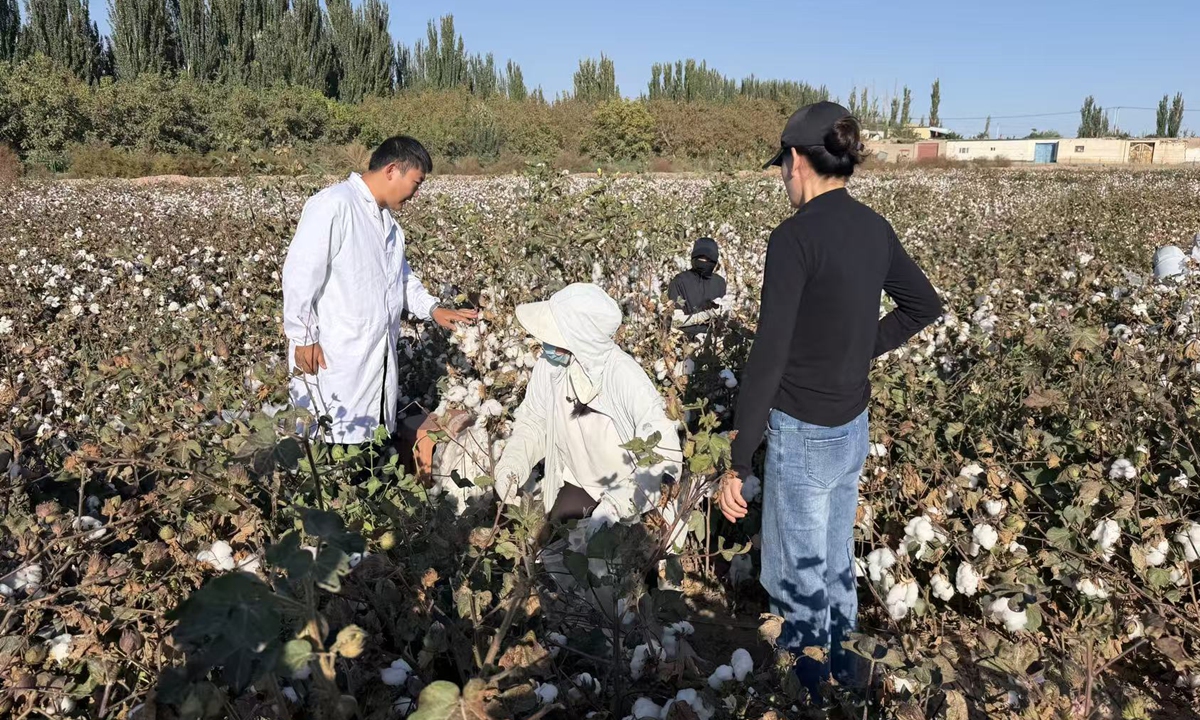
Dr Long Yilei and his colleagues from a modern agricultural innovation center in Kuqa city, Aksu Prefecture, work in the experimental fields on October 9, 2026. Photo: Liu Xin/Global Times
For people's wellbeing
In Xinjiang, the transformation of the whole cotton industry chain is ultimately woven into the everyday lives of countless families, delivering tangible, down-to-earth improvements to people's wellbeing.
Yasin Imin, born in 1982 in Shaya county, Aksu Prefecture, began working as a ferryman on the Tarim River with his father at the age of 16. "Back then, there was no running water or electricity. My father and I endured tremendous hardship," Yasin Imin told the Global Times.
"Later, power lines were installed and life got a little easier. Bridges were built across the Tarim River, which meant fewer and fewer needed the ferry."
As mechanization spread across Xinjiang's cotton fields, Yasin Imin and his family decided to set up an agricultural cooperative. Local authorities warmly backed their plan and helped them secure startup loans. Today, the cooperative farms more than 466 hectares of cotton land. It has purchased five planters, one drone and two cotton harvesters, and employs nearly 70 villagers under formal labor contracts.
Asked about his income, Yasin Imin spoke with pride: "In good years, I make over one million yuan. I've placed an order for 3,000 sheep to arrive next spring, and I plan to raise more cattle and sheep."
Stories like Yasin Imin's abound across Xinjiang. Every household has its own unique experience, yet they share the same uplifting trajectory: escaping poverty to secure basic subsistence, then moving toward moderate prosperity; shifting from small scattered plots to large-scale operations; and swapping backbreaking manual labor for skilled, tech-enabled farming.
As cotton farmers thrive, institutions protecting their rights keep improving. On July 1, the cotton quality promotion regulation in Xinjiang took effect - China's first local statute targeting the cotton sector. The regulation lays out clear penalties for payment arrears and mandates a full-chain digital traceability system, so every cotton bale is "traceable from its source, trackable to its destination and accountable for liabilities."
The Xinjiang region's cotton story is far from finished. Every autumn, the roar of harvesters marks a fresh chapter. As China enters the start of its 15th Five Year Plan period, this industrial story taking root across the Tianshan range continues to unfold.
While local farmers are embracing modern farming with high mechanization, allegations from certain Western countries over "forced labor" are laughable to them. Yasin Imin posed a rhetorical question: "They claim we use 'forced labor,' yet we rely on machines. Do we force machines to work?" He said his cotton fields and other cotton and textile factories are open for visitors to come and see the humming machinery for themselves.
RELATED ARTICLES