Ninety years on, the great Long March spirit is a light shining on the world: Global Times editorial
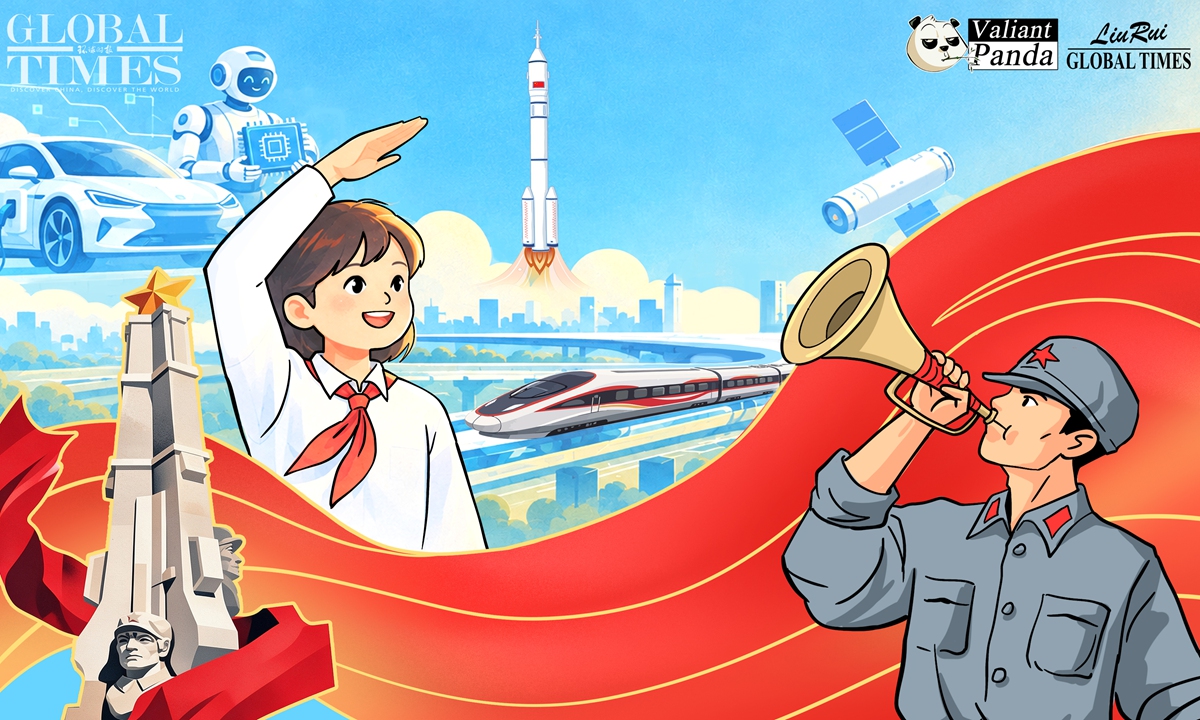
Marching toward prosperity. Illustration: Liu Rui/GT
The great Long March spirit has been deeply etched into the DNA of Chinese society. It is the determination to rise to challenges and to persist for the long haul; it is the courage to fear no sacrifice and to dare to try; it is the clarity to face reality and actively seek change; and above all, it is the original aspiration of standing with the people through life and death, sharing weal and woe, and striving arduously.
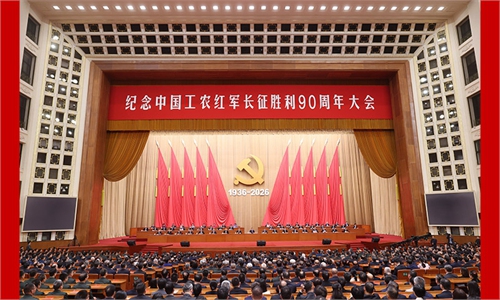
The 90th anniversary of the victory of the Long March of the Chinese Workers' and Peasants' Red Army was commemorated at a grand gathering in Beijing on Thursday morning. General Secretary of the Communist Party of China (CPC) Central Committee Xi Jinping, also Chinese president and chairman of the Central Military Commission, attended the gathering and delivered an important speech.
Xi stressed that the great spirit of the Long March demonstrates the power of loyalty, truth, justice and unity. As an important part of the spiritual lineage of the CPC, it transcends time and space and remains evergreen. It will always be a precious treasure and a powerful driving force inspiring us to overcome difficulties and forge ahead courageously.
The Long March was a beam of light that burst forth from the Chinese nation at its darkest hour. It showed the world clearly that, even in an old China mired in darkness with no visible way out, there was a group of people striving with all their might to build a new China. In the book The Life Millennium: The 100 Most Important Events and People of the Past 1000 Years, published by the American Time-Life Books, scholars from around the world jointly selected 100 events that shaped the world from 1000 to 2000 AD. The Long March of the Red Army was one of three historical events from China to make the list. It profoundly inspires people that as long as one remains firm in will and unyielding in the face of setbacks, a way out can always be found through continuous exploration, and an entirely new path can be opened.
From Edgar Snow to Henry Kissinger, from Nelson Mandela to Fidel Castro, many observers and strategists have pondered why this Long March in the East was able to succeed. To this day, whenever China astonishes the world with technological breakthroughs or reshapes perceptions with development miracles, the world still asks: "How do the Chinese do it?" These questions all point to the same answer: We have found the right path - a path of never yielding, always moving forward, and never retreating. The Long March is both a spiritual treasure that inspires the Chinese people and a display of the Chinese nation's resilient character to the world.
Today, the term "Long March" has become a shared name for any arduous journey that ultimately reaches its destination. In this sense, the value of the Long March lies not only in the arrival itself, but in the act of continuing to set forth, again and again. After the victory of the Long March, the nation did not stop: It kept marching through the flames of the War of Resistance Against Japanese Aggression, kept advancing on the tide of reform and opening-up, and continues to advance under the call of the new era, all the way toward the great rejuvenation of the Chinese nation.
Today, the great Long March spirit has been deeply etched into the DNA of Chinese society. It is the determination to rise to challenges and to persist for the long haul; it is the courage to fear no sacrifice and to dare to try; it is the clarity to face reality and actively seek change; and above all, it is the original aspiration of standing with the people through life and death, sharing weal and woe, and striving arduously.
Ninety years on, the great Long March spirit no longer belongs only to history; it is a light that grows ever brighter and shines upon the world. Currently, global governance is experiencing a "darkest hour": climate change, the North-South divide, geopolitical conflicts, and the undercurrents of deglobalization.
Old paradigms are failing, and new rules have yet to take shape. Solving many major issues requires long-term planning and sustained effort that transcend political cycles and short-term gains and losses.
The spirit of firm conviction, unity and cooperation, and unyielding struggle transcends national borders and ideologies. It inspires humanity to overcome adversity and pursue a brighter future. This both suggests that global governance needs to blaze new trails toward common development, common security, and common prosperity, and helps the world better understand the spiritual bedrock of the Chinese nation, enabling outsiders to better grasp where this "enabling great power" is heading.
"Where the spirit lies, there lies the strength." The great Long March spirit resonates with the Chinese nation's cultural tradition of constant self-improvement and has gained new contemporary meaning in the process of Chinese modernization. While it is no longer possible for China today to replicate the march back then, this spirit will always remain, proving to the world that the Chinese nation possesses extraordinary resilience.
After decades of struggle, China has long since become the world's second-largest economy and is comprehensively advancing the great rejuvenation of the Chinese nation through Chinese modernization.
The enduring national resilience behind the great Long March spirit has been a key factor in creating this development miracle. It is the confidence that allows China to navigate storms and seize the historical initiative, and it also provides a stabilizing expectation for a world full of uncertainty.
In the 1980s, Zbigniew Brzezinski, who once served as US national security advisor, walked with his family along the route once taken by the Red Army. He later reflected: "The Long March is more than an epic of almost unmatched heroism." Today, more and more foreigners are coming to China to retrace the Long March route, and places like Loushan Pass have once again become a popular destination for visitors. This is one indication that the great Long March spirit is increasingly needed by the world. As a spiritual monument that the Chinese nation has offered to the world, its importance will become even more prominent in the future. As military writer Wang Shuzeng once described: "The Long March belongs to that category of events in human history which, even after the passage of long years, continue to be sought after by people."
"The history of the Long March has never faded; the road of the Long March continues to extend." For China, on the new journey, the Long March has no endpoint.
To carry forward the great Long March spirit is to always maintain a high-spirited posture of storming passes and seizing fortresses, to continue the arduous trek on the journey of Chinese modernization, and to respond to all risks and challenges with an unstoppable fighting spirit. It is to both successfully navigate the Long March of our own generation and infuse a world marked by turbulence and transformation with confidence and strength from the East.
RELATED ARTICLES