Xi calls for new achievements on new Long March
‘Only by remembering history can we create a brighter future’
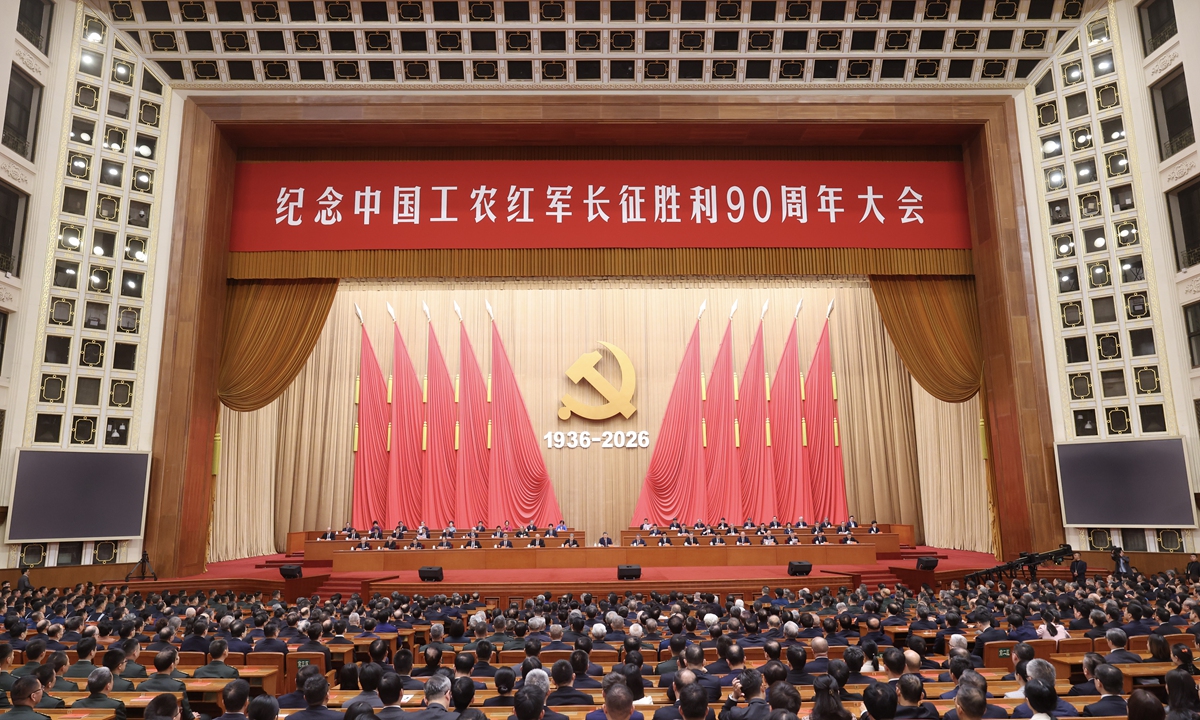
A gathering commemorating the 90th anniversary of the victory of the Red Army's Long March is held at the Great Hall of the People in Beijing, capital of China, on October 22, 2026. Photo: CNS Photo
Chinese President Xi Jinping on Thursday called for new achievements on the new Long March as China commemorates the 90th anniversary of the victory of the Red Army's Long March.
"Only by remembering history can we create a brighter future," said Xi, also general secretary of the Communist Party of China (CPC) Central Committee and chairman of the Central Military Commission, when addressing a gathering held in Beijing to mark the anniversary, according to the Xinhua News Agency.
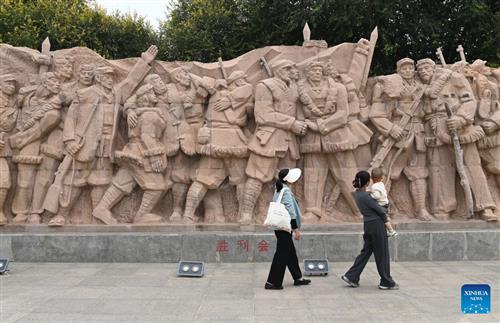
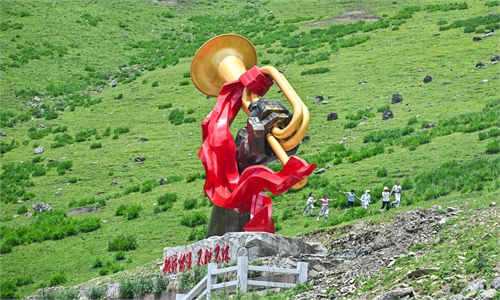
The Long March was an epic military trek from 1934 to 1936 that broke through the encirclement of Kuomintang forces. Some Red Army soldiers marched as far as 12,500 kilometers, in a maneuver that helped lay the foundation for the eventual victory of the Chinese revolution.
Nine decades later, the anniversary offers an opportunity to consider how the lessons of that journey continue to inform China's development. Chinese experts pointed to self-reliance, decisions grounded in reality and the ability to adapt under pressure as sources of strength for the country's modernization, from scientific innovation and the green transition to military development.
Long March spirit
"This earth-shattering revolutionary feat holds great significance in the history of our Party, country and military, and has a profound impact on our path toward the rejuvenation of the Chinese nation," Xi noted, according to Xinhua.
He said the great spirit of the Long March demonstrates the power of loyalty, truth, justice and unity. "It will always be a precious treasure and a powerful driving force inspiring us to overcome difficulties and forge ahead courageously."
That spirit emerged from a struggle for survival. In 1934, the CPC was forced to abandon its main base in Jiangxi and Fujian provinces after failing to repel the Kuomintang regime's fifth encirclement and suppression campaign. That October, some 86,000 Red Army soldiers crossed the Yudu River in East China's Jiangxi Province and embarked on the grueling 12,500-kilometer journey. Many lost their lives during the roughly two years that followed. American journalist Edgar Snow hailed the journey as "an odyssey unequaled in modern times."
Revisiting this history is about drawing wisdom and strength for further progress, Yang Zhe, an associate professor at the School of Marxism at Beijing Forestry University, told the Global Times. Looking back after 90 years offers a deeper understanding of why the victory was inevitable and of the principles that enabled the CPC and the people's military to advance, Yang said.
The significance of the anniversary therefore extends beyond remembering a military expedition. It also invites reflection on the path China has traveled and the choices that will shape its future.
Seeking truth from facts was a crucial element of the Long March spirit, Song Zhongping, a Chinese military affairs expert, told the Global Times. The victory depended on strategies, tactics and strategic guidance grounded in actual conditions, together with the Party's absolute leadership over the military, he said.
These principles helped establish the correct course for the Red Army, Song said. The experience demonstrated the importance of combining firm leadership with an accurate understanding of the circumstances in which decisions must be made.
New journey
During the address, Xi said the road of the Long March continues to extend. "On our new journey, we are now committed to realizing the Second Centenary Goal of building China into a great modern socialist country in all respects and advancing the rejuvenation of the Chinese nation on all fronts through a Chinese path to modernization," he said, Xinhua reported.
To forge ahead on the new Long March, Xi said, it is imperative to stay committed to the Party's ideals, convictions and purpose and rely closely on the people to create new achievements.
The Long March was a turning point in CPC history, and its significance lies in both the victory and the experience and lessons it left behind, Yang said. Those lessons remain relevant when established approaches failed to provide adequate answers to new problems.
"When faced with difficulties and setbacks, we must find a way forward based on our own circumstances, rather than mechanically applying established doctrines or simply copying others' experience," Yang added.
Navigating an increasingly complex and unpredictable international environment requires strategic resolve alongside tactical flexibility, Yang said. "Today, as China advances modernization amid profound global changes, we face new 'snow-capped mountains' and 'grasslands.' The way forward must be forged through action and exploration."
Chinese observers noted that profound global changes are accelerating and reshaping international cooperation and competition. China's development faces strategic opportunities alongside risks and challenges. While opportunities outweigh challenges, uncertainties are increasing. Against that backdrop, China is playing a growing role as a stabilizing force internationally while advancing in fields including nature, technology and energy.
An October 14 news feature in Nature described China as one of the world's largest spenders on research and development, a leader in patent applications and a dominant force in research into dozens of crucial technologies, including nuclear energy and synthetic biology. Chinese universities and research institutes are rivaling established Western academic leaders and have reached the top of the Nature Index rankings for the first time, the feature said.
Beyond spending and rankings, the report highlighted breakthroughs attracting global attention, from the development of game-changing artificial intelligence models to the first successful retrieval of rock samples from the far side of the Moon.
"Instead of competing mainly through its advantages in low labour costs, China is increasingly competing through its technological abilities, innovation ecosystems and the control of technologies," Hao Bin, an economist at Xi'an Jiaotong-Liverpool University in Suzhou, was quoted by Nature as saying.
China's green transition offers another example of its changing development capabilities. In the first half of 2026, China's installed renewable energy capacity reached 2.455 billion kilowatts, accounting for 60.7 percent of its total power generation capacity. By the end of July, solar photovoltaic power had overtaken coal to become the country's largest power source by installed capacity.
These advances take place amid geopolitical conflicts and overlapping crises. The ability to identify shortcomings and make timely adjustments is essential to opening new possibilities under difficult conditions, Yang said, describing it as a lesson from the Long March that remains relevant to challenges in semiconductors, technological self-reliance and the green transition.
Rigorous Party self-governance
The drive for modernization also extends to national defense. Xi emphasized the importance of moving more quickly to reinforce the people's armed forces to world-class standards and adhering to the Party's absolute leadership over the military.
It is also vital to uphold the leadership of the Party, strengthen Party building and persevere with full and rigorous Party self-governance, he added.
An August 1 PLA Daily article marking Army Day described the effort to build a strong military as a cause requiring sustained work across generations. During the 15th Five-Year Plan period (2026-30), the military should build on achieving its centenary goals and press ahead toward basically realizing the modernization of national defense and the armed forces, the article said. This places new and higher demands on pursuing that modernization with high quality.
For Song, the Party's leadership over the military, equipment development and the course of military modernization are all part of the new Long March. The Red Army once faced severe limitations in equipment; today, China's stronger economy and technological capabilities provide a foundation for further advances in its defense industry and modern weaponry, he said.
An increasingly complex international environment and the need for stronger combat and equipment capabilities make the lessons of the Red Army's victory particularly relevant, Song said. "China's military modernization is itself a new Long March. Remembering the experience behind the Red Army's victory will help the PLA achieve even greater successes."
RELATED ARTICLES