Along the Long March route, clean energy and ecological restoration are reshaping relationship between people and fragile landscapes
By Published: Sep 16, 2026 10:27 PM

At Jiaoping Ferry on the Jinsha River, Pei Xinghui now runs a restaurant called Boatmen's Home. Its name reaches back to her grandfather Zhang Chaoman, one of 37 local boatmen who spent seven days and nights ferrying the main force of the Central Red Army across the river in May 1935.
Pei's own life was later reshaped by the same river. Her family moved from its old home in 2020 during the construction of the Wudongde Hydropower Station. As visitors began arriving to retrace the Long March route, she and her husband opened the restaurant near their new community.
Pei's family story reflects the broader transformation unfolding along the Long March route, where green development is changing both the landscape and the livelihoods built around it.
The wooden boats that once carried Red Army soldiers across the big river have long since given way to a bridge spanning the reservoir. Roads and power lines wind through the valleys around snow-covered mountains. Rows of solar panels now rise above grazing land on the vast grasslands.
Ninety years ago, the same river, mountain and wetlands formed some of the most difficult stretches of the Long March. From October 1934 to October 1936, the Chinese Workers' and Peasants' Red Army soldiers left their bases and marched through raging rivers, frigid mountains and arid grassland to break the siege of the Kuomintang forces and continue to fight the Japanese aggressors. Some of them marched as far as 12,500 kilometers, the Xinhua News Agency reported.
The Long March was a remarkable turning point for the Communist Party of China (CPC) and China's revolutionary cause. The "Long March spirit" is also summarized as seeking truth from the facts, strict self-discipline, acknowledgment of the overall interests of the people, solidarity and involving people from all walks of life, according to Xinhua.
In this story, we return to three representative points along the Long March route, the Jinsha River, Jiajin Mountain and Ruoergai Grassland, to examine how hydropower, transport links, resilient electricity networks, wetland restoration and solar projects are changing places once remembered primarily for hardship and isolation.
A river crossed, a corridor built
In May 1935, after moving across Guizhou and into Yunnan, the Central Red Army needed to cross the Jinsha River and continue north. The current was fast, the banks were steep and pursuing forces were closing in. At Jiaoping Ferry, 37 local boatmen worked for seven days and nights, using a handful of wooden boats to carry the main Red Army force across the river, per Xinhua report.
The episode is usually remembered as the "Red Army's clever crossing of the Jinsha River." Yet it was not a military story alone. It depended on people who knew the river: where a boat could land, how the current shifted and how repeated crossings could be made with limited equipment.
Among the boatmen was Zhang Chaoman, then in his 20s. His granddaughter, Pei Xinghui, later ran a small grocery shop near the Jiaoping Ferry bridge of the Jinsha River.
Her family's life remained tied to the river until another major change arrived: Construction of the Wudongde Hydropower Station required residents in the reservoir area to move.
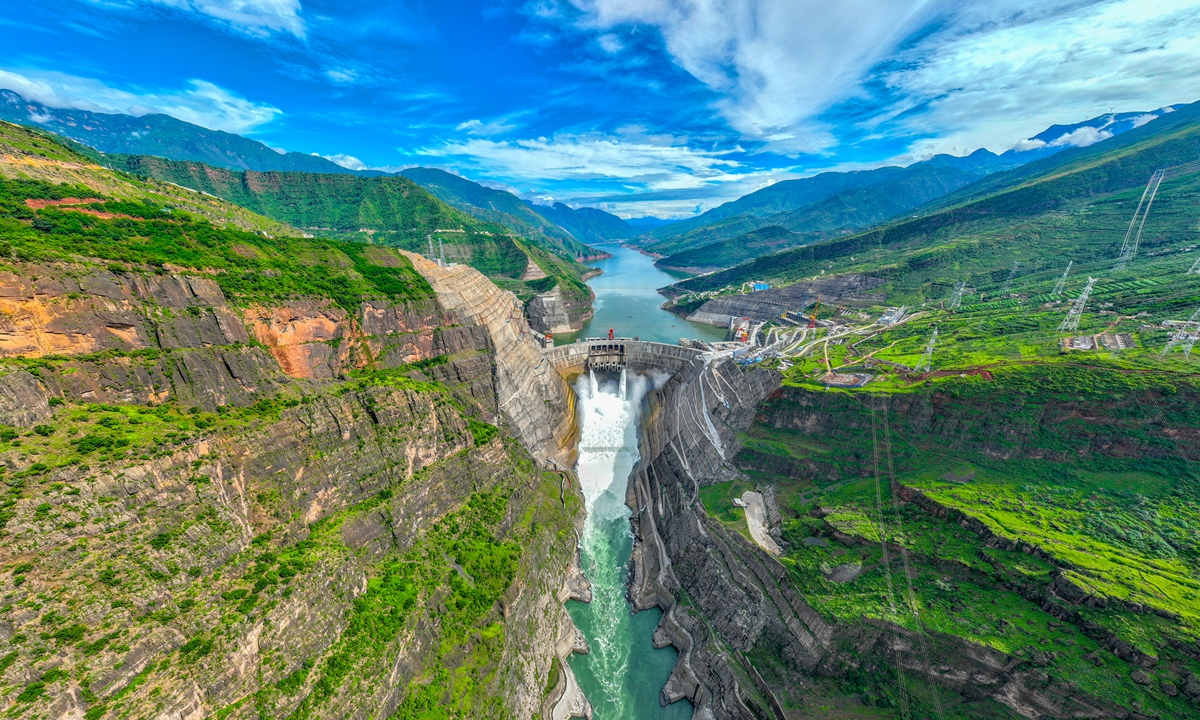
The Wudongde Hydropower Station today sits on the Jinsha River, which splits Southwest China's Sichuan and Yunnan provinces. It became fully operational in June 2021, when its 12th and final generating unit entered service. With a total installed capacity of 10.2 million kilowatts, the station has a designed average annual output of 38.91 billion kilowatt-hours, according to the National Energy Administration.
Wudongde is the uppermost of four cascade hydropower stations on the lower Jinsha River, together with Baihetan, Xiluodu and Xiangjiaba. These four stations, along with the Three Gorges and Gezhouba stations on the middle reaches of the Yangtze River, form a 1,800-kilometer clean-energy corridor, Xinhua reported.
New housing and roads created better conditions, but a better life still had to be built through one's own work, Pei said.
Beyond conquering the mountain
North of the Jinsha River, the Long March route rose toward Jiajin Mountain in today's Baoxing County, Southwest China's Sichuan Province. In June 1935, the Central Red Army crossed it, the first major snow-covered mountain on its route. Thin air, cold and rapidly changing weather turned altitude into a threat as serious as the mountain path itself.
More than 90 years later, the old route also passes through a landscape where transport, local livelihoods and wildlife protection have to be managed together.
The change is visible at the Jiajin Mountain Tunnel, which began trial operation in October 2025. The 9.35-kilometer tunnel shortened the drive across the mountain from about one hour to 10 minutes and provided a year-round link for around 110,000 residents on both sides, the People's Daily reported.
As the route lies within the Giant Panda National Park, its ventilation passage was changed from a conventional shaft to a parallel tunnel to avoid large-scale excavation of the mountain. Builders also removed or centrally disposed of construction spoil and used energy-saving ventilation, natural lighting and wastewater recycling.
Jiajin Mountain is part of the Giant Panda National Park and also lies within the UNESCO-listed Sichuan Giant Panda Sanctuaries. The World Heritage site contains more than 30 percent of the world's wild giant pandas and is the largest remaining contiguous habitat for the species. It also supports red pandas, snow leopards and clouded leopards.

The same protection system stretches across several mountain ranges. During the Global Times reporters' visit to Hongkou in Dujiangyan, another part of the park's Sichuan section, Yang Guorong walked through the forest with an all-female patrol team made up of seven local women. The team patrols five routes twice a month. A short route takes about four hours; a longer one can take seven or eight. Along the way, members look for illegal logging, unauthorized entry and poaching, while recording signs of wildlife and plants.
At the time of the interview, infrared cameras had identified "16 wild pandas from two panda populations" in the Dujiangyan area, Liu Bo, head of the Hongkou protection station, told the Global Times. The women rarely see the animals directly. More often, they hear calls or find fresh droppings before the pandas move away from human scent.
The patrol work also involves explaining conservation rules to neighbors whose communities overlap with panda habitat.
Yang said local residents had found other sources of income, including growing medicinal herbs and working in ecotourism. "Previously, we relied on the forest to survive. Now, we protect it," she said.
Power and protection on the grasslands
Beyond the snow mountains, the Red Army entered the Songpan grasslands during the Long March. According to Xinhua, the historical grassland route covered areas that are now part of Songpan, Hongyuan, Aba and Ruoergai counties in Sichuan. What appeared to be open meadow was often waterlogged wetland, with concealed bogs and few clear paths, making the grassland crossing one of the most difficult sections of the journey.
Ninety years after the Long March concluded, this landscape remains defined by water. Ruoergai lies in the upper reaches of the Yellow River, and its wetlands cover 292,700 hectares, according to the National Forestry and Grassland Administration. Work now focuses on restoring degraded grassland and peat marshes, controlling desertification and monitoring the wildlife that depends on the wetland ecosystem.
That work can still require people to enter places vehicles cannot reach. Suolang Duoerji, head of the scientific research section of the Sichuan Ruoergai Wetland National Nature Reserve administration, told the Global Times that a field survey usually lasted five days. During earlier surveys, he recalled, water sometimes reached team members' waists, forcing them to hold onto a rope and move forward step by step.
The reserve has hired 85 local residents to patrol the area and monitor biodiversity, including wild wolves, Suolang told the Global Times. He said the "greater Ruoergai wetland" covers Ruoergai, Hongyuan and Aba counties. An estimate in 2020 put their combined wild wolf population at about 200, while a systematic survey in 2023 recorded 343. The latter survey combined infrared-camera monitoring with the tracking of animal traces.
Conservation is not the only change taking place along this section of the Long March route. In Ruoergai's Tangke and Xiaman townships, CTG is developing a photovoltaic and sand-control project with a planned capacity of 1 million kilowatts and investment of about 4.4 billion yuan. Its 40,000-kilowatt first phase was fully connected to the grid on May 31, 2025, the Global Times learned.
The first phase covers about 60 hectares, and contains approximately 78,000 photovoltaic modules. By May 31, 2026, it had generated 62.62 million kilowatt-hours of electricity, according to project materials. A 960,000-kilowatt second phase is scheduled to begin construction in 2027 and achieve full grid connection by the end of 2029.
Company materials describe a three-layer model: solar panels generate electricity, livestock graze between the panel rows, and sand-control measures stabilize the soil below. The first phase is expected to deliver an annual average of 75.08 million kilowatt-hours to the grid, combining power generation with grazing and the treatment of degraded land.
Patrols continue as the solar project moves forward. Local herders are familiar with the pastures and are often the first to notice changes in wildlife activity, vegetation and wetland conditions, Suolang told the Global Times.
Their knowledge remains essential in the same difficult grasslands once crossed by the Red Army, placing reliance on local people - an element of the Long March spirit - within the daily work of ecological protection and development.
Pei's own life was later reshaped by the same river. Her family moved from its old home in 2020 during the construction of the Wudongde Hydropower Station. As visitors began arriving to retrace the Long March route, she and her husband opened the restaurant near their new community.
Pei's family story reflects the broader transformation unfolding along the Long March route, where green development is changing both the landscape and the livelihoods built around it.
The wooden boats that once carried Red Army soldiers across the big river have long since given way to a bridge spanning the reservoir. Roads and power lines wind through the valleys around snow-covered mountains. Rows of solar panels now rise above grazing land on the vast grasslands.
Ninety years ago, the same river, mountain and wetlands formed some of the most difficult stretches of the Long March. From October 1934 to October 1936, the Chinese Workers' and Peasants' Red Army soldiers left their bases and marched through raging rivers, frigid mountains and arid grassland to break the siege of the Kuomintang forces and continue to fight the Japanese aggressors. Some of them marched as far as 12,500 kilometers, the Xinhua News Agency reported.
The Long March was a remarkable turning point for the Communist Party of China (CPC) and China's revolutionary cause. The "Long March spirit" is also summarized as seeking truth from the facts, strict self-discipline, acknowledgment of the overall interests of the people, solidarity and involving people from all walks of life, according to Xinhua.
In this story, we return to three representative points along the Long March route, the Jinsha River, Jiajin Mountain and Ruoergai Grassland, to examine how hydropower, transport links, resilient electricity networks, wetland restoration and solar projects are changing places once remembered primarily for hardship and isolation.
A river crossed, a corridor built
In May 1935, after moving across Guizhou and into Yunnan, the Central Red Army needed to cross the Jinsha River and continue north. The current was fast, the banks were steep and pursuing forces were closing in. At Jiaoping Ferry, 37 local boatmen worked for seven days and nights, using a handful of wooden boats to carry the main Red Army force across the river, per Xinhua report.
The episode is usually remembered as the "Red Army's clever crossing of the Jinsha River." Yet it was not a military story alone. It depended on people who knew the river: where a boat could land, how the current shifted and how repeated crossings could be made with limited equipment.
Among the boatmen was Zhang Chaoman, then in his 20s. His granddaughter, Pei Xinghui, later ran a small grocery shop near the Jiaoping Ferry bridge of the Jinsha River.
Her family's life remained tied to the river until another major change arrived: Construction of the Wudongde Hydropower Station required residents in the reservoir area to move.
An aerial drone photo shows a view of the Baihetan hydropower station on the Jinsha River in Southwest China. Photo: Courtesy of CTG
In 2020, Pei's family left its old home and moved to a resettlement community near the station. The relocation opened another livelihood, according to the China Three Gorges Corp (CTG), the operator of the Wudongde project.The Wudongde Hydropower Station today sits on the Jinsha River, which splits Southwest China's Sichuan and Yunnan provinces. It became fully operational in June 2021, when its 12th and final generating unit entered service. With a total installed capacity of 10.2 million kilowatts, the station has a designed average annual output of 38.91 billion kilowatt-hours, according to the National Energy Administration.
Wudongde is the uppermost of four cascade hydropower stations on the lower Jinsha River, together with Baihetan, Xiluodu and Xiangjiaba. These four stations, along with the Three Gorges and Gezhouba stations on the middle reaches of the Yangtze River, form a 1,800-kilometer clean-energy corridor, Xinhua reported.
New housing and roads created better conditions, but a better life still had to be built through one's own work, Pei said.
Beyond conquering the mountain
North of the Jinsha River, the Long March route rose toward Jiajin Mountain in today's Baoxing County, Southwest China's Sichuan Province. In June 1935, the Central Red Army crossed it, the first major snow-covered mountain on its route. Thin air, cold and rapidly changing weather turned altitude into a threat as serious as the mountain path itself.
More than 90 years later, the old route also passes through a landscape where transport, local livelihoods and wildlife protection have to be managed together.
The change is visible at the Jiajin Mountain Tunnel, which began trial operation in October 2025. The 9.35-kilometer tunnel shortened the drive across the mountain from about one hour to 10 minutes and provided a year-round link for around 110,000 residents on both sides, the People's Daily reported.
As the route lies within the Giant Panda National Park, its ventilation passage was changed from a conventional shaft to a parallel tunnel to avoid large-scale excavation of the mountain. Builders also removed or centrally disposed of construction spoil and used energy-saving ventilation, natural lighting and wastewater recycling.
Jiajin Mountain is part of the Giant Panda National Park and also lies within the UNESCO-listed Sichuan Giant Panda Sanctuaries. The World Heritage site contains more than 30 percent of the world's wild giant pandas and is the largest remaining contiguous habitat for the species. It also supports red pandas, snow leopards and clouded leopards.
Located on the route of the Long March, the Jiajin Mountain area is a habitat for giant pandas. Photo: VCG
Long Chongjiang, a ranger with the Jiajin Mountain Forestry Bureau in Baoxing, has spent nearly 20 years on forest patrols. He told Xinhua that he had watched the forest grow denser over that period. Photographs on his phone showed red pandas and golden snub-nosed monkeys. After the national park was established, Long and his colleagues increased the frequency of their patrols.The same protection system stretches across several mountain ranges. During the Global Times reporters' visit to Hongkou in Dujiangyan, another part of the park's Sichuan section, Yang Guorong walked through the forest with an all-female patrol team made up of seven local women. The team patrols five routes twice a month. A short route takes about four hours; a longer one can take seven or eight. Along the way, members look for illegal logging, unauthorized entry and poaching, while recording signs of wildlife and plants.
At the time of the interview, infrared cameras had identified "16 wild pandas from two panda populations" in the Dujiangyan area, Liu Bo, head of the Hongkou protection station, told the Global Times. The women rarely see the animals directly. More often, they hear calls or find fresh droppings before the pandas move away from human scent.
The patrol work also involves explaining conservation rules to neighbors whose communities overlap with panda habitat.
Yang said local residents had found other sources of income, including growing medicinal herbs and working in ecotourism. "Previously, we relied on the forest to survive. Now, we protect it," she said.
Power and protection on the grasslands
Beyond the snow mountains, the Red Army entered the Songpan grasslands during the Long March. According to Xinhua, the historical grassland route covered areas that are now part of Songpan, Hongyuan, Aba and Ruoergai counties in Sichuan. What appeared to be open meadow was often waterlogged wetland, with concealed bogs and few clear paths, making the grassland crossing one of the most difficult sections of the journey.
Ninety years after the Long March concluded, this landscape remains defined by water. Ruoergai lies in the upper reaches of the Yellow River, and its wetlands cover 292,700 hectares, according to the National Forestry and Grassland Administration. Work now focuses on restoring degraded grassland and peat marshes, controlling desertification and monitoring the wildlife that depends on the wetland ecosystem.
That work can still require people to enter places vehicles cannot reach. Suolang Duoerji, head of the scientific research section of the Sichuan Ruoergai Wetland National Nature Reserve administration, told the Global Times that a field survey usually lasted five days. During earlier surveys, he recalled, water sometimes reached team members' waists, forcing them to hold onto a rope and move forward step by step.
The reserve has hired 85 local residents to patrol the area and monitor biodiversity, including wild wolves, Suolang told the Global Times. He said the "greater Ruoergai wetland" covers Ruoergai, Hongyuan and Aba counties. An estimate in 2020 put their combined wild wolf population at about 200, while a systematic survey in 2023 recorded 343. The latter survey combined infrared-camera monitoring with the tracking of animal traces.
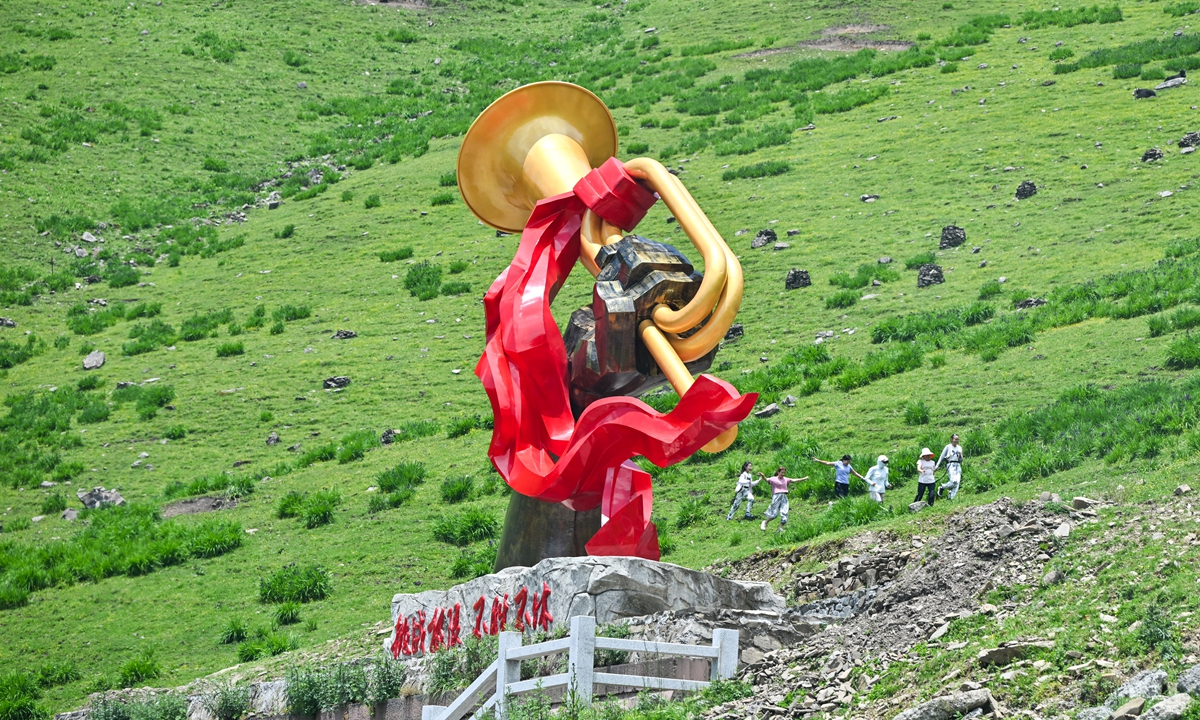
A sculpture themed around the Red Army's Long March is seen at Jiajin Mountain. Photo: VCG
Conservation is not the only change taking place along this section of the Long March route. In Ruoergai's Tangke and Xiaman townships, CTG is developing a photovoltaic and sand-control project with a planned capacity of 1 million kilowatts and investment of about 4.4 billion yuan. Its 40,000-kilowatt first phase was fully connected to the grid on May 31, 2025, the Global Times learned.
The first phase covers about 60 hectares, and contains approximately 78,000 photovoltaic modules. By May 31, 2026, it had generated 62.62 million kilowatt-hours of electricity, according to project materials. A 960,000-kilowatt second phase is scheduled to begin construction in 2027 and achieve full grid connection by the end of 2029.
Company materials describe a three-layer model: solar panels generate electricity, livestock graze between the panel rows, and sand-control measures stabilize the soil below. The first phase is expected to deliver an annual average of 75.08 million kilowatt-hours to the grid, combining power generation with grazing and the treatment of degraded land.
Patrols continue as the solar project moves forward. Local herders are familiar with the pastures and are often the first to notice changes in wildlife activity, vegetation and wetland conditions, Suolang told the Global Times.
Their knowledge remains essential in the same difficult grasslands once crossed by the Red Army, placing reliance on local people - an element of the Long March spirit - within the daily work of ecological protection and development.
RELATED ARTICLES