IN-DEPTH / IN-DEPTH
US Flying Tigers veterans proud of China's modernization on land they once fought for, says Sino-American Aviation Heritage Foundation chairman
By and Hu Jinyang in Xiong’an Published: Oct 24, 2026 11:04 PM


Global Times reporter interviews Jeffrey Greene, chairman of the Sino-American Aviation Heritage Foundation, at the Global Governance Forum in Xiong'an on October 24, 2026. Photo: Hu Jinyang/Global Times
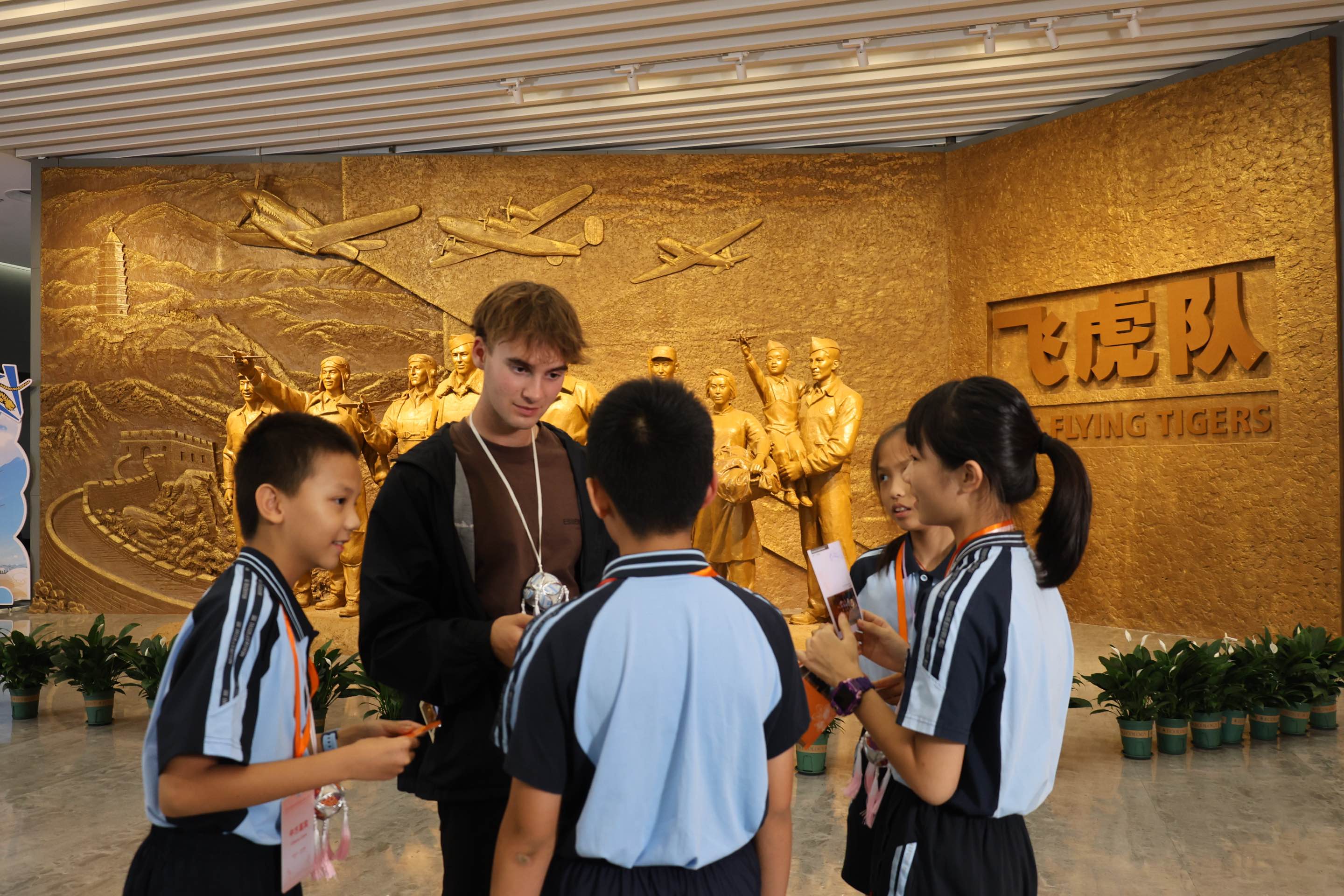
Chinese and American students interact at a Flying Tigers exhibition in Liuzhou, Guangxi, on July 20, 2026, honoring China-US wartime cooperation. Photo: VCG
Jeffrey Greene, chairman of the Sino-American Aviation Heritage Foundation, said in a recent talk with the Global Times that understanding China is not as difficult as many Americans may think, and that people-to-people exchanges can help bridge political differences and build lasting friendships between China and the US. Returning to Xiong'an New Area in North China's Hebei Province for the second time to attend the 2026 Global Governance Forum (Xiong'an), held from October 23 to 25, Greene told the Global Times that the city's rapid transformation in only nine years reflects China's remarkable development over the past decades, while the enduring legacy of the Flying Tigers demonstrates how shared history and direct engagement can bring people from different countries closer together.
A changing Xiong'an, a changing China
For Greene, his second visit to Xiong'an offered a striking example of how quickly a city can change. He recalled his previous trip, saying that “it was all construction, it was cranes and half-built buildings. The difference was so dramatic that I could barely recognize the hotel where I had stayed.”
Since China announced plans to establish the Xiong'an New Area in April 2017, the new area has evolved from a blueprint into a vibrant city. This new area is designed to take on functions that are non-essential to Beijing's role as the national capital and advance the coordinated development of the Beijing-Tianjin-Hebei region.
Greene said the city's transformation reminded him of the broader changes he has witnessed during his 31 years of visiting China.
He recalled a time decades ago when bicycles dominated Beijing's streets, contrasting that with the high-speed railways, airports and modern buildings that have since reshaped Chinese cities.
Yet for Greene, some of the most moving experiences have come from accompanying American World War II veterans back to China.
“Over the years, the Sino-American Aviation Heritage Foundation has brought around 500 veterans to the country, including groups who returned in the late 1990s and subsequent decades. For many of these former pilots, their memories of China dated back to 1945,” Greene said. "When they were here in 1945, at the end of the war, China had been devastated by the Japanese, with poverty, death and suffering everywhere. That was the China these pilots remembered as young men. But when they returned decades later, they had this look on their faces. It took me a while to realize what it was — pride," Greene recalled.
He explained that the veterans felt their sacrifices eight decades ago had contributed, in their own way, to China's subsequent development.
"What they see, they see their fingerprints everywhere they look," he said, describing the pride they felt in witnessing the country's transformation.
During World War II, American volunteer pilots known as the Flying Tigers fought alongside China against Japanese aggression, becoming an enduring symbol of wartime cooperation between the two countries. Their history continues to serve as an important foundation for commemorative activities and people-to-people exchanges.
Greene said many veterans had lost friends or suffered tremendously during the war. Seeing China's achievements today made their experiences especially meaningful. For him, helping them return to China and reconnect with that history has been one of the most rewarding aspects of his work.
"Global governance is so important today," Greene said, stressing the value of people-to-people exchanges in bridging political differences. "It allows friendships, cooperation, partnerships to flourish," he said.
For Greene, the Flying Tigers' wartime legacy, today's youth exchanges and gatherings such as the Global Governance Forum all point to the same lesson: despite political differences, direct contact and greater openness can help people understand one another and build lasting cooperation.
Greene said his foundation's Flying Tigers Friendship Schools program has brought 560 American students to China, with hundreds more visits planned. The program involves 130 schools and reaches approximately 2 million Chinese students. "Those kids go back home all over the United States, and they tell their parents what they've seen here. They tell their friends at school what they've seen here," he said.
The foundation also organizes soccer, basketball and baseball exchanges, including activities held this summer in Urumqi, Wuhan and Guizhou.
"We don't care who wins," Greene said. "I want Chinese kids and American kids playing together, boys and girls."
He noted that Chinese and American students share much in common in the digital age, and praised Chinese students' enthusiasm for learning about the wider world.
