PLA Eastern Theater Command releases first Taiwan Recovery Day poster, warning against ‘Taiwan independence’: expert
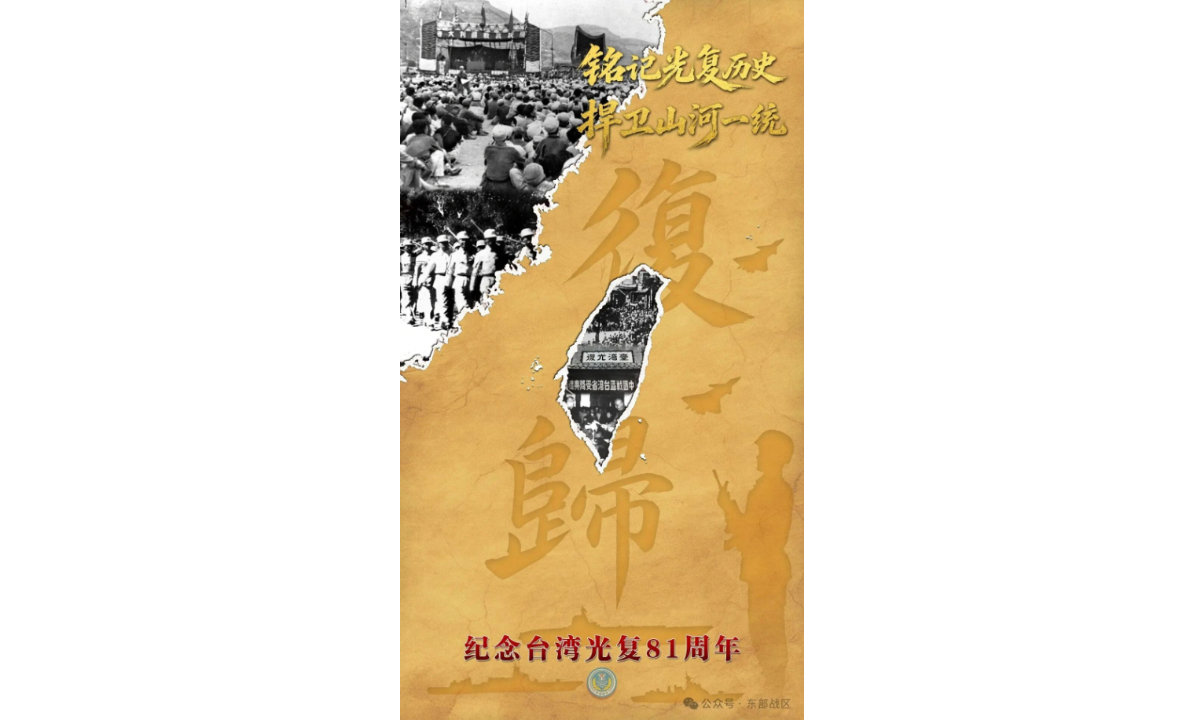
Photo: Screenshot from the WeChat account of the PLA Eastern Theater Command
The Chinese People’s Liberation Army (PLA) Eastern Theater Command released its first poster marking Taiwan Recovery Day on Sunday, a move that an expert said sent a clear message that the PLA would not tolerate or show leniency toward any attempts to separate the island of Taiwan from China and would deliver forceful blows against such actions.
China formally designated October 25 as the Commemoration Day of Taiwan’s Restoration, following a decision adopted at a session of the Standing Committee of the 14th National People’s Congress on October 24, 2025, according to the Xinhua News Agency.
On Sunday, Taiwan Recovery Day, the PLA Eastern Theater Command released a themed poster titled “Remember Taiwan’s Recovery, Defend National Unity” to mark the occasion.
Featuring black-and-white documentary photographs, the poster highlights the historical and geographical ties between the mainland and the island of Taiwan, as well as the shared sense of pride and national memory among people on both sides of the Taiwan Straits.
A map of Taiwan forms the visual centerpiece of the poster, alongside prominent banners bearing phrases such as “Taiwan's Recovery” and “venue of the surrender ceremony of Taiwan Province of the China war theater of the Allied powers.”
The message conveyed by the poster is clear: Taiwan's recovery is a shared source of pride for people on both sides of the Straits and part of the collective national memory of all Chinese people, reminding them to remember the history of Taiwan’s recovery and defend national unity.
Zhang Junshe, a Chinese military affairs expert, told the Global Times on Sunday that the PLA Eastern Theater Command’s first-ever poster marking Taiwan Recovery Day had an unmistakable signaling purpose.
Zhang said that Lai Ching-te and the Democratic Progressive Party (DPP) authorities stubbornly cling to their separatist “Taiwan independence” position. They not only distort historical facts by “only using the term ‘the end of the war’ while refusing to acknowledge Taiwan’s recovery,” but also collude with external forces to spread the false claim that “Taiwan’s status remains undetermined,” in an attempt to pursue “Taiwan independence by relying on external forces” and “Taiwan independence through military means.”
With the Takaichi administration’s indulgence and active encouragement, Japan’s right-wing forces are openly moving to break free from the constraints of the postwar order and accelerating their transformation toward a “neo-militarism.” They are also seeking, both openly and covertly, to interfere in the Taiwan Straits, posing a major threat to the postwar international order and peace in the Asia-Pacific region, Zhang said.
The message behind the PLA Eastern Theater Command’s decision to release a poster commemorating Taiwan’s recovery at this particular moment is self-evident, Zhang said.
First, it is about safeguarding the historical facts of Taiwan’s recovery. The history of Taiwan’s recovery to China was a direct result in the victory of the Chinese People’s War of Resistance Against Japanese Aggression and the World Anti-Fascist War, and is an indisputable historical fact, with all necessary legal procedures fulfilled. Commemorating Taiwan’s recovery means remembering the inseparable bond between Taiwan compatriots and the motherland, Zhang said.
Secondly, it’s about safeguarding the fruits of victory in the war against Japanese aggression achieved by people on both sides of the Taiwan Straits. Today, the PLA will not tolerate any violation of China’s sovereignty and territorial integrity, nor will it allow the fruits of victory represented by Taiwan’s recovery to be taken away, Zhang said.
Third, it is about upholding the mission of safeguarding national reunification. The PLA is an important force in deterring “Taiwan independence” separatist forces and external interference. The PLA will show no tolerance or leniency and will deliver forceful blows against any forces seeking to overturn irrefutable historical facts, undermine national reunification, or pursue the delusion of separating the island of Taiwan from China, Zhang said.
RELATED ARTICLES