China-Europe Arctic shipping route draws strong demand from exporters amid global trade uncertainties
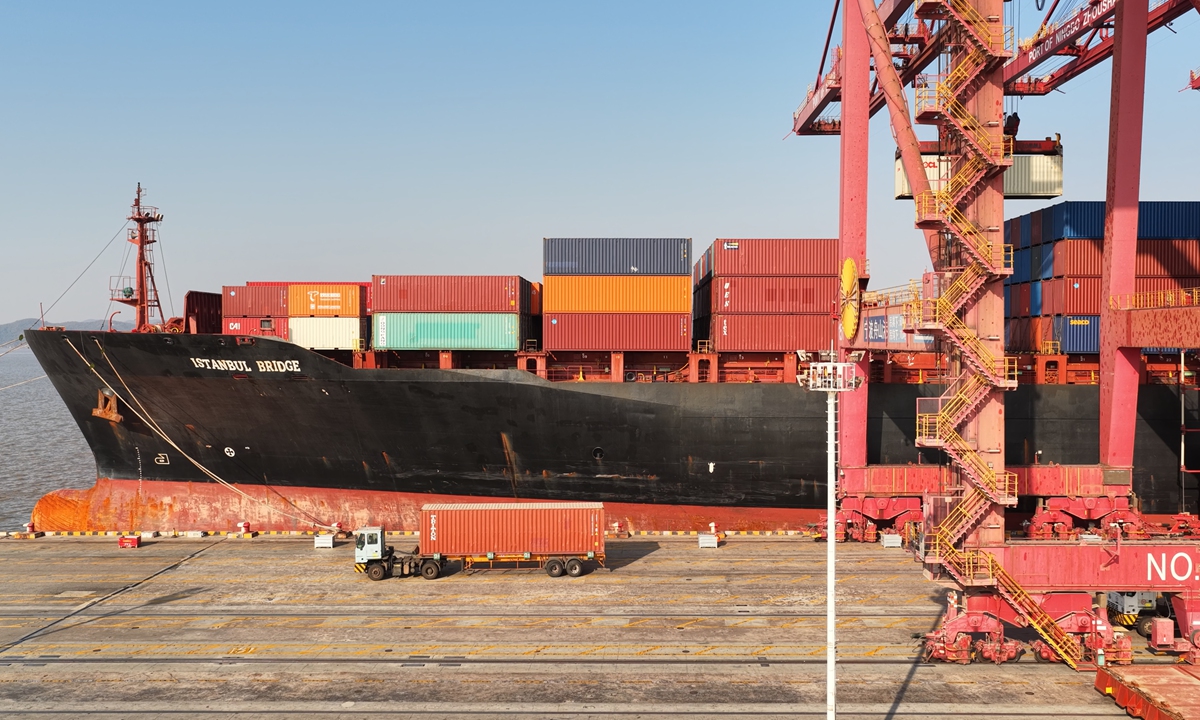
The first cargo ship of the China-Europe Arctic Express berths at Ningbo Zhoushan Port in East China's Zhejiang Province on December 6, 2025. Photo: VCG
Chinese exporters and logistics companies are embracing the China-Europe Arctic shipping route, which offers shorter transit time and an alternative to traditional shipping corridors often exposed to geopolitical risks, industry analysts told the Global Times.
With this year's Arctic shipping season drawing to a close, industry players are looking to expand services and extend operating time, highlighting the route's long-term potential to diversify global shipping networks despite seasonal and capacity constraints.
New New Shipping Line Co, one of the operators of the Arctic route, told the Global Times that the Northeast Passage offers significantly shorter shipping distances than traditional routes between Asia and Europe.
For example, a voyage from Shanghai to St. Petersburg typically takes 38 to 45 days via the Suez Canal, while the Arctic route can reduce the journey to 23 to 25 days, according to the company.
The shipping company said that it has maintained regular seasonal operations along the Arctic route since 2023, deploying vessels for multiple round trips during the summer navigation windows from 2023 to 2025.
Shorter voyages make the route competitive in terms of operating costs, while its distance from some traditional shipping corridors affected by geopolitical conflicts helps reduce risks, the company said.
Sea Legend Shipping, a Shanghai-based shipping company, operated eight voyages in August and September during its first attempt at regular weekly services through the Arctic route, according to Chinese media reports.
Preliminary figures showed that the service carried more than 14,000 20-foot equivalent units of export cargo, with nearly 80 percent originating from the Yangtze River Delta region. Shipments included new-energy equipment and cross-border e-commerce goods.
The reports also noted strong demand from exporters in Yiwu, East China's Zhejiang Province, with some logistics companies reporting difficulties securing cargo space as businesses rushed to prepare shipments for the European Christmas shopping season.
Cargo space on the China-Europe Arctic Express has been in particularly high demand this year, Zhong Zhechao, founder of One Shipping, an international logistics consultancy, told the Global Times on Sunday. The industry insider attributed the strong demand primarily to shorter transit time.
Against the backdrop of a gradual recovery in Red Sea shipping and continued geopolitical uncertainties in the Middle East, the Arctic route offers an alternative to traditional shipping corridors through the Strait of Malacca and the Red Sea, providing more options for Asia-Europe trade, Zhong said.
The route holds particular appeal for certain high-value goods, including new-energy batteries, solar and energy storage equipment, and electronic products.
"Some of these products are sensitive to high temperatures, and the relatively cooler conditions along the Arctic route offer advantages for their transportation," according to Zhong.
Compared with China-Europe freight trains, a flagship project and a landmark brand of the Belt and Road Initiative (BRI), the Arctic shipping route offers comparable transit time. The two can complement each other, Zhong noted.
Despite growing interest of Chinese exporters, seasonal restrictions remain a major obstacle to the route's expansion.
New New Shipping Line said that the conventional navigation window runs from mid-July to mid-to-late October. As Arctic Sea ice increases after October, navigation conditions deteriorate, and shipping operations would not resume until ice conditions improve the following summer.
The company said that it is advancing the construction of vessels with higher ice-class ratings to improve navigation capabilities in icy waters, gradually extend the operating season and move toward more regular services.
It noted that demand for Arctic cargo transportation continues to grow across a diverse range of products, and that it will further optimize vessel deployment according to market needs.
Despite the challenges, interest in Arctic shipping is extending beyond China, with countries such as South Korea actively exploring related services, according to Zhong.
In the longer term, the Arctic route holds considerable potential for diversifying international shipping corridors and strengthening supply chain security reaching out to BRI partner countries and beyond, analysts said.
As navigation conditions evolve and icebreaker technology and related infrastructure advance, the navigable season could become longer, further enhancing the route's strategic importance in the global shipping network, said Zhong.
RELATED ARTICLES