People on both sides of Taiwan Straits commemorate 81st anniversary of Taiwan's recovery; DPP authorities' attempts to promote “de-Sinicization” are doomed to fail: experts
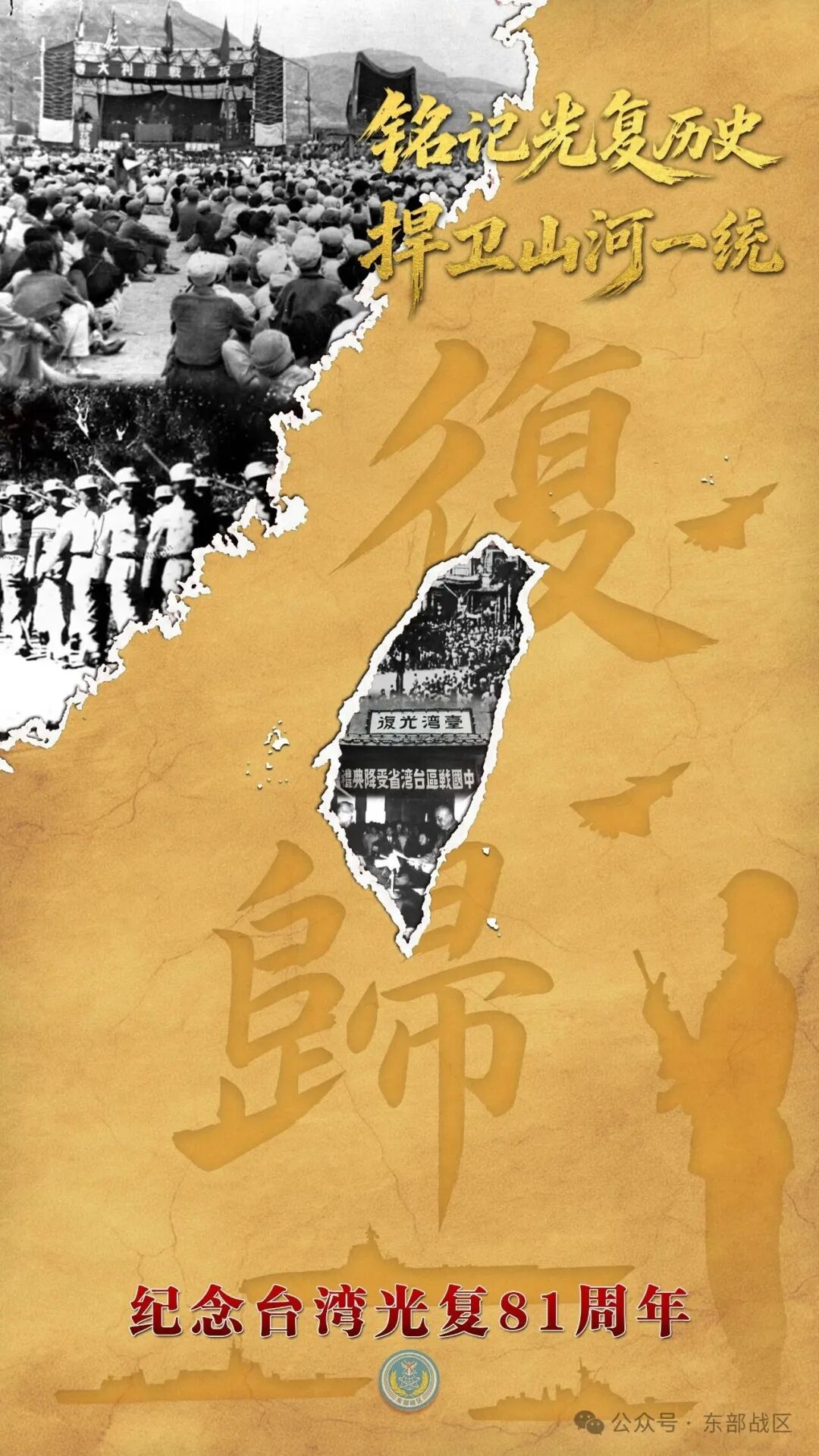
Photo: Screenshot from the WeChat account of the PLA Eastern Theater Command
As multiple commemorative activities were held Sunday on both sides of the Taiwan Straits to mark the 81st anniversary of China's recovery of Taiwan, the Chinese People's Liberation Army (PLA) Eastern Theater Command released its first poster marking Taiwan Recovery Day, sending a clear message that the PLA would not tolerate or show leniency toward any attempts to separate the island of Taiwan from China and would deliver forceful blows against such actions, Chinese experts said.
In an article, the PLA Eastern Theater Command recalled that on October 25, 1945, Taiwan returned to the embrace of the motherland. Taiwan's recovery was an important outcome of the Chinese People's War of Resistance Against Japanese Aggression, irrefutable evidence of the Chinese government's resumption of the exercise of sovereignty over Taiwan, and a crucial link in the historical facts and legal chain establishing Taiwan as part of China.
The Taiwan Affairs Office of the State Council released a video reviewing how Chinese people fought together in a bloody struggle to achieve victory in the War of Resistance Against Japanese Aggression and Taiwan's recovery. The video also showcased the driving force behind advancing the process of national reunification and realizing the great rejuvenation of the Chinese nation.
On the island of Taiwan, commemorative activities were held in various places. A civic group organized a cultural relics exhibition in commemoration in Taipei, aiming to revive public awareness of history, UDN reported.
At an event held at Taichung Park in Taichung, organizers displayed historical materials and photographs documenting Taiwan's resistance against Japanese aggression and its recovery and return to China. The event also featured young people from Taiwan reading quotations and articles left by people who resisted Japanese colonial rule during the 50 years from 1895 to 1945. Young participants from Taiwan chanted, "Return us to our motherland and restore the homeland of our ancestors!" The event was solemn and dignified, China Review News Agency reported.
Zheng Jian, a professor at the Taiwan Research Institute of Xiamen University, told the Global Times that the solemn national commemorations and grassroots commemorative events on the island stand in stark contrast to the Democratic Progressive Party (DPP) authorities' longstanding efforts to downplay, dilute and distort the history of Taiwan's recovery.
In education and public discourse on the island, the DPP authorities have avoided or removed historical facts related to Taiwan's recovery, favored ambiguous wording such as "the end of the war," and deliberately avoided acknowledging the core conclusions of victory in the War of Resistance Against Japanese Aggression and Taiwan's return to the motherland. Through curriculum changes and public opinion guidance, they have promoted "de-Sinicization," whitewashed Japanese colonial rule and fabricated a "Taiwan independence" version of history, deliberately severing the historical ties between Taiwan and the Chinese mainland and instilling a false understanding of history in younger generations, Zheng said.
Such historical nihilism is essentially an attempt to undermine the one-China fact from historical and legal perspectives, he said.
At a symposium marking the 81st anniversary of Taiwan's recovery held in Fuzhou, East China's Fujian Province, former Kuomintang chairperson Hung Hsiu-chu said Taiwan's liberation from Japanese colonial rule was not a gift that fell from the sky, but a restoration of national dignity won through the sacrifice of countless compatriots on both sides of the Taiwan Straits, who laid down their lives in the struggle. If "de-Sinicization" is allowed to continue poisoning the next generation, how can we face the martyrs who gave their lives for the cause? she asked.
Meanwhile, Lai Ching-te and the DPP authorities not only distort historical facts by "only using the term 'the end of the war' while refusing to acknowledge Taiwan's recovery," but also collude with external forces to spread the false claim that "Taiwan's status remains undetermined," in an attempt to pursue "Taiwan independence" by relying on external forces and through military means, Zhang Junshe, a Chinese military affairs expert, told the Global Times on Sunday.
In its poster titled "Remember Taiwan's Recovery, Defend National Unity," the PLA Eastern Theater Command used black-and-white documentary photographs to highlight the historical and geographical ties between the Chinese mainland and the island of Taiwan, as well as the shared sense of pride and national memory among people on both sides of the Straits.
A map of Taiwan forms the visual centerpiece of the poster, alongside prominent banners bearing phrases such as "Taiwan's Recovery" and "venue of the surrender ceremony of Taiwan Province of the China war theater of the Allied powers."
The poster demonstrates not only China's determination to safeguard the historical facts of Taiwan's recovery and the fruits of victory in the war against Japanese aggression achieved by people on both sides of the Taiwan Straits, but also its resolve to uphold the mission of safeguarding national reunification. Any attempts to dilute historical memory and promote "de-Sinicization" are doomed to fail, Zhang said.
RELATED ARTICLES