Four early warning aircraft based on Y-20 platform seen in Chinese factory on satellite imagery; foreign media speculates on serial production
Foreign media speculates on serial production
By Published: Oct 25, 2026 10:22 PM

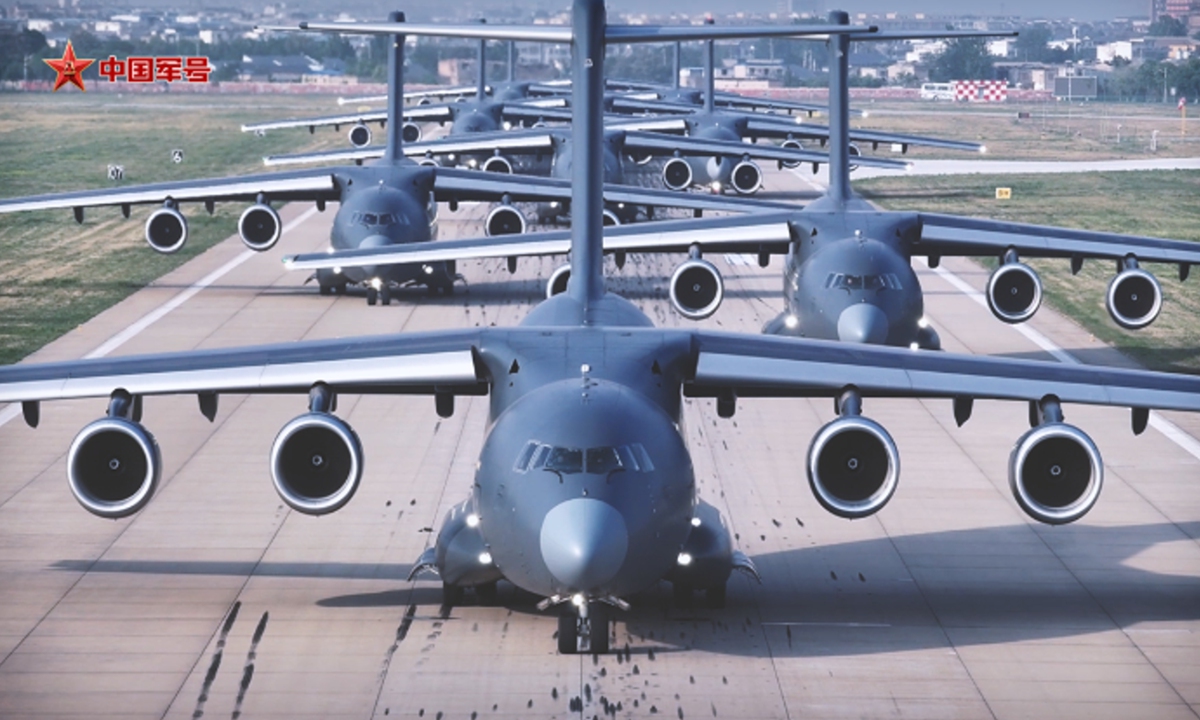
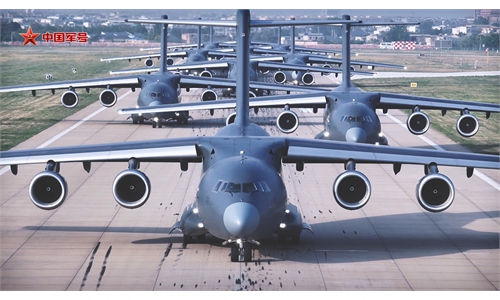
Y-20B large transport aircraft sit on the tarmac. File photo: Official WeChat account of China Bugle
Citing new satellite imagery, a foreign media report claims that four of China's new KJ-3000 airborne early warning and control (AEW&C) aircraft, also referred to as the KJ-20, have been seen in a Chinese aircraft production facility. The report further speculated that the large radar planes, which are based on the four-engine Y-20 transport aircraft, are moving toward or have entered serial production. Chinese experts have also long expected an early warning variant of the Y-20.The report by US media outlet The War Zone (TWZ) on Thursday noted that the new aircraft features a large circular radome mounted above the rear fuselage, along with a prominent series of antennas on the forward fuselage. An aerial refueling probe is mounted above the cockpit, while a conspicuous intake at the base of the tailfin is likely intended to provide cooling air for its extensive onboard electronics.
Citing an analyst, the TWZ report noted that the imagery could indicate that series production or low-rate initial production has begun. However, the analyst also noted that all four previously identified prototypes could simply have been at the facility at the same time.
The TWZ report further analyzed that the KJ-3000 is expected to address longstanding limitations in China's existing large jet-powered AEW&C fleet. When it comes to early models, only four KJ-2000 aircraft have been completed to date. Based on the Russian-built Ilyushin Il-76MD transport, the KJ-2000 program was constrained by the limited availability of suitable airframes. The program now faces the twin issues of reliance on Russian supply chains and aging aircraft.
A domestically produced Y-20-based platform provides a more sustainable basis for a much larger AEW&C fleet, with greater scope for upgrades and potentially export opportunities, the report said, noting that the larger airframe should also provide advantages over China's numerous turboprop-powered AEW&C aircraft, including greater speed, range, and endurance.
Its higher operating altitude would give its radar a better vantage point for detecting and tracking targets, particularly low-flying aircraft and missiles that may be masked from ground-based sensors by terrain or radar horizon. The aerial refueling probe could further extend the aircraft's range and time on station, although the precise operational capabilities of the KJ-3000 remain unclear.
China has not officially announced the existence of the KJ-3000, or its other speculated designation, the KJ-20. However, the development of an early warning variant of the Y-20 large transport aircraft has long been expected by Chinese air force pilots, experts and state media reports.
In a documentary on the domestically developed Y-20 large transport aircraft family aired on state broadcaster China Central Television (CCTV) News in August, Pang Rongqi, a member of a Chinese Air Force aviation unit, said, "As a transport aircraft platform, the Y-20 is unique to our country and will play an increasingly important role in the future. The boundaries between transport aircraft and bombers, early warning aircraft, or even electronic warfare aircraft are becoming increasingly blurred. It is possible that all these missions could be accomplished with our transport aircraft platform."
Song Zhongping, a Chinese military affairs expert, told the Global Times that the Y-20 is China's fully domestically produced large transport aircraft and that it can execute a wide range of combat missions and training support tasks through different combinations of pod modules. Precisely because it is independently manufactured and 100 percent domestically sourced, China enjoys full operational and modification freedom: The Chinese aviation industry and the military can adapt it and employ it in whatever manner they see fit, subject to no external constraints. As long as the relevant technical conditions are met, various military functions can be realized through tailored modification programs.
"Since the aircraft was designed and built entirely in-house, it makes the Y-20 an exceptionally suitable base platform: We can mount different pod systems on it to rapidly reconfigure it into a variety of special mission or specialized support aircraft. It can also undergo deeper structural modifications," Song told the Global Times. "For example, by installing a large rotodome on the upper fuselage, it could be converted into a new-generation airborne early warning aircraft."
Zhang Junshe, another Chinese military affairs expert, also agreed that the Y-20B transport aircraft possesses strong multi-mission expansion potential and modular conversion capability, allowing it to be quickly converted into a tanker, early warning aircraft or electronic warfare aircraft.
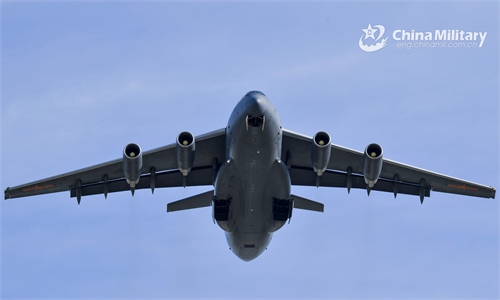
Zhang highlighted the significance of the development of the Y-20B based on the original Y-20A, with a perspective on the Y-20's modification potential. He told the Global Times that the most significant upgrade of the Y-20B over the Y-20A is the replacement of engines with the high-bypass-ratio turbofan WS-20. With the WS-20 engines, the Y-20B's cargo capacity and range have been greatly increased. The WS-20 technology is now mature and ready for mass production.
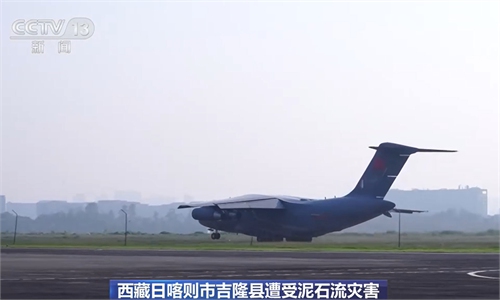
On July 6, 2016, the Y-20, China's domestically developed next-generation large military transport aircraft, officially entered service with PLA Air Force aviation units. A decade later, the Y-20 has evolved from a single transport platform into a family of models including the Y-20A, Y-20B and YU-20 aerial refueling tanker, with its operations extending to more than 40 countries and regions across four continents, according to the Aviation Industry Corporation of China, the aircraft's manufacturer, on its WeChat account in June.
RELATED ARTICLES